

On this page
Skin, muscle and bone all block light. Yet the lens behind your pupil lets light through almost untouched, even though it is packed with protein. It does this with three design choices, each linked to something you study in biology or optics.
For a refresher on where the lens sits, see our guide to the parts of the human eye. If transparent, translucent and opaque blur together, this explainer on how materials treat light sorts them out.
What makes the eye lens transparent?
Nothing inside it is big enough, or uneven enough, to scatter much light. Three features make that possible.
No blood vessels. The lens has none, and it is sealed inside a capsule, so old cells cannot be shed (Lynnerup and colleagues, PLoS ONE 2008).
Cells that empty themselves. Lens fibre cells break down their nucleus, mitochondria and other organelles as they mature.
Tightly packed crystallins. Each fibre cell is filled with proteins called crystallins, arranged so that scattered light largely cancels out.
The same 2008 study used radiocarbon dating to show that the crystallins in the lens's central core (its nucleus) form around the time of birth and are never turned over afterwards. The proteins at the centre of your lens are about as old as you are.
Why don't lens cells have nuclei?
An organelle would act like a speck of dust in a window. A 2021 study in Nature by Morishita and colleagues, working in zebrafish and mice, showed that lens fibre cells destroy all their membrane-bound organelles to form an organelle-free zone, using enzymes called PLAAT phospholipases, and that this step is essential for optimal lens transparency (Nature, 2021).
The nucleus goes too. A review of crystallin genetics notes that cell nuclei are usually degraded in secondary lens fibre cells, and that remnants of nuclei stay behind in cataracts caused by mutations in gamma-crystallin genes in mice (Graw, Experimental Eye Research 2009).
How can a lens packed with protein stay clear?
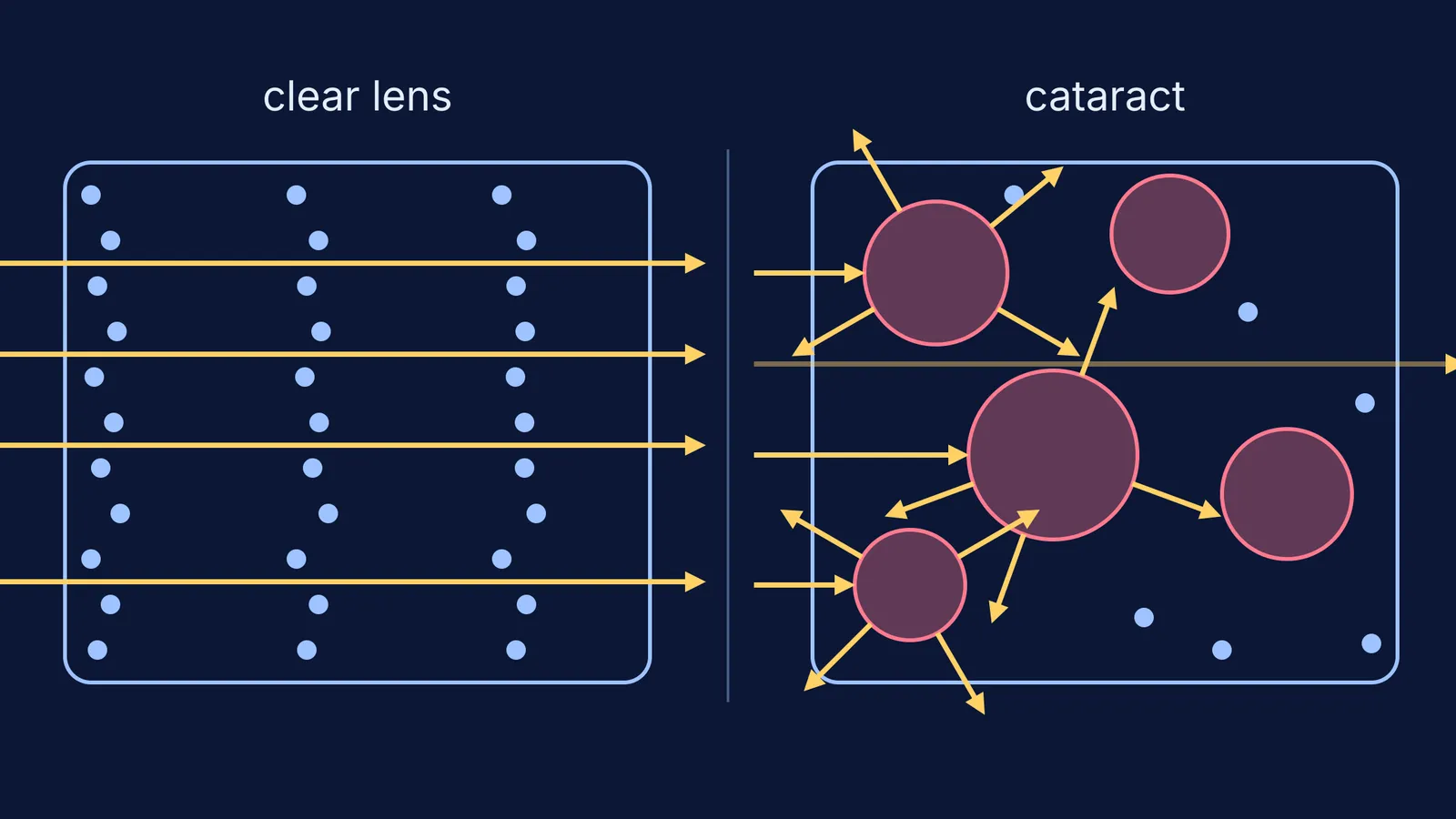
Here biology meets wave optics. In 1971 G. B. Benedek showed mathematically that light is scattered only by variations in refractive index whose length scale is at least half the wavelength of light in the medium (Benedek, Applied Optics 1971). Smaller, evenly spread variations send out scattered waves that interfere destructively, so the light carries on straight.
In 1983 Mireille Delaye and Annette Tardieu tested the packing with small-angle X-ray scattering on calf lens cytoplasm, in intact lenses and in extracts with crystallin concentrations from 3 to 510 mg per ml (Nature, 1983). Their data fitted short-range order, as in dense liquids or glasses, which they said provides a simple explanation for lens transparency. Despite the name, crystallins do not form a crystal. They are crowded so evenly that no region differs much from its neighbours.
If interference and scattering feel shaky, the Fermi Concept Library has a lesson for every concept in physics, chemistry and biology, with its place in the map, so you can see how wave optics links to this topic.
What happens to the proteins in a cataract?
A cataract is a cloudy area in the lens; the US National Eye Institute explains that from around age 40, lens proteins start to break down and clump together (NEI).
A review by Moreau and King describes the chain: UV radiation, oxidation and other damage build up, crystallins partly unfold, and they stick together into insoluble aggregates that scatter light (Trends in Molecular Medicine, 2012). The aggregates can overwhelm the lens's chaperone proteins. In Benedek's terms, the clumps are now big enough to scatter. It is the same unfolding you meet in protein denaturation, happening slowly inside a living eye.
This matters in India. In a national survey of 85,135 people aged 50 and over, cataract caused 66.2% of blindness (Vashist and colleagues, PLoS ONE 2022). Worldwide, the WHO counts 94 million people with distance vision impairment or blindness due to cataract (WHO fact sheet).
How do you explain lens transparency in an exam answer?
Use this three-step plan: one point per step, then link them.
Structure: the lens has no blood vessels and its mature fibre cells lack nuclei and organelles, so nothing large scatters light.
Proteins: crystallins are packed densely with short-range order, so scattered waves cancel and light passes straight through.
Failure mode: with age, UV and oxidative damage make crystallins unfold and clump; the clumps scatter light and form a cataract.
For a longer answer, add why the lens cannot repair this: the crystallins at its core are never replaced, so damage builds up over a lifetime.
To practise questions that mix biology and optics like this, the Fermi Problem Library has worked problems with a step-by-step solver that explains the reasoning rather than printing an answer.


