

On this page
What are transparent, translucent and opaque objects?
Every material in our environment interacts with light when it hits its surface. Whether a material lets light through, scatters it, or blocks it completely determines how we categorise it in physics.
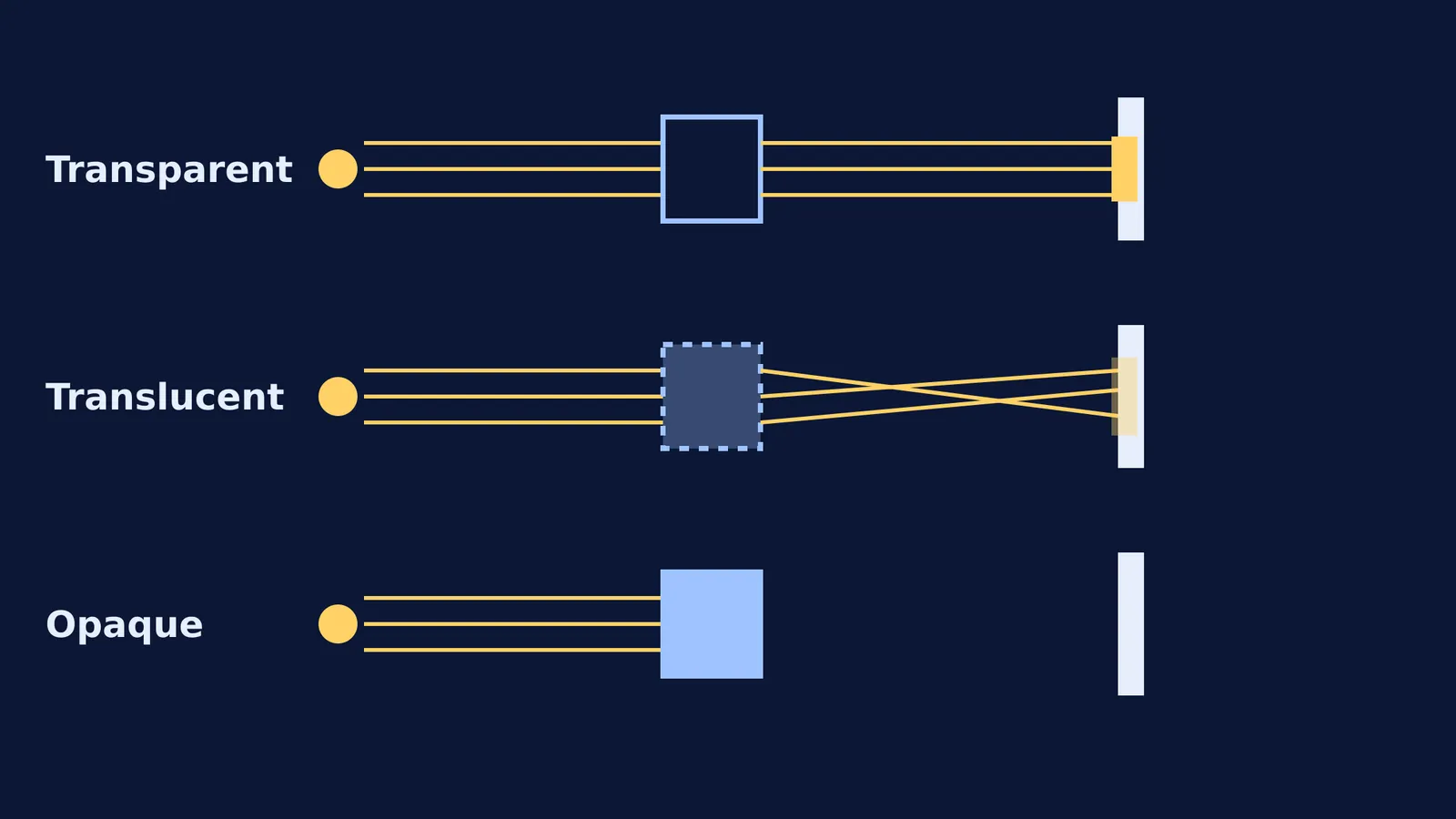
Transparent materials allow almost all the light that strikes them to pass directly through them CK-12. Because light travels straight through them without scattering, you can see objects clearly on the other side. This is why window panes are useful for letting sunlight into a room while allowing you to see outside perfectly.
Translucent materials, on the other hand, allow some light to pass through but scatter it in many different directions as it passes CK-12. Because the light rays are sent in unpredictable paths, you cannot see a clear image through them. Objects on the other side will appear blurry or fuzzy.
Opaque materials do not allow any light to pass through them at all CK-12. Instead, these materials absorb the light or reflect it back into the environment. Because no light gets through, you cannot see through them.
What are examples of transparent, translucent and opaque objects?
If you look around your home or classroom, you can find everyday examples of each material type.
Transparent objects: Clear glass windows, clean water, and the air around us are all transparent. Lenses in glasses and pure plastic wrap also fall into this group. If you are preparing for optics experiments, you will see how light travels straight through a glass slab without losing its image, as shown in our guide to tracing a ray through a glass slab.
Translucent objects: Frosted glass, wax paper, and thin fabrics are classic examples. Vegetable oil and cloudy ice also scatter light enough to make whatever is behind them look fuzzy. These materials are often used when we want to let light into a space but maintain privacy.
Opaque objects: Wooden doors, metal pans, bricks, and thick cardboard do not let light through at all. A metal spoon will reflect light, while a dark wooden board will absorb most of it, but neither will let light pass to the other side.
If you want to review more about how light travels in different mediums, the Fermi Concept Library covers every concept in physics and chemistry with its own lesson.
How do materials reflect and absorb light?
When light strikes an opaque material, the light energy must go somewhere since it cannot pass through. Opaque materials handle this light in two main ways: reflection and absorption.
Reflection happens when the light bounces off the surface. A shiny metal surface, for example, reflects almost all the light that hits it. Absorption occurs when the material takes in the light energy. A dark piece of wood or black cardboard absorbs most of the light, converting it into a tiny amount of heat.
Most opaque objects do a combination of both, reflecting some colours of light and absorbing others, which gives them their colour. Because they stop all light from continuing forward, they are perfect for creating shade.
How are shadows formed?
A shadow is the dark area formed when an object blocks a source of light. Because light normally travels in straight lines, anything that steps in its path will create an outline of darkness behind it.
Opaque materials cast the darkest and sharpest shadows because they completely block all the light rays travelling toward them. You will see a clear outline of the object on the surface behind it.
Translucent materials cast a faint, blurry shadow because they block some light while scattering the rest. The shadow will not be completely dark, and its edges will be soft.
Transparent materials usually do not cast a visible shadow at all, though they might leave a very faint outline if the material bends the light slightly at its edges.
When studying how light bends through different materials, you might explore topics like dispersion of white light by a glass prism. If you are struggling with the geometries of these optics problems, the Fermi Problem Library has worked problems with a step-by-step solver that explains the reasoning rather than printing an answer.
For a clearer visual understanding of how light rays behave, you can try manipulating the light source in the Fermi Simulation Lab, which features interactive simulations for the ideas that are easier to see than to read.


