

On this page
In an Indian classroom most eyes are dark brown; in a northern European family photo you may see blue, grey, green and hazel. The difference comes down to one pigment, one bit of physics and many genes.
What gives eyes their colour?
The coloured ring of your eye, the iris, gets its colour from melanin, the same pigment that colours skin and hair. According to MedlinePlus Genetics, people with brown eyes have a large amount of melanin in the iris, while people with blue eyes have much less.
Melanin absorbs light, so a lot of it makes the iris look brown or nearly black. A moderate amount, combined with some scattered light, gives green eyes, as Davinia Beaver, a postdoctoral research fellow at Bond University, explains in The Conversation. The type of melanin matters as well as the amount: a 1998 study in Experimental Eye Research found both brown-black eumelanin and reddish-yellow pheomelanin in human irises, with a pheomelanin-type pigment linked to green irises.
So eye colour works like a dial, from very little pigment to a lot, not a set of boxes.
Why do blue eyes look blue if there is no blue pigment?
Blue eyes contain no blue pigment. Their colour comes from the scattering of light within the iris, a physical effect known as the Tyndall effect, "a bit like the effect that makes the sky look blue", The Conversation explains.
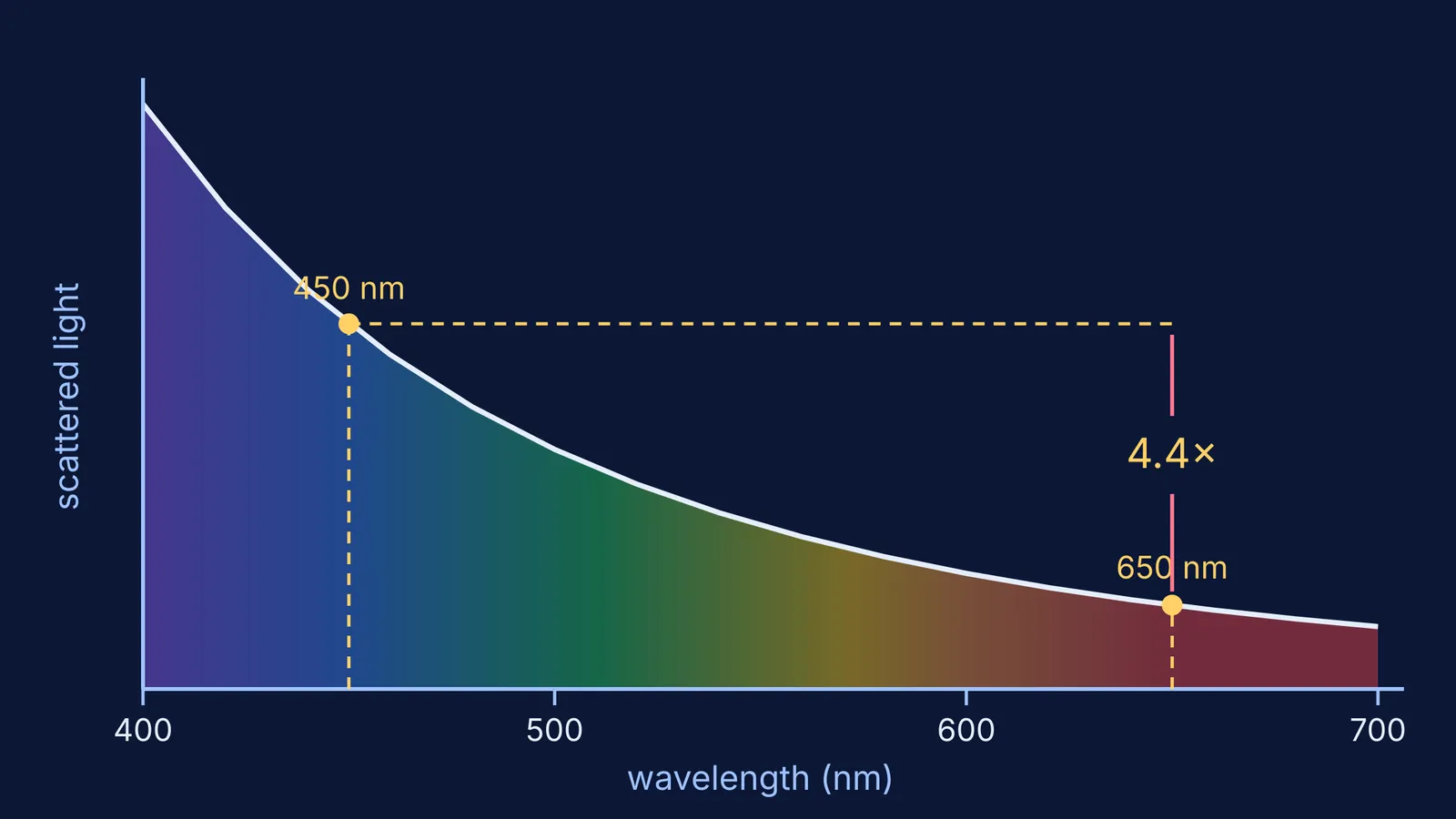
When there is little melanin to absorb it, white light entering the iris bounces off fine structures in the tissue, and short wavelengths are scattered more than long ones. For particles much smaller than the wavelength, the scattered intensity goes as 1/λ⁴, the same rule behind why the sky is blue. In that ideal case, blue light at 450 nm is scattered about (650/450)⁴ ≈ 4.4 times more than red light at 650 nm; the iris only roughly follows it. So more blue comes back out and the iris looks blue.
If 1/λ⁴ feels abstract, the Fermi Simulation Lab has interactive simulations for ideas that are easier to see than to read.
Is eye colour controlled by one gene?
No. A 2009 review by Richard Sturm and Mats Larsson in Pigment Cell & Melanoma Research calls the simple Mendelian dominant-recessive model "too simplistic" and describes eye colour as a polygenic trait.
One region still dominates. The review reports that 74% of the variance in human eye colour can be explained by one interval on chromosome 15 that contains the OCA2 gene. A single DNA letter change nearby, inside the neighbouring HERC2 gene, explains almost all of that link with blue or brown eyes (Sturm and Larsson, 2009). It sits in a stretch of DNA that acts like a switch, turning OCA2 on or off (MedlinePlus Genetics).
In 2008, Hans Eiberg and colleagues found one shared stretch of DNA around that switch in 155 blue-eyed people from Denmark, and in five from Turkey and two from Jordan (Human Genetics, 2008). They suggested that blue eyes trace back to a common founder mutation that dials down OCA2.
A 2021 genome-wide study of up to 192,986 European participants identified 61 genomic regions linked to eye colour, 50 of them new (Simcoe and colleagues, Science Advances). Even all those variants together explained only 53.2% of the variation in eye colour, and some genes affect the structure of the iris rather than its pigment.
Can two blue-eyed parents have a brown-eyed child?
Yes, though it is uncommon, MedlinePlus Genetics notes. That shows a one-gene model is not the whole story: in a simple one-gene cross, two blue-eyed (recessive) parents could only have blue-eyed children.
For how many small gene effects blend into a smooth spread, see why height forms a bell curve.
How should you think through an eye colour question?
Use this four-step check for a family puzzle or a Class 12 genetics question.
Place each person on the dial, from little melanin (blue, grey) through moderate (green, hazel) to a lot (brown).
Remember that the biggest single effect comes from the OCA2 and HERC2 region, so brown-eyed parents can carry a "low pigment" version and have a blue-eyed child.
Add the other genes: dozens of smaller effects can nudge a child lighter or darker than either parent.
Give a likelihood, not a certainty. Say "blue is more likely" rather than "blue is guaranteed".
Worked example: two blue-eyed parents have a child with light brown eyes. Both parents sit at the low end of the dial, but other variants can still raise melanin a little: unlikely but possible, as MedlinePlus reports.
For other cases where Mendel's ratios break down, see our list of exceptions to Mendel's laws. If terms like polygenic keep tripping you up, the Fermi Concept Library gives each biology concept its own lesson and shows where it sits in the map.


