

On this page
You leave a concert or a wedding DJ night and the world sounds muffled, with a high whine in your ears. Here is what happened inside your ear, and how to work out your own safe limit.
Why do your ears ring after loud music?
The ringing starts in the cochlea, the snail-shaped, fluid-filled part of your inner ear. Sound makes the basilar membrane inside it move, and the hair cells on that membrane move with it. According to the US National Institute on Deafness and Other Communication Disorders (NIDCD), tiny projections called stereocilia on each hair cell bend, channels at their tips open, and chemicals rush in to create an electrical signal for the brain.
WHO's safe listening guidance says that exposure to loud sounds over time causes fatigue of these sensory cells, and the result is temporary hearing loss or tinnitus.
Tinnitus is a ringing, buzzing or roaring sound with no outside source. The NIDCD tinnitus page explains that inner-ear damage can change the signal reaching the brain, and researchers think the brain's auditory cortex then generates the phantom sound.
What is a temporary threshold shift?
Your hearing threshold is the quietest sound you can detect. After loud exposure it rises, so soft sounds briefly vanish. This is a temporary threshold shift, and it is why everything sounds muffled after a gig.
The NIDCD page on noise-induced hearing loss says loud noise sometimes causes a temporary hearing loss that disappears 16 to 48 hours later, though residual long-term damage may remain. The same page notes that human hair cells, unlike those of birds and amphibians, don't grow back.
Does the ringing going away mean your ears are fine?
Not necessarily. In a 2009 mouse study in the Journal of Neuroscience, Sharon Kujawa and M. Charles Liberman found that noise causing a completely reversible threshold rise still caused an immediate loss of nerve terminals and a delayed degeneration of the cochlear nerve, even though the sensory cells stayed intact. The authors suggest this hidden damage could make it harder to hear in noisy places and could contribute to tinnitus.
WHO says the same thing in everyday terms: prolonged or repeated exposure to loud sound can lead to permanent, irreversible hearing loss.
How loud is too loud, according to WHO?
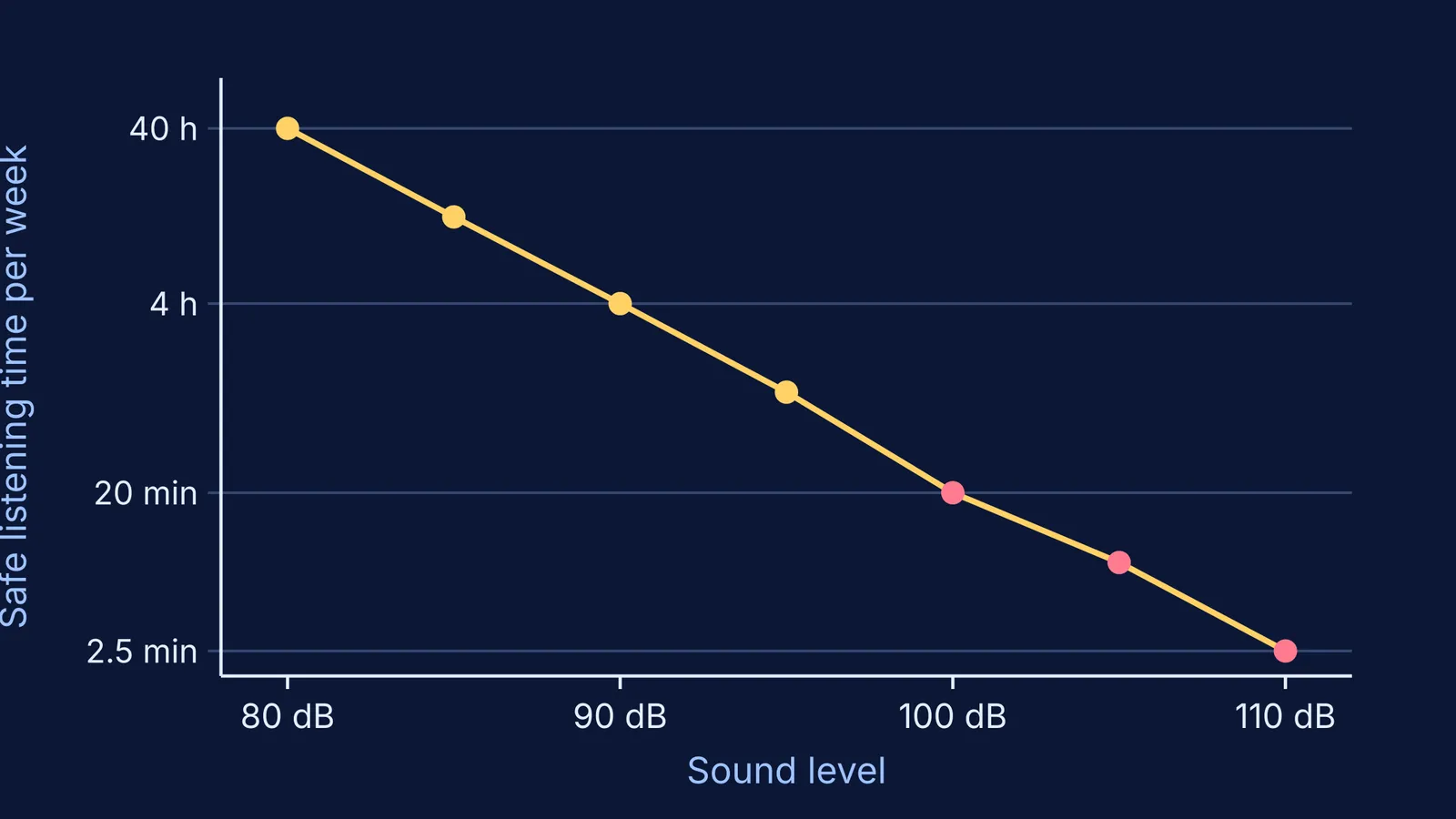
WHO's safe listening limits per week are:
80 dB (a doorbell): 40 hours
85 dB (heavy traffic, heard inside a car): 12 hours 30 minutes
90 dB (a shouted conversation): 4 hours
95 dB (a motorcycle): 1 hour 15 minutes
100 dB (a hair dryer): 20 minutes
105 dB (a car horn at 5 metres): 8 minutes
110 dB (shouting in the ear): 2.5 minutes
Each 10 dB step cuts the safe time to roughly a tenth. For concerts and clubs, WHO's 2022 global standard for safe listening venues sets a maximum average sound level of 100 dB. The same release estimates that over 1 billion people aged 12 to 35 risk losing their hearing from loud music and other recreational sounds.
If decibels still feel slippery, the Fermi Concept Library gives every physics concept, sound included, its own lesson. Our post on amplitude, loudness and decibels covers the basics.
How do you work out your own weekly sound budget?
Treat WHO's limits as a weekly allowance: divide your time at a level by the time allowed. It is a rough guide, since sound-meter apps only estimate.
A worked example, with assumed levels:
Earphones on the bus and while studying, at about 85 dB for 2 hours a day, add up to 14 hours a week. That is 112% of the 12.5-hour allowance.
One sangeet where the dance floor averages 100 dB for 3 hours gives you 180 minutes against an allowance of 20. That is nine weeks' worth in one night.
The fix: drop the earphones to around 80 dB, where the allowance is 40 hours, and spend the sangeet away from the speakers, with foam earplugs if you can.
WHO's everyday checklist:
Keep your device at no more than 60% of maximum volume.
Use well-fitted, noise-cancelling headphones so you need less volume in noisy places.
In noisy places, use earplugs and stay away from loudspeakers.
Give your ears frequent breaks from loud sound.
Parents can read what to do when your teen wears earphones all day, and curious students can see how the cochlea sorts frequencies.
When should you get your hearing checked?
WHO's safe listening guidance lists the warning signs: ringing in the ear that persists, or trouble hearing high-pitched sounds or following conversations. If you notice them, contact a professional.
The NIDCD advises having your hearing tested if you think you might have hearing loss. Its tinnitus guidance suggests starting with your regular doctor, who can check for causes such as earwax or fluid from an ear infection.
If waves are easier for you to see than to read about, the Fermi Simulation Lab has interactive simulations for ideas like these.


