On this page
When a phone rings while a bus rumbles past, you can tell the two apart. The sorting starts in the cochlea, the coiled tube of your inner ear, which separates sound by place.
How does the cochlea detect different frequencies?
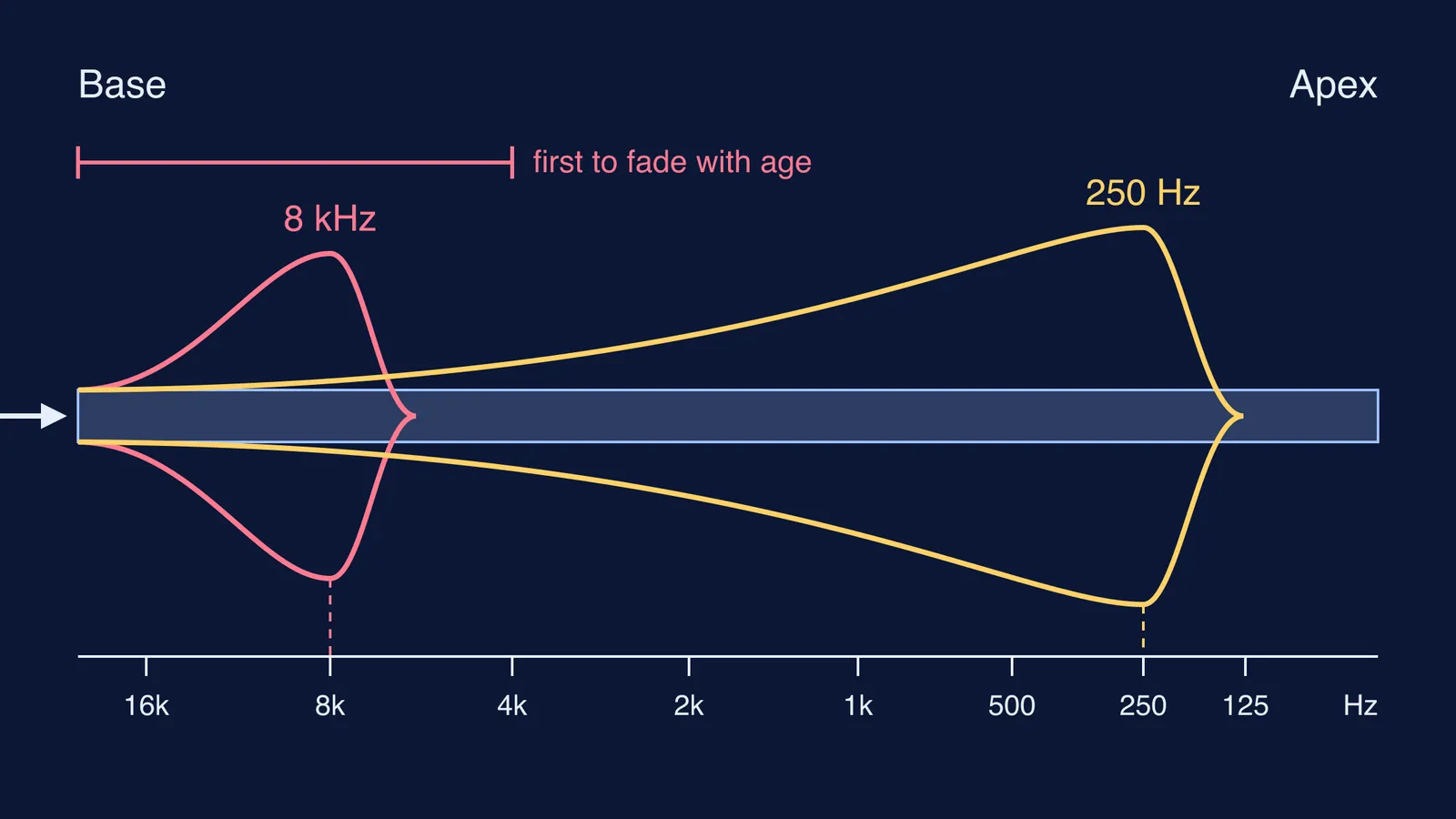
Inside the cochlea, an elastic partition called the basilar membrane runs from the beginning to the end of the coil, and key hearing structures, including the sensory hair cells, sit on it, according to the US National Institute on Deafness and Other Communication Disorders (NIDCD). Hair cells near the wide end of the snail shape detect higher-pitched sounds, and those closer to the centre detect lower-pitched sounds, the NIDCD explains. The wide end, next to the middle ear, is called the base; the centre of the coil is the apex.
The physics is a stiffness gradient. The cochlear partition is about one hundred times stiffer at the base than at the apex, according to a 2015 review in the Journal of Audiology and Otology. The same review notes that the travelling wave always moves from base to apex, with high frequencies reaching their largest amplitude at the base and low frequencies at the apex. Picture a row of springs that softens along its length: a slow vibration travels further before it finds a stretch loose enough to swing hard.
Georg von Békésy received the 1961 Nobel Prize in Physiology or Medicine "for his discoveries of the physical mechanism of stimulation within the cochlea".
Where on the cochlea does each pitch land?
In 1990, Donald Greenwood published a cochlear frequency-position function and reported that newer data from human cadaver ears and living animal preparations "are quite well fit by the same basic function". A 2025 paper in Ear and Hearing gives the human version as F = 165.4 × (10^(2.1x) − 0.88), where F is the frequency in hertz and x is the fraction of the way from the apex (0) to the base (1). That paper puts the most apical frequency at 20 Hz and the average human organ of Corti at about 33 mm long, varying by about 10 to 15% between people.
We plugged common pitches into that formula with the 33 mm length. Distance of each peak from the base:
16,000 Hz: about 2 mm
8,000 Hz: about 6 mm
4,000 Hz: about 11 mm
1,000 Hz: about 20 mm
250 Hz: about 27 mm
20 Hz: at the apex, about 33 mm
Above about 1,000 Hz, each doubling of pitch (one octave) takes roughly the same 4.3 to 4.7 mm of membrane; lower octaves get squeezed.
Try it yourself for the midpoint of the cochlea:
Halfway, x = 0.5, so the exponent is 1.05.
10^1.05 is about 11.22; subtract 0.88 to get 10.34.
Multiply by 165.4: about 1,710 Hz.
So the middle of your cochlea is tuned near 1.7 kHz, not the 10 kHz you would guess if 20 Hz to 20 kHz were spread evenly.
If the travelling wave is hard to picture from a formula, the Fermi Simulation Lab has interactive simulations for ideas that are easier to see than to read, and the Fermi Concept Library gives each concept in physics and biology its own lesson.
Why do older people lose high-pitched hearing first?
High-frequency hearing loss corresponds to damage to outer hair cells at the base of the cochlea, and basal outer hair cells are more susceptible to damage than apical ones, a 2025 study in Advanced Science notes. After rats or mice are exposed to noise or ototoxic drugs, the same paper reports, the high-frequency region is damaged first.
About one in three people in the US aged 65 to 74 has hearing loss, and nearly half of those older than 75 have difficulty hearing, according to the NIDCD. Worldwide, over 25% of people older than 60 are affected by disabling hearing loss, the World Health Organization says.
MedlinePlus lists signs of age-related hearing loss such as more difficulty understanding people with higher-pitched voices, problems telling apart sounds like "s" or "th", and problems hearing in noisy areas.
How can you protect the high-frequency end of your cochlea?
Over 1 billion young adults are at risk of permanent, avoidable hearing loss due to unsafe listening practices, according to the WHO. The WHO's safe listening guidance says you can listen at an average of 80 dB for up to 40 hours a week, but at 90 dB for only about four hours a week.
A simple plan for your family:
Keep earphone volume below 60% of maximum, as the WHO recommends.
Keep sessions short: the WHO notes that the higher the sound level and the longer the duration, the greater the risk.
Know who to ask. The NIDCD names primary care doctors, otolaryngologists (ENT doctors) and audiologists as part of hearing care, and MedlinePlus says a sudden change in hearing should be checked by a provider right away.