

On this page
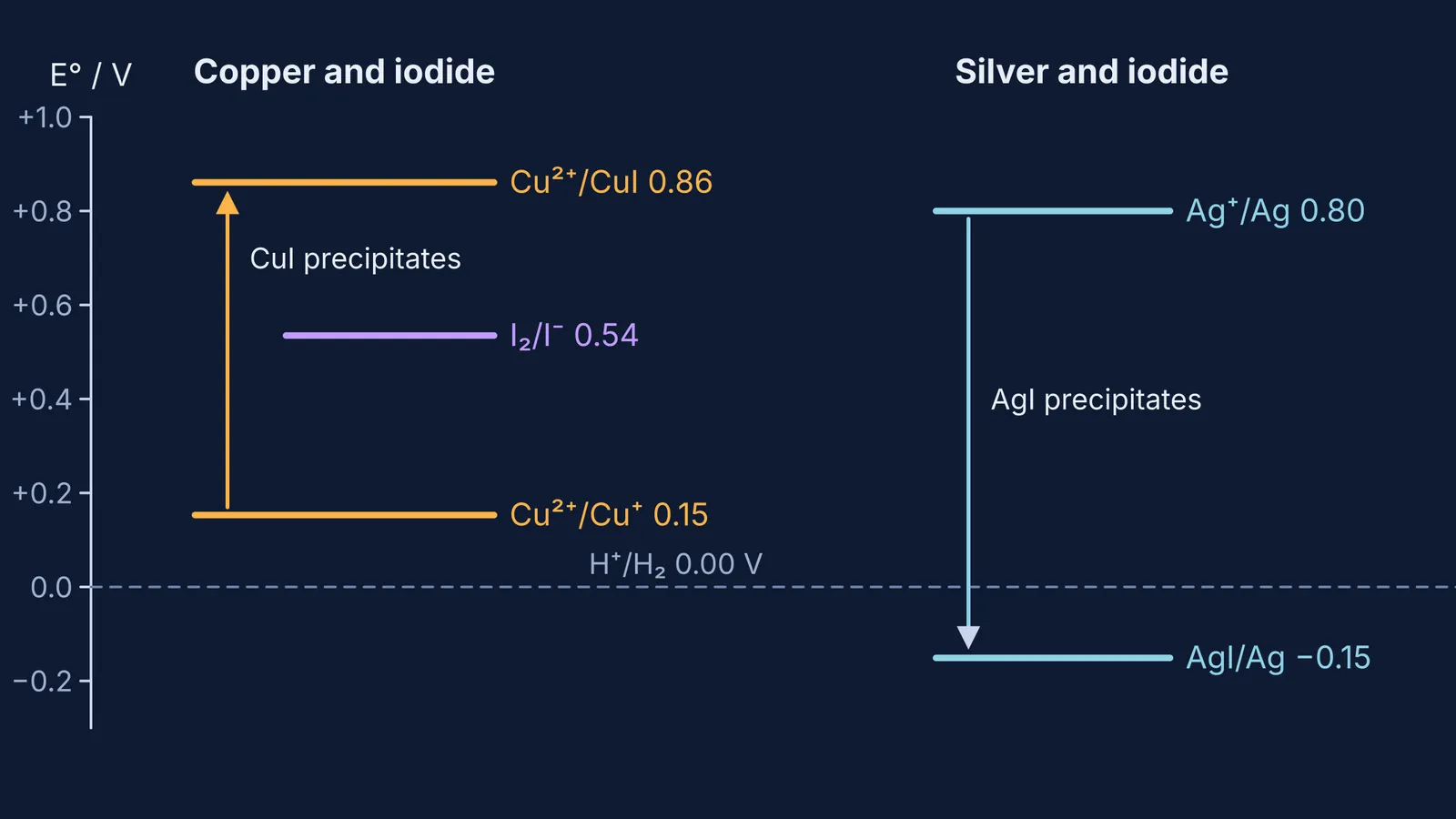
Add potassium iodide to blue copper(II) sulphate solution and the mixture turns brown at once. Iodine has been set free, and an off-white solid, copper(I) iodide, settles out. This reaction is the basis of the iodometric estimation of copper. Yet if you look up the two standard potentials, the reaction should not go: E°(Cu²⁺/Cu⁺) is 0.15 V, well below E°(I₂/I⁻) at 0.54 V. This post explains the contradiction. The short version: the potential that matters is not Cu²⁺/Cu⁺ but Cu²⁺/CuI, and precipitation of CuI raises it to about 0.86 V.
Why does Cu²⁺ oxidise iodide when E° says it should not?
Start with what the table predicts. If the products were free Cu⁺ ions in solution, the reaction would be:
2Cu²⁺ + 2I⁻ → 2Cu⁺ + I₂
E°cell = E°(Cu²⁺/Cu⁺) − E°(I₂/I⁻) = 0.15 − 0.54 = −0.38 V.
A negative E°cell means ΔG° is positive and K is tiny, about 10⁻¹³. On this basis Cu²⁺ cannot oxidise I⁻.
But free Cu⁺ is not the product. Cu⁺ meets a large excess of I⁻ and is removed as solid CuI, one of the least soluble salts you meet in Class 12. The real reaction is:
2Cu²⁺ + 4I⁻ → 2CuI(s) + I₂
Check the balance: 2 Cu, 4 I and a total charge of +4 − 4 = 0 on the left; 2 Cu, 4 I and zero charge on the right.
Removing Cu⁺ as it forms keeps [Cu⁺] extremely low. By Le Chatelier's principle, and by the Nernst equation, a very low product concentration makes the reduction of Cu²⁺ much more favourable. The table value of 0.15 V applies only when [Cu⁺] = 1 M, which never happens when iodide is present.
Many textbook answers stop at "CuI₂ is unstable" or "Cu²⁺ is an oxidising agent". Both are true, but they skip the reason. The reason is the solubility product of CuI.
How do you calculate E° for the Cu²⁺/CuI couple?
The half-reaction you need is:
Cu²⁺ + I⁻ + e⁻ → CuI(s)
Its standard potential is defined with [Cu²⁺] = 1 M and [I⁻] = 1 M. You can get it from E°(Cu²⁺/Cu⁺) and Ksp(CuI) with the Nernst equation.
Data. E°(Cu²⁺/Cu⁺) = 0.153 V. Ksp(CuI) is about 1.1 × 10⁻¹². Tables quote values from about 1 × 10⁻¹² to 1.3 × 10⁻¹², and the answer barely changes.
Nernst equation for Cu²⁺/Cu⁺ at 298 K. E = 0.153 − 0.0592 log([Cu⁺]/[Cu²⁺]).
Find [Cu⁺] in the presence of CuI. With solid CuI present and [I⁻] = 1 M, [Cu⁺] = Ksp ÷ [I⁻] = 1.1 × 10⁻¹² M.
Substitute with [Cu²⁺] = 1 M. E = 0.153 − 0.0592 × log(1.1 × 10⁻¹²) = 0.153 − 0.0592 × (−11.96) = 0.153 + 0.708.
Result. E°(Cu²⁺/CuI) = 0.86 V (approximately; 0.86 V is the commonly tabulated value).
So the compact formula is E°(Cu²⁺/CuI) = E°(Cu²⁺/Cu⁺) − 0.0592 log Ksp(CuI). Because log Ksp is a large negative number, this raises the potential by about 0.71 V.
Now redo the cell with the correct couple:
E°cell = E°(Cu²⁺/CuI) − E°(I₂/I⁻) = 0.86 − 0.54 = +0.32 V (0.326 V with 0.861 and 0.535).
With n = 2, log K = 2 × 0.326 ÷ 0.0592 ≈ 11.0, so K ≈ 10¹¹. The reaction goes essentially to completion. That is exactly why it works as a quantitative method. The titration itself, with sodium thiosulphate and starch, is worked through in iodometric vs iodimetric titration, with worked calculations. The reverse calculation, getting Ksp from a measured EMF, is in how to find solubility product from cell EMF.
Why doesn't Cu²⁺ oxidise chloride or bromide the same way?
CuCl and CuBr are also sparingly soluble, so their couples are raised too, just not by enough. Using approximate Ksp values of 1.7 × 10⁻⁷ for CuCl and 6.3 × 10⁻⁹ for CuBr:
E°(Cu²⁺/CuCl) ≈ 0.153 + 0.0592 × 6.77 ≈ 0.55 V, far below E°(Cl₂/Cl⁻) = 1.36 V.
E°(Cu²⁺/CuBr) ≈ 0.153 + 0.0592 × 8.20 ≈ 0.64 V, well below E°(Br₂/Br⁻) = 1.09 V.
E°(Cu²⁺/CuI) ≈ 0.86 V, above E°(I₂/I⁻) = 0.54 V.
Two trends work together for iodide. CuI is the least soluble of the three, so its couple is raised the most. And I⁻ is by far the easiest halide to oxidise. Only for iodide does the copper couple end up above the halogen couple. This is why CuI₂ does not exist as a stable solid while CuCl₂ and CuBr₂ do.
The same insolubility also explains a puzzle from the d-block chapter. Cu⁺ disproportionates in water into Cu²⁺ and Cu, as shown in why Cu⁺ is unstable in water. But solid CuI is perfectly stable in water. Locked in the lattice, Cu⁺ is not free to disproportionate.
Why does silver release hydrogen from HI but not from HCl?
The same idea, applied the other way round, explains a reaction that looks impossible. Silver sits above hydrogen in the electrochemical series, with E°(Ag⁺/Ag) = +0.80 V, so it should not displace H₂ from acids. With HCl it does not. With HI it does.
Here the metal is being oxidised, and the Ag⁺ it forms precipitates as AgX. The relevant couple is AgX/Ag:
AgX(s) + e⁻ → Ag(s) + X⁻
E°(AgX/Ag) = E°(Ag⁺/Ag) + 0.0592 log Ksp(AgX)
AgCl, Ksp ≈ 1.8 × 10⁻¹⁰: E° ≈ 0.80 − 0.0592 × 9.74 ≈ +0.22 V. Still above 0.00 V, so Ag does not reduce H⁺ in HCl.
AgI, Ksp ≈ 8.5 × 10⁻¹⁷: E° ≈ 0.80 − 0.0592 × 16.07 ≈ −0.15 V. Now below 0.00 V.
For 2Ag + 2HI → 2AgI + H₂, E°cell = 0.00 − (−0.15) = +0.15 V, so the reaction is favourable. In practice silver does dissolve in concentrated hydriodic acid with evolution of hydrogen. Here a precipitating oxidised form lowers the couple and makes the metal a stronger reducing agent.
To see how changing concentrations shifts a potential in real time, the Simulation Lab has interactive simulations for ideas that are easier to see than read.
What mistakes cost marks on this reaction?
Using E°(Cu²⁺/Cu⁺) = 0.15 V and concluding "no reaction". The correct couple is Cu²⁺/CuI.
Writing 2Cu²⁺ + 2I⁻ → 2Cu⁺ + I₂. The product is solid CuI, so four iodides are used per two Cu²⁺.
Getting the sign of the correction wrong. log Ksp is negative, so subtracting 0.0592 log Ksp adds to E°.
Thinking Cu²⁺ is "just a strong oxidiser". It cannot oxidise Cl⁻ or Br⁻.
Quick checklist
2Cu²⁺ + 4I⁻ → 2CuI + I₂ (balanced in atoms and charge).
E°(Cu²⁺/Cu⁺) = 0.15 V is below E°(I₂/I⁻) = 0.54 V, so free Cu⁺ cannot be the product.
E°(Cu²⁺/CuI) = E°(Cu²⁺/Cu⁺) − 0.0592 log Ksp(CuI) ≈ 0.86 V.
E°cell ≈ +0.32 V, K ≈ 10¹¹: essentially complete.
CuCl and CuBr do not raise the couple enough to oxidise Cl⁻ or Br⁻.
E°(AgI/Ag) ≈ −0.15 V, so silver releases H₂ from HI but not from HCl.


