

On this page
Hydrogen and oxygen combine in a fixed ratio: 2H₂ + O₂ → 2H₂O. A chemistry student would feed them in exactly that ratio so nothing is wasted. A rocket engine does not. LOX/LH₂ engines, such as the CE-20 on the upper stage of ISRO's LVM3, are fed more hydrogen than the oxygen can burn, and the unburnt hydrogen leaves in the exhaust. That looks like waste. It is a deliberate choice, and the reason is the molar mass of the exhaust gas.
What is the stoichiometric ratio of oxygen to hydrogen?
Engineers describe the feed by the oxidiser-to-fuel mass ratio, O/F. From the balanced equation, 2 mol H₂ (2 × 2.016 = 4.032 g) react with 1 mol O₂ (32.00 g). So the stoichiometric ratio is:
O/F = 32.00 ÷ 4.032 = 7.94
Any ratio below 7.94 means oxygen is the limiting reagent and hydrogen is in excess. Any ratio above it means oxygen is left over. If limiting reagent problems still trip you up, work through limiting reagent and percentage yield problems first.
What mixture ratio does ISRO's CE-20 engine use?
ISRO's LVM3-M5 brochure lists the C25 cryogenic stage as carrying about 28.6 tonnes of LH₂ and LOX. ISRO's CE-20 hot test report mentions testing at various thrust and mixture-ratio levels, but its public pages do not give the nominal ratio. Secondary references put it near 5, so this post uses O/F = 5.0 as an illustrative ratio, not an official figure.
What is well documented is the general pattern. The documentation for RocketCEA, a tool built on NASA's chemical equilibrium code, notes that theoretical performance for LOX/LH₂ peaks at a ratio of about 4.5 to 5, and that real engines typically run at about 5.5 to 6. Both are well below 7.94: LOX/LH₂ engines run fuel-rich.
Why does extra hydrogen make the exhaust faster?
A rocket gets its push by throwing gas out of the nozzle, and the faster the gas leaves, the more push it gets from each kilogram of propellant. NASA's summary of the rocket thrust equations gives the exit speed as Vₑ = Mₑ√(γRTₑ), where R is the gas constant per kilogram, which is the universal gas constant divided by the molar mass of the gas.
So, roughly, exhaust speed scales as √(T/M). This is the same idea as the rms speed of gas molecules, √(3RT/M), which is why H₂ molecules move four times faster than O₂ at the same temperature (see RMS speed of hydrogen vs oxygen). The full nozzle calculation also depends on γ and on the pressure ratio, so treat √(T/M) as a guide to the direction, not a formula for exact numbers.
Now think about the exhaust. At 7.94 it is pure steam, M = 18.0 g/mol. Add spare hydrogen at 2 g/mol and the average molar mass drops fast. The flame gets somewhat cooler, because the same reaction heat is shared with more gas, but M falls faster than T does, up to a point. Past that point, too much unburnt hydrogen cools the gas too much and performance falls again, which is why the theoretical peak sits near 4.5 to 5 and not at 1 or 2.
Worked example: exhaust molar mass, energy and tank size
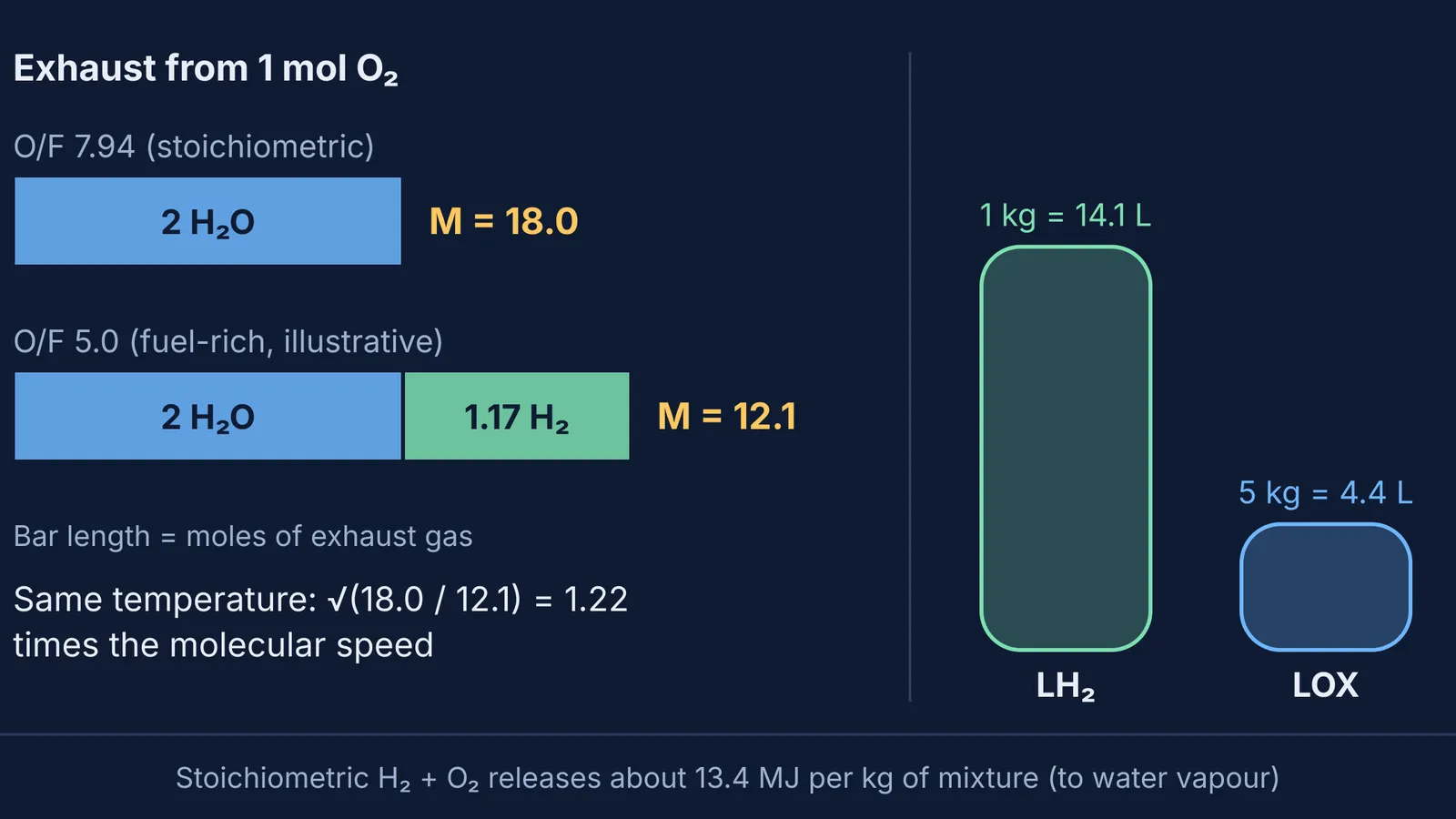
(a) Exhaust composition at O/F = 5.0
Take 1 mol O₂ = 32.00 g. At O/F 5.0, the hydrogen fed is 32.00 ÷ 5.0 = 6.40 g = 6.40 ÷ 2.016 = 3.17 mol H₂.
O₂ is limiting. 1 mol O₂ uses 2 mol H₂ and makes 2 mol H₂O.
H₂ left over = 3.17 − 2 = 1.17 mol.
Exhaust: 2 mol H₂O + 1.17 mol H₂ = 3.17 mol, mass 32.00 + 6.40 = 38.4 g.
Average molar mass M = 38.4 ÷ 3.17 = 12.1 g/mol, against 18.0 g/mol at O/F 7.94.
At the same temperature, √(18.0 ÷ 12.1) = 1.22. The hydrogen-rich exhaust molecules move about 22% faster. The real gain is smaller, because the fuel-rich flame is cooler, but it is still a gain.
(b) Energy per kilogram of propellant
H₂(g) + ½O₂(g) → H₂O(g), ΔH = −241.8 kJ/mol (NIST WebBook, water vapour as product, the lower heating value).
One mole of steam is 18.02 g of propellant (2.016 g H₂ + 16.00 g O). So the stoichiometric mixture releases 241.8 ÷ 18.02 = 13.4 MJ per kg of propellant.
Per kilogram of hydrogen alone it is 241.8 ÷ 2.016 = 120 MJ/kg. With liquid water as product (285.8 kJ/mol) it is about 142 MJ/kg, the figure you see in calorific value tables.
At O/F 5.0: 2 mol of steam per 38.4 g, so 2 × 241.8 ÷ 38.4 = 12.6 MJ/kg.
Two lessons. First, hydrogen's famous 120 to 142 MJ/kg counts only the fuel; a rocket must carry its oxygen too, and per kilogram of both, the number is about 13 MJ. Second, running fuel-rich gives up only about 6% of the energy per kilogram (12.6 against 13.4) while cutting the exhaust molar mass by a third.
(c) Why the hydrogen tank is the big one
Densities at their normal boiling points: liquid hydrogen about 70.8 kg/m³ at 20.3 K, liquid oxygen about 1,141 kg/m³ at 90.2 K (NIST fluid properties).
At O/F 5.0, 1 kg of LH₂ goes with 5 kg of LOX.
Volume of LH₂: 1 ÷ 70.8 = 0.0141 m³ = 14.1 L.
Volume of LOX: 5 ÷ 1,141 = 0.0044 m³ = 4.4 L.
The hydrogen takes about 3.2 times the volume while holding one-fifth the mass.
This is the other half of the story. A bigger hydrogen tank means more structure to carry, so engineers cannot simply add hydrogen until the exhaust is as light as possible. The operating ratio is a balance between exhaust speed, flame temperature, and tank size and mass. Molar mass explains why the ratio sits below 7.94; tank size explains why it does not go much lower.
If the average molar mass step is the one you keep getting wrong, the Fermi Problem Library has worked problems with a step-by-step solver that explains the reasoning.
Does a hydrogen-rich exhaust help the engine in other ways?
Yes, in two textbook-level ways. A cooler flame is gentler on the combustion chamber. And hydrogen is a reducing gas, so a hydrogen-rich exhaust is less likely to oxidise hot metal surfaces than an oxygen-rich one. For how ISRO's engine keeps its walls cool, see what a cryogenic rocket engine is.
Quick checklist
Stoichiometric O/F for H₂ and O₂ is 32.00 ÷ 4.032 = 7.94.
LOX/LH₂ engines run fuel-rich; O₂ is the limiting reagent and H₂ is in excess.
Exhaust speed scales roughly as √(T/M); extra H₂ lowers M from 18.0 to about 12.1 at O/F 5.
Average molar mass = total mass ÷ total moles, never a plain average.
Per kilogram of H₂ + O₂ the energy is only about 13.4 MJ (water vapour, lower heating value).
LH₂ is so light that its tank is about three times the LOX tank's volume at O/F 5.


