

On this page
When you watch a heavy-lift rocket launch, the fiery liftoff is just the beginning. To push a satellite into its precise final orbit, engineers rely on a highly efficient final stage known as a cryogenic engine. In India's Launch Vehicle Mark 3 (LVM3), this job is handled by the indigenous CE-20 engine, which must operate across large temperature gradients.
A. P. J. Abdul Kalam emphasised the importance of rocket staging and optimizing payload mass in his early work with the SLV-3 (as discussed in our post on A. P. J. Abdul Kalam's rocket science: SLV-3 and why stages matter). Today, the cryogenic stage is the ultimate expression of that staging philosophy.
What is a cryogenic engine in ISRO rockets?
A cryogenic rocket engine is one that uses supercooled gases, liquefied at extremely low temperatures, as its propellant. In ISRO's heavy-lift LVM3 rocket, the upper stage (C25) is powered by the CE-20 cryogenic engine.
The primary advantage of a cryogenic engine is its specific impulse. Think of specific impulse as the rocket equivalent of fuel mileage in a car; it measures how many seconds a given mass of propellant can produce a set amount of thrust. The higher the specific impulse, the more 'push' the rocket gets from every drop of fuel.
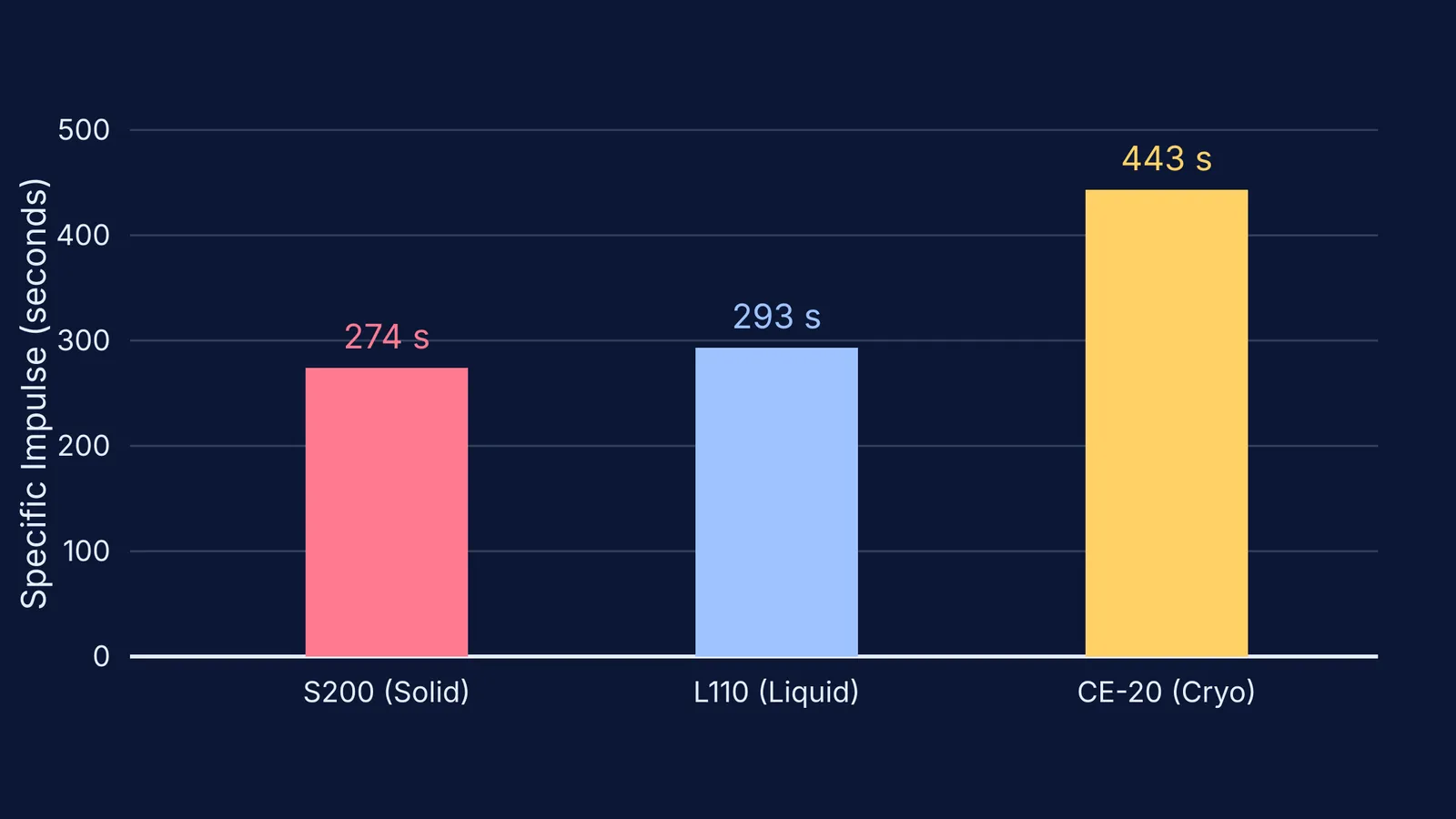
The CE-20 engine delivers a vacuum specific impulse of 443 seconds, which is significantly higher than both the solid rocket boosters and the standard liquid core stages used earlier in the flight [[1]](https://en.wikipedia.org/wiki/LVM3). This efficiency means the rocket can carry a heavier payload without needing extremely large fuel tanks for the final leg of the journey.
The cryogenic stage's final job is placing the payload into a precise orbit. If you find it hard to picture how a rocket alters its orbit in the vacuum of space, the Fermi Simulation Lab provides interactive simulations where you can adjust engine thrust and instantly see how it changes a spacecraft's trajectory.
Why are liquid hydrogen and liquid oxygen used?
Rocket engines need both a fuel and an oxidizer to burn in the vacuum of space. ISRO's cryogenic engines use hydrogen as the fuel and oxygen as the oxidizer.
Hydrogen is the lightest element in the universe, which means when it burns, the exhaust gases have a very low molecular weight and travel at a high velocity. This high exhaust velocity is what gives the engine its high specific impulse. However, hydrogen gas takes up far too much space to be stored practically on a rocket.
To solve this, the gases are cooled until they become dense liquids. In the LVM3, liquid hydrogen (LH2) is stored at extremely low temperatures, making it one of the coldest fluids handled in aerospace. The liquid oxygen (LOX) oxidizer is stored alongside it.
Storing these fluids comes with strict requirements. Liquid hydrogen is so cold that it boils off rapidly if not heavily insulated. Furthermore, hydrogen molecules are incredibly small and can leak through microscopic pores in ordinary seals, requiring specialized materials and precision engineering.
How does a cryogenic engine survive extreme temperatures?
Handling fluids at near absolute zero introduces severe engineering challenges. The materials used to build the fuel tanks and plumbing must not become brittle and shatter when exposed to the supercooled liquids.
Another challenge occurs inside the engine itself. While the propellants are stored at extreme sub-zero temperatures, the chemical reaction inside the combustion chamber creates extremely high temperatures. The engine must withstand this thermal shock without melting.
To survive this, engineers use a technique called regenerative cooling. Before the liquid hydrogen is injected into the combustion chamber to burn, it is pumped through a network of tiny tubes lining the walls of the engine nozzle and chamber. The supercooled hydrogen absorbs the heat of the engine, cooling the metal walls while simultaneously pre-heating the hydrogen so it burns more efficiently. (When calculating the heat and work done by the expanding gases in a chamber, it is easy to mix up your signs—see our guide to thermodynamics sign conventions for the physics and chemistry rules.)
Unlike the earlier CE-7.5 engine used on the GSLV Mk II, which relied on a complex staged combustion cycle, the LVM3's CE-20 engine uses a highly reliable gas-generator cycle. This simpler design allows it to safely produce the 200 kN thrust needed to loft India's heaviest payloads [[1]](https://en.wikipedia.org/wiki/LVM3).
How do ISRO's LVM3 rocket stages compare?
To see why the complex cryogenic stage is saved for last, compare the efficiency of the three main propulsion systems used in ISRO's LVM3 [[1]](https://en.wikipedia.org/wiki/LVM3):
Solid boosters (S200): These use HTPB propellant and provide high thrust for liftoff, but have a lower specific impulse of approximately 274 seconds.
Liquid core (L110): Powered by Vikas engines using earth-storable propellants (UH25 and N2O4), offering a medium specific impulse of 293 seconds.
Cryogenic upper stage (CE-20): Burns liquid hydrogen and oxygen, delivering the highest specific impulse of 443 seconds to push heavy payloads into orbit.
By mastering this demanding technology, ISRO ensures that missions like Chandrayaan and Gaganyaan have the heavy-lift capability needed to reach their destinations. To explore the math behind these launches, read our guide to orbital speed and energy.


