

On this page
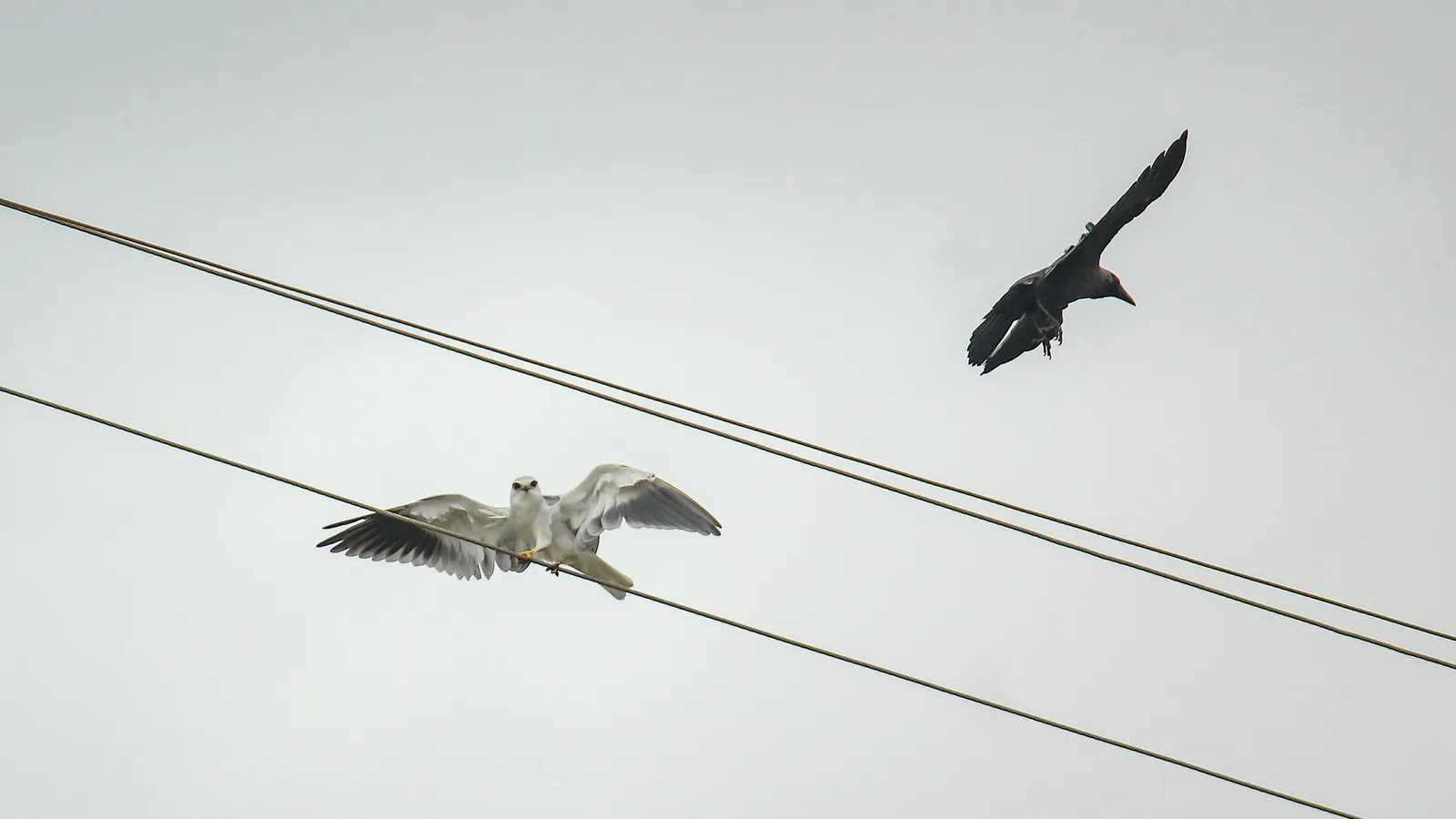
You usually hear it before you see it. Crows caw hard at one branch, and mynas and bulbuls join in with harsh chattering. Look closely and you will often find an owl in the leaves, or a kite on a wire.
Biologists call this mobbing: prey animals gather around a dangerous predator and harass it instead of running away (Wikipedia)).
Why do crows attack owls and eagles?
A bird of prey nearby is a threat to nests and nestlings, and crows react to owls especially strongly. "Crows have a particularly violent reaction to owls," writes Matthew L. Miller, director of science communications at The Nature Conservancy, who has seen more than 100 crows mob a single great horned owl (The Nature Conservancy).
In 1978 the biologist Eberhard Curio set out nine possible explanations for mobbing (Curio 1978). Here are four of them:
Move it on. A predator that has been spotted has little reason to stay.
Warn the neighbours. The calls tell every bird nearby where the danger is.
Teach who the enemy is. In an experiment, captive European blackbirds that watched another blackbird mob an unfamiliar, harmless bird went on to mob that bird themselves, and the lesson passed along a chain of at least six birds (Curio, Ernst and Vieth, Science, 1978).
Call in a bigger bird. In a 2020 field experiment, playing bulbul mobbing calls aimed at a collared scops owl next to an owl model brought in crested goshawks, which attacked the model (Fang and colleagues, Animal Behaviour, 2020).
Do crows remember who threatened them?
They do, and mobbing spreads that memory. In Seattle, researchers trapped crows while wearing one mask. In the first two weeks after trapping, about 26% of crows they encountered scolded the mask. After 2.7 years, 66% did. Over 5 years the scolding spread at least 1.2 km from where it started, crows that had never been caught joined in, and young crows learned it from their parents (Cornell and colleagues, Proceedings of the Royal Society B, 2011).
That is the reverse of how habituation makes birds ignore scarecrows that never hurt them.
Is mobbing dangerous for the birds that do it?
Yes, mobbing a predator can be deadly, so birds weigh up the risk. In a Brazilian study, 79 of 157 bird species (50.31%) mobbed owl models, and smaller species were more likely to join in. Faced with the ferruginous pygmy-owl, whose diet is 43% birds, they gathered in bigger groups but mobbed less intensely than they did a burrowing owl, which eats mostly insects and other arthropods (da Cunha and colleagues, Behavioral Ecology, 2017).
When black-capped chickadees were shown 15 different predators, their mobbing calls changed with the predator's size. The researchers explain that a small, agile pygmy-owl is more dangerous to a chickadee than a great horned owl (University of Washington, on Templeton, Greene and Davis, Science, 2005).
Why owls are worth this fuss comes down to how owls hunt at night. Other animals listen in on alarm calls too, as deer do with langurs.
How do you spot and record a mobbing event from your balcony?
Signs to watch for:
Several birds calling harshly, all facing one branch, wire or ledge
Crows, mynas and bulbuls joining the same noise
Short swoops at one spot, pulling away each time
A large bird flying off with smaller birds chasing it
When it starts, note down:
Time it started, and the weather
The target (owl, kite, cat, snake or unknown) and where it is sitting
Each mobbing species, with the most birds of that species you saw at once
What they did: calling, swooping or making contact
How close the birds got (roughly, in body lengths)
How long it lasted
How it ended: the target left, the mob gave up, or you lost sight of it
A sample entry (made up, to show the format): "7:40 am, clear. Spotted owlet on a neem branch. House crows 4, common mynas 2, red-vented bulbuls 3. Calling and swooping, no contact, closest about 3 body lengths. 11 minutes. Owlet flew to the next tree; crows followed."
You can also upload your counts to eBird. Bird Count India's 2020 Lockdown Birding Challenge asked people to look for birds for exactly 15 minutes, standing in one place (Bird Count India), a format a balcony suits.
A month of entries shows which species mob most, when, and which targets draw the biggest crowds: a good school project. If you are not sure where to start, Fermi's AI tutor works out what you already know and builds a plan for the session, and the Fermi Concept Library covers every concept in biology, each with its own lesson.
Next time the crows outside start shouting, go and look for what they want gone.


