On this page
Owls hunt at night against three problems: too little light, the sound of their own wings, and prey hidden under grass or leaves. Each has a matching adaptation: a structure whose shape fits a job in a particular environment. Here is what researchers have measured, and a four-step way to turn it into a full answer.
How do owls see in the dark?
Owls are crepuscular or nocturnal birds with rod-dominated retinas, according to a 2019 study of owl eyes in Vision Research. Rods are the photoreceptors that are more sensitive to light and allow vision in dim light; a 2025 review of low-light retinas notes that rod-dominated retinas favour sensitivity at the cost of fine detail, and that colour vision is generally sacrificed too.
The eye is built to collect light. Comparing nine owl species, Lisney and colleagues (2012) found that nocturnal owls have relatively larger corneas, compared with the length of the eye, than owls active by day. Owl eyes are tube-shaped and do not move in their sockets, so an owl turns its head instead (McGill Office for Science and Society). They also face forward: in the tawny owl, the binocular field, where the two eyes' views overlap, is at most 48 degrees wide, Graham Martin measured in Vision Research (1984)90005-1).
Does it work? Three barn owls tested by Orlowski, Harmening and Wagner (2012) kept a quarter of their best visual acuity even when the light dropped by 5.5 log units, a factor of more than 300,000.
How do owls fly silently?
Bachmann and colleagues (2007) compared barn owl and pigeon wing feathers and described three owl features:
A comb of serrations on the leading edge of the outermost wing feathers, about 1.8 mm long and about 18 per centimetre in their samples.
Fringes on the trailing edge of the inner vane, where barb tips are unconnected and float freely.
A velvety upper surface, made by long barbule extensions that cover the barb shafts.
How these cut noise is still debated; Bachmann's team noted that convincing quantitative data were missing. A 2020 review by Christopher Clark, Krista LePiane and Lori Liu argues that the fringes and velvet mainly reduce the sound of feathers rubbing together. It also asks why owls fly quietly at all: so prey cannot hear them, or so they do not drown out their own hearing? Current evidence slightly favours the second, but the question is open.
Why are owl ears at different heights?
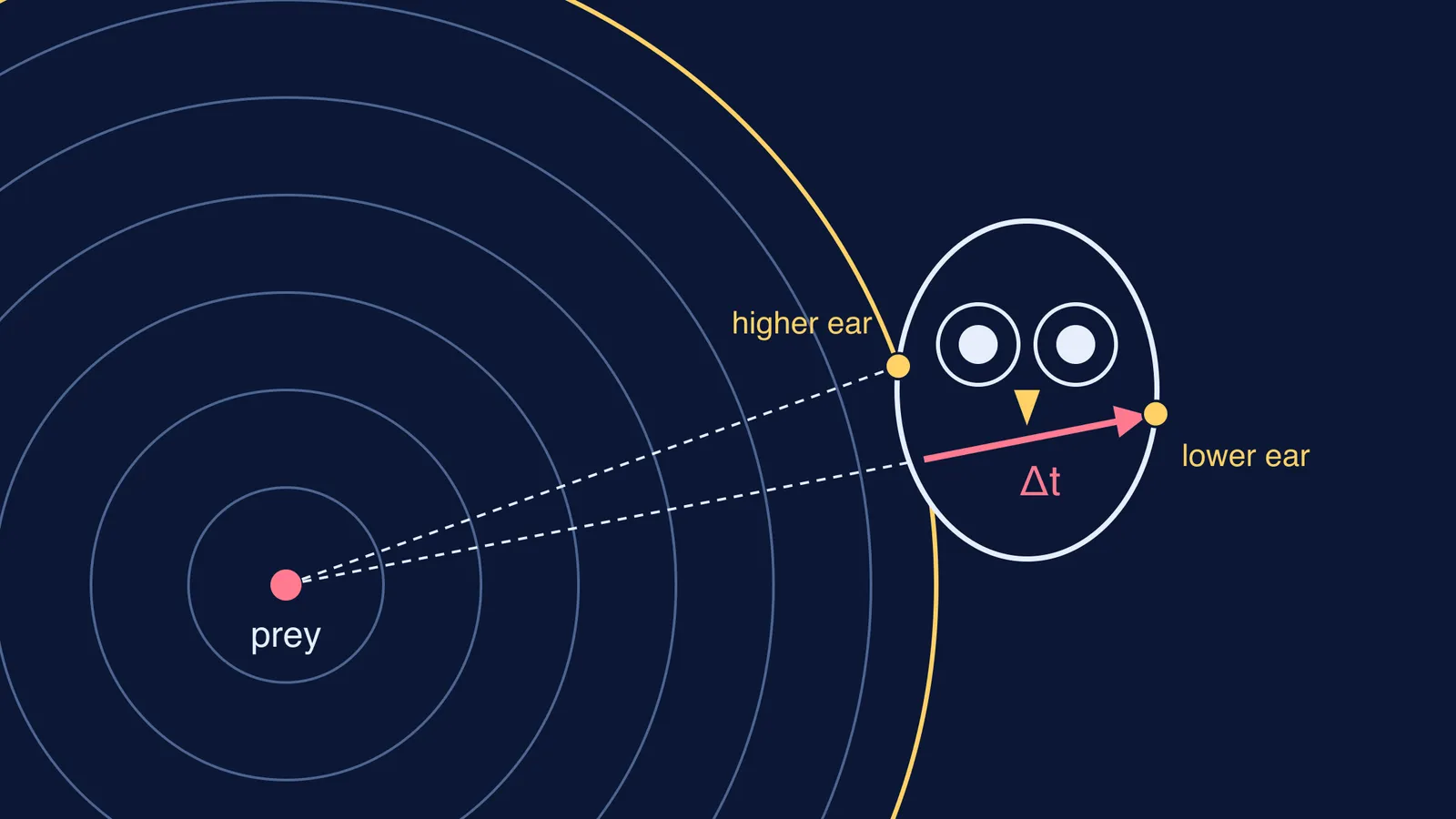
Barn owls can locate prey in complete darkness using hearing alone, with errors under 1 degree both side to side and up and down, Roger Payne reported in the Journal of Experimental Biology (1971). His trained owls depended on sound frequencies above 5 kHz.
The trick is that some owls have vertically asymmetrical ears: one ear opening sits higher than the other. In the barn owl, the difference in arrival time at the two ears gives left-right position, and the difference in loudness gives up-down position (Gutiérrez-Ibáñez, Iwaniuk and Wylie, 2011). A 2017 study in eNeuro refined this: loudness differences vary mainly with height but also somewhat with left-right position.
Ear asymmetry evolved up to seven times independently in owls (Krings, Müller-Limberger and Wagner, 2019). Bats solve the same problem differently, by making their own calls: see how bats find insects in total darkness, using echoes.
How do you write an adaptation answer in an exam?
Use four steps, in this order:
Structure: name the feature exactly ("rod-dominated retina", not "good eyes").
Function: say what it does physically.
Environment: say which problem in the habitat it solves.
Trade-off: say what it costs, if you know.
Worked example. Question: "Explain how owls are adapted to hunt at night."
Eyes: tube-shaped eyes with relatively large corneas and a rod-dominated retina (structure) take in more light and respond in dim light (function), so the owl can see prey after dark (environment). The cost is less colour and fine detail (trade-off).
Feathers: serrated leading edges, fringed edges and a velvety surface (structure) reduce flight noise, including feathers rubbing (function), so prey hears less and the owl hears more (environment).
Ears: openings at different heights (structure) create loudness differences that signal height, while timing differences signal left-right direction (function), so the owl can strike prey it cannot see (environment).
Practise the same steps on waterproof duck feathers and webbed feet, then on cave animals that are blind and pale, where the trade-off runs the other way.
If rods, cones or sound waves feel shaky, the Fermi Concept Library has a lesson for every concept in biology and physics, each with its place in the map. When you want to test your own answer, Fermi's AI tutor checks understanding as it goes and decides whether to explain, ask or show.
Next time you hear an owl at night, try naming all three adaptations, and what each one costs.