On this page
A duck dives, bobs back up and shakes off the water as if it had never been wet. Two adaptations do most of that work. The webbed feet are paddles that open on the push and fold on the way back. The feathers are built to hold a layer of air, and oil from a gland near the tail keeps them in working order.
Why do ducks have webbed feet?
A paddle works by pushing water backwards. By Newton's third law, the water pushes the duck forwards. A bigger pushing surface moves more water, which is why the skin between a duck's three front toes matters.
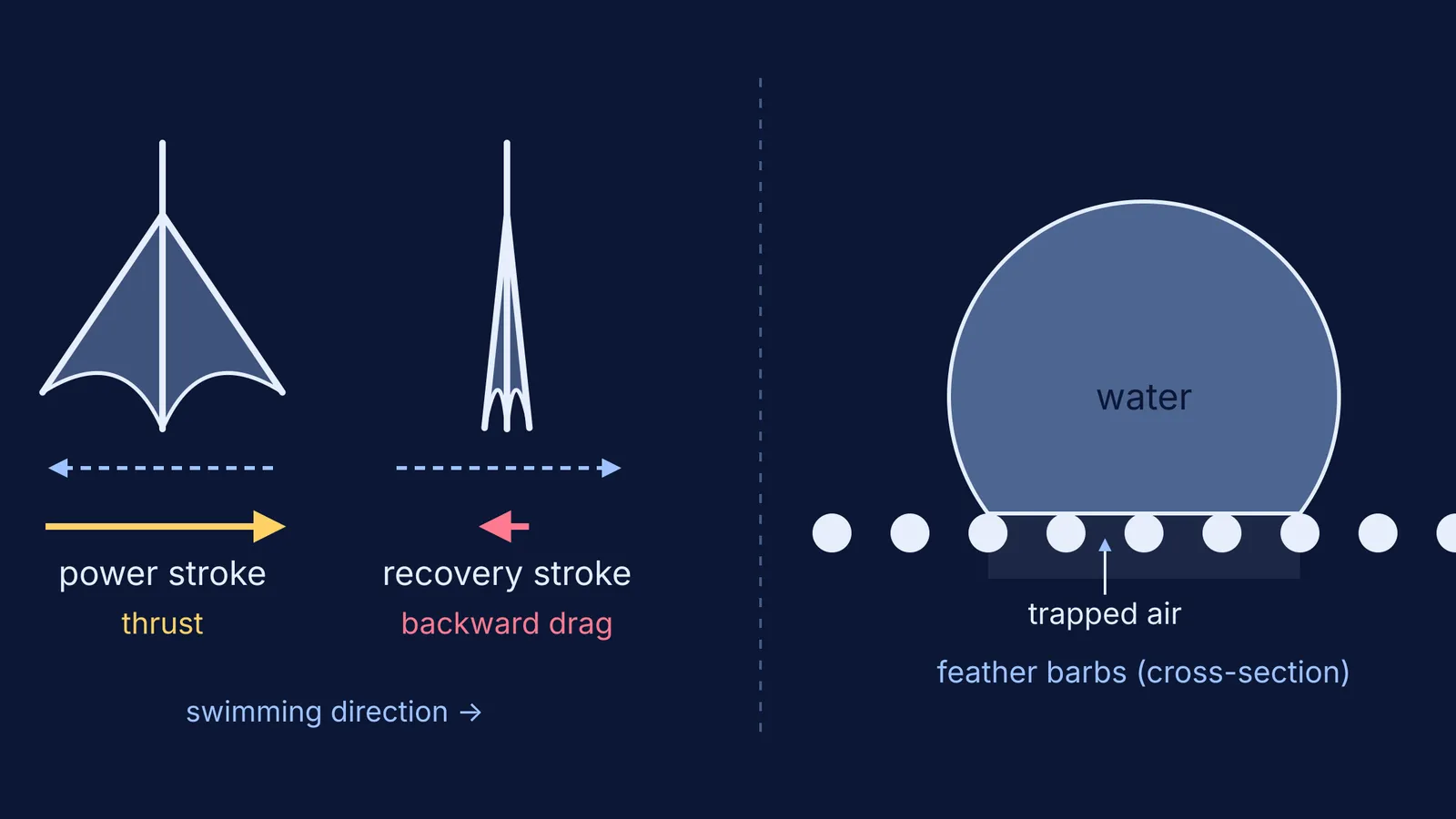
The clever part is the return stroke. In a 2010 PLOS ONE study of diving ducks, Gal Ribak and colleagues filmed Barrow's goldeneyes with two cameras to track their feet in 3D. They found the toes are spread during the power phase, while the webbed area is collapsed during the recovery phase. A folded foot has less area, so it meets less drag as it swings forward again. The same study found that ducks holding position near the bottom tilted steeply head-down, so that 98% of their paddling force (in the body's front-to-back plane) worked against their own buoyancy.
Are duck feet oars or wings?
Scientists have argued about this. A 2003 Nature paper by Johansson and Norberg proposed that webbed feet push mainly by drag early in the stroke, then switch to lift later, working like a triangular "delta wing".
A 2023 study in Scientific Reports tested 3D-printed models of a diving duck's foot in a wind tunnel. Drag provided the forward thrust for the first 80% of the power phase, and lift took over only at the end. The authors concluded that duck feet work more like oars than delta wings, and suit swimming both on and below the surface.
How do ducks keep their feathers waterproof?
Start with structure. A feather vane is made of barbs, and each barb carries tiny barbules. A 2024 systematic review in the Journal of Avian Biology notes that early 1900s ideas credited the oil, but later studies showed the feather's layered structure creates a porous surface that repels water with or without oil. The review stresses the role of the barbules.
An MIT-led study of feathers from six aquatic bird species explains why. Water drops sit on top of the barbules with air trapped underneath, a non-wetting state called the Cassie-Baxter state. The researchers predicted that water pressure forces its way in at depths of about 1 to 4 metres, but the feathers dry out by themselves once the bird surfaces. For common oils, the same analysis predicted the opposite: a fully wetted feather.
What does the preen gland actually do?
The preen gland, or uropygial gland, sits on the upper side of the base of a bird's tail. Birds spread its oil through their feathers when they preen.
In experiments on ducks reported in 1954, William Elder found that preen oil, which contains fatty acids and waxes, keeps feathers water-repellent, either directly or by preserving their structure, as the British Ornithologists' Union summarises. A 2017 review in Biological Reviews agrees that preen oil improves waterproofing, but says it is still unclear whether it forms a water-repelling layer or simply keeps the plumage in good shape.
So the honest answer: the feather's structure repels water, and preen oil helps keep it that way, though exactly how is still debated.
How do you write this as an exam answer?
Use this five-step plan for any "adaptations of aquatic birds" question:
Name the adaptations: webbed feet, waterproof plumage, preen (uropygial) gland.
Describe the structure: skin web between the front toes; barbs and barbules; gland at the base of the tail.
Give the function: the web pushes more water on the backstroke and folds on the return; feathers trap air so water beads and rolls off; preen oil keeps feathers in condition.
Link to habitat: these help the bird swim, dive and come out of the water dry.
Add the physics: Newton's third law for thrust, and drag rising with area.
Common slips to avoid:
Saying the oil alone makes feathers waterproof.
Forgetting that the web folds on the forward stroke.
Placing the preen gland anywhere but the base of the tail.
Try it at home: in a bucket of water, sweep your open palm backwards flat-on, then edge-on. The flat palm meets far more resistance. That is the power stroke and recovery stroke in your own hand.
If drag, Newton's third law or surface wetting still feel shaky, the Fermi Concept Library has every concept in physics, chemistry, biology and mathematics, each with its own lesson. For numericals on forces in fluids, the Fermi Problem Library has worked problems with a step-by-step solver that explains the reasoning.
Where does this fit in your syllabus?
Duck feet are one example of matching body shape to habitat. Compare them with how fish use a streamlined body and fins, how hydrophytes adapt to life in water, and how polar bears and camels survive extreme habitats.