

On this page
Hydrophytes, or aquatic plants, live in an environment where water is abundant but oxygen and sunlight can be scarce. To survive, plants like the lotus, water hyacinth and *Hydrilla* have evolved specific structural changes. Their roots, stems and leaves look and function differently from those of terrestrial plants.
For students preparing for exams, plant anatomy is a high-yield topic. Here is how hydrophytes adapt to their watery habitats, and why these structural features are essential for their survival.
What are air spaces and aerenchyma in aquatic plants?
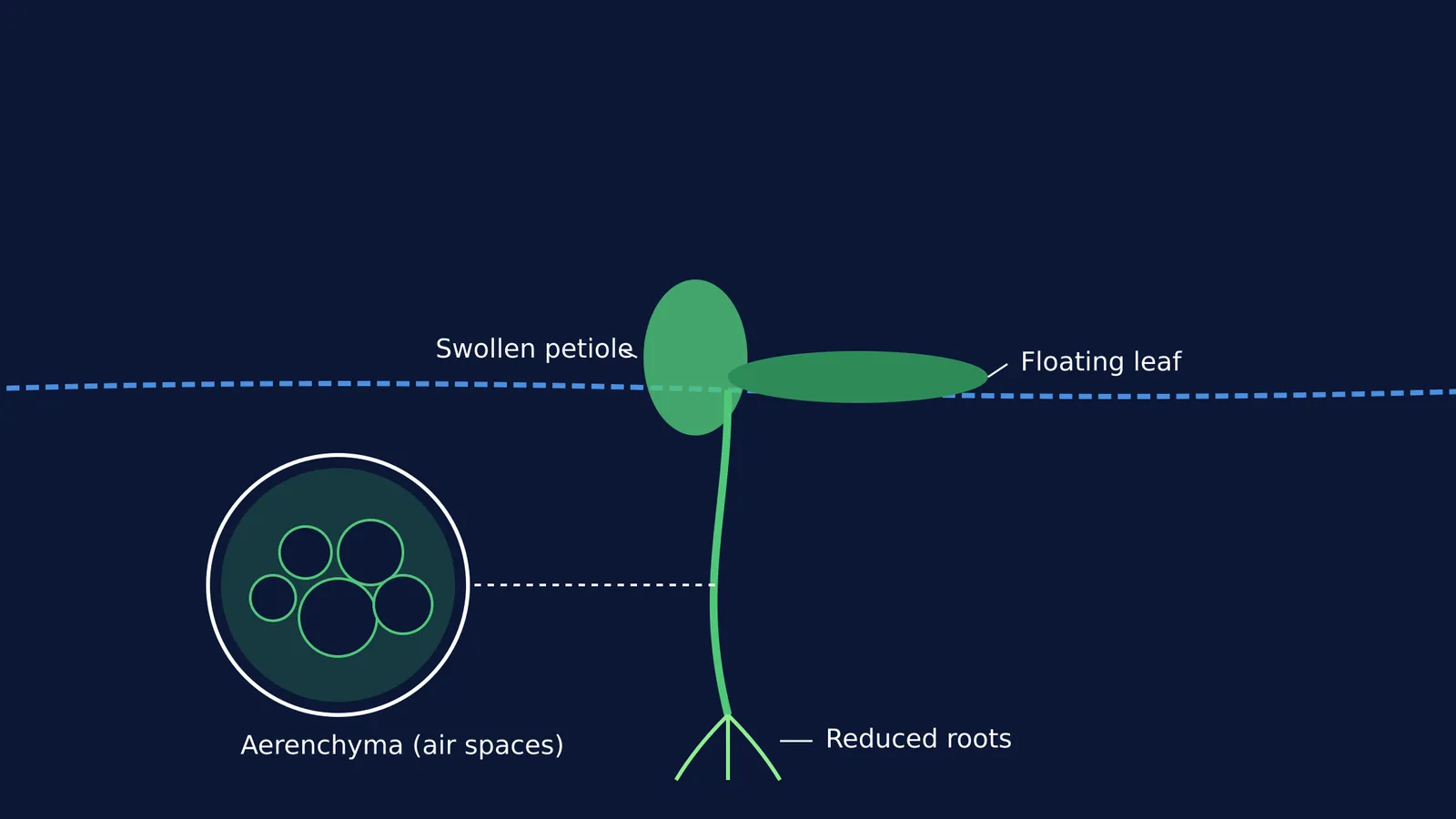
The most defining internal feature of a hydrophyte is its spongy, air-filled tissue called aerenchyma. While terrestrial plants generally have about 2% to 7% air space in their tissues, aerenchyma can make up 20% to 60% of the total tissue volume in aquatic plants.
This large network of interconnected air spaces serves two critical functions:
Buoyancy: Trapped air reduces the plant's overall density, allowing it to float. This ensures leaves stay near the surface to capture the maximum amount of sunlight for photosynthesis.
Gas exchange: Mud and deep water are often anoxic (lacking oxygen). The continuous air channels act like an internal snorkel, moving oxygen from the leaves down to the submerged stems and roots so that cellular respiration can continue.
If you are revising plant anatomy, you can explore the internal structures of different tissues in the Fermi Concept Library to see exactly how these large cavities form and function.
How do lotus, water hyacinth and Hydrilla adapt?
Different hydrophytes adapt depending on whether they are emergent, free-floating or completely submerged. Each lifestyle requires a different approach to gas exchange, light capture, and structural support.
Floating leaves and thin cuticles
Plants that float or emerge from the water, such as the lotus (*Nelumbo nucifera*), have broad leaves that rest on the surface. These leaves have stomata only on their upper epidermis (epistomatic leaves) to allow direct gas exchange with the air. A thick waxy coating on the upper surface prevents water from clogging these pores.
In completely submerged plants like *Hydrilla*, the cuticle is exceptionally thin or absent entirely. Because they live underwater and do not need to prevent transpiration (water loss), a thin cuticle allows the plant to absorb dissolved carbon dioxide, oxygen, and essential nutrients directly through the leaf surface.
Swollen petioles for free-floating
The water hyacinth (*Eichhornia crassipes*) is a classic example of a free-floating hydrophyte. It stays afloat across the water's surface thanks to its swollen, bulbous leaf stalks (petioles). These inflated stalks are packed with spongy aerenchyma, turning each leaf stalk into a natural life jacket that keeps the plant suspended in areas with optimal sunlight.
Reduced roots and flexible stems
Because water provides natural support and moisture is available everywhere, hydrophytes invest very little cellular energy in building rigid structures or extensive root systems:
Reduced root systems: Unlike land plants that need deep taproots to search for groundwater, free-floating plants like the water hyacinth have poorly developed roots that mostly serve to balance the plant in the water. In some hydrophytes, roots are absent entirely, as the plant absorbs nutrients directly through its leaves.
Lack of mechanical tissue: Hydrophyte stems have very little xylem and lignin (the heavy, woody tissues that make land plants rigid). Instead, their stems are highly flexible, allowing them to sway safely with water currents without breaking.
What happens to reproduction and nutrient absorption in water?
Beyond their physical structure, hydrophytes have adapted their physiological processes to suit an aquatic lifestyle. Because they are entirely surrounded by a nutrient-rich aqueous solution, their approach to absorbing minerals is distinct. Submerged plants absorb water, dissolved gases, and minerals directly through their entire general body surface. Their exceptionally thin cuticles facilitate this rapid exchange, meaning the need for a complex vascular system is greatly reduced.
Reproductive strategies have also shifted. Terrestrial plants often rely on wind or insects to carry pollen, but many submerged aquatic plants use the water itself. In some species, the male flowers detach and float to the surface, where water currents carry them to the female flowers. This method ensures that pollination can occur even when insect pollinators are absent. Once fertilised, the seeds of many hydrophytes are encased in spongy, water-resistant coverings that trap air, allowing them to float on the water's surface and colonise new areas rapidly.
How can you test your knowledge of hydrophyte adaptations?
When answering questions about the anatomy of flowering plants, examiners often ask you to link a structural feature to its survival function. Use this systematic framework to check your understanding of any aquatic plant:
Roots: Are they reduced or absent? (Function: water is already abundant; roots just provide balance or light anchorage, saving the plant energy).
Stems: Are they flexible and lacking woody tissue? (Function: moving with water currents prevents damage; buoyancy is provided by the surrounding water rather than a rigid trunk).
Leaves: Is the cuticle thin or thick? Are stomata on the top, bottom, or absent? (Function: preventing water-logging while maximising gas exchange from the air or water).
Internal tissue: Is aerenchyma present in large volumes? (Function: buoyancy and the transport of oxygen to submerged tissues).
By understanding the "why" behind phototropism, geotropism and other tropic movements, as well as internal anatomy, you can deduce the right answers logically rather than relying solely on rote memory. If you are comparing different plant families, reviewing the morphology of flowering plants will help you spot these adaptive patterns across different species.


