On this page
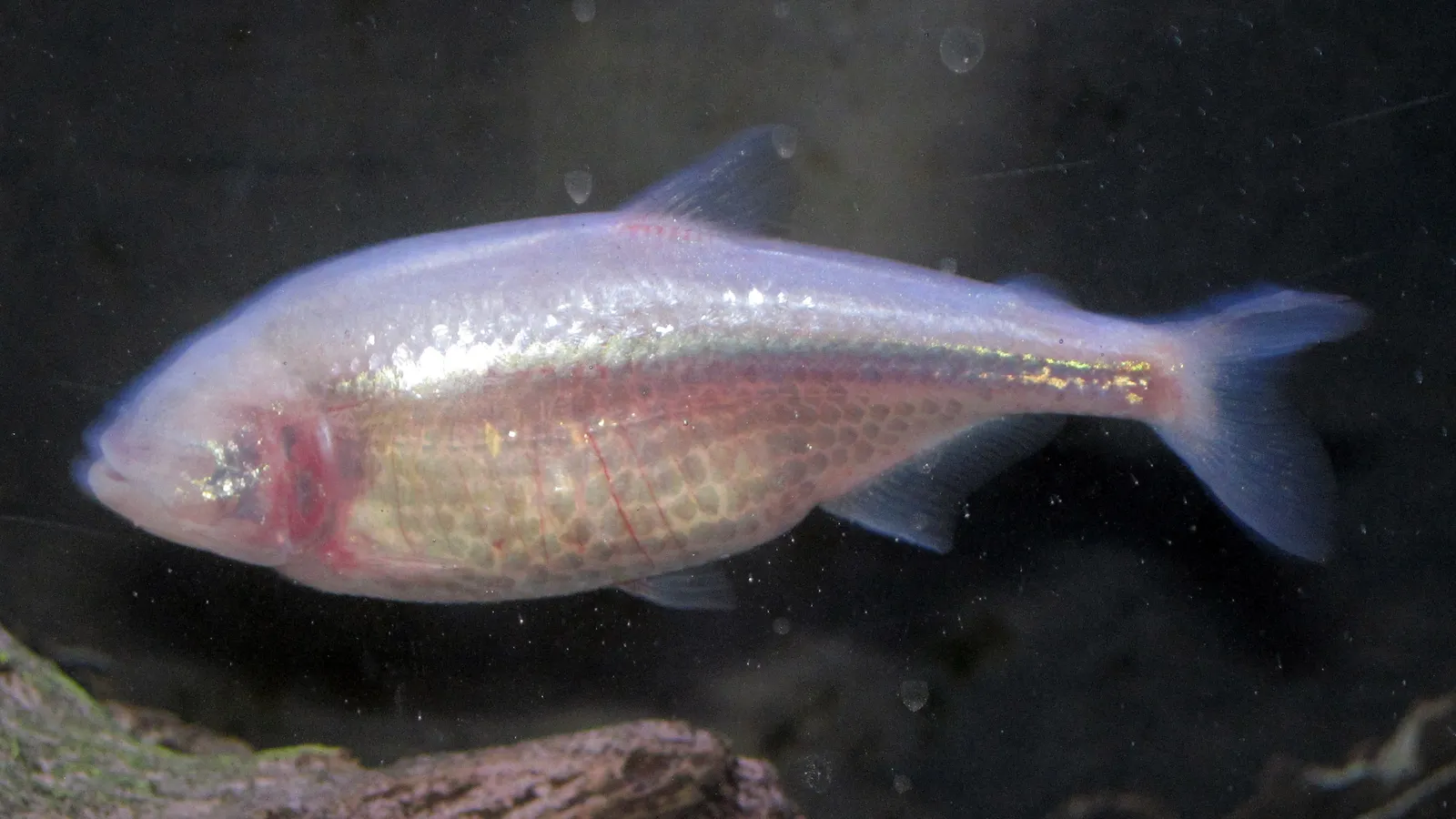
In 2019, the world's largest known subterranean fish was discovered in caves in Meghalaya's East Jaintia Hills. When scientists described it as a new species, Neolissochilus pnar, in 2023, its defining features included eyes ranging from highly reduced to no externally visible eyes at all, and a complete lack of pigmentation (Dahanukar et al., Vertebrate Zoology, 2023). Blind and pale: the same pair of traits turns up in cave animals around the world. Here is why, and what they use instead of sight.
Why are cave animals blind and pale?
The best-studied example is the Mexican tetra, Astyanax mexicanus, which lives as an eyed fish in rivers and as more than 30 blind cave populations in Mexico (Sifuentes-Romero et al., Integrative and Comparative Biology, 2023). The review weighs several explanations, and more than one seems to be at work:
Nothing keeps the eye working. In total darkness, selection that maintains the eye is relaxed, so damaging mutations can pile up by chance, the process our post on gene flow vs genetic drift explains.
Eyes are expensive. Selection can also favour smaller eyes directly, because caves have little food.
Linked traits. Some genes that shrink the eye may also strengthen other cave traits.
How expensive are eyes? Researchers at Lund University estimated the energy used by the eyes and the brain's visual centre in the eyed river form. Vision costs 15% of resting metabolism in a 1-gram fish, falling to 5% in an 8.5-gram fish (Moran, Softley and Warrant, Science Advances, 2015). In a food-poor cave, that is a large bill for an organ that sees nothing.
How does a cave fish lose its eyes?
Cave fish embryos still start to build eyes. All cave populations studied so far form an eye primordium, and the eye then degenerates through cell death that starts in the lens and later spreads to the retina (Sifuentes-Romero et al., 2023).
A classic experiment showed the lens is in charge. When Yoshiyuki Yamamoto and William Jeffery transplanted a surface-fish lens into a cave-fish eye cup, the eye grew and lost tissues were restored; a cave-fish lens in a surface-fish eye held growth back (Yamamoto and Jeffery, Science, 2000). The instructions for an eye are still there. What changed is a signal from the lens that tells the eye to keep growing.
Why are cave fish white instead of coloured?
Cave fish have reduced melanin, the dark pigment. A genetic study traced albinism in two separate Mexican cave populations to the same pigment gene, Oca2, with each population carrying a different deletion (Protas et al., Nature Genetics, 2006). Evolution reached the same result twice, by breaking one gene in two ways. For how albinism is inherited, see our explainer on albinism, melanin and recessive inheritance.
How do blind cave animals find food in the dark?
Cave fish have evolved more taste buds spread more widely, larger olfactory pits for smell, and an expanded lateral line, the sensors that feel water movement (Sifuentes-Romero et al., 2023).
Vibration attraction behaviour is the ability of a fish to swim toward the source of a water disturbance in darkness (Yoshizawa et al., Current Biology, 2010). In that study it was typical of cave fish and rare in surface fish, helped them feed in the dark, was triggered by vibrations peaking at 35 Hz, was blocked by lateral-line inhibitors and was significantly reduced when the surface sensors called neuromasts were removed. Later genetic work found that the regions linked to this behaviour overlap with those linked to eye size (Sifuentes-Romero et al., 2023), which fits the idea that eye loss and touch-sensing evolved together.
Insects follow the same pattern. Cave-adapted beetles are all eyeless or have reduced, depigmented eyes, and the most cave-adapted have slender bodies with extremely long legs and antennae (Moldovan et al., Environmental Microbiome, 2023). River dolphins in muddy water took another route, which our post on why the Ganges river dolphin is blind and uses echolocation covers.
How do you write this in an exam answer?
If you are asked why cave animals are blind, use this four-step frame:
Loss: name what is lost (eyes, pigment) and the condition (no light).
Cause: no selection keeps the trait, mutations build up, and dropping costly tissue saves energy where food is scarce.
Gain: name what replaces sight (touch, taste, smell, vibration sensing).
Example: Mexican cave fish, cave beetles, or Meghalaya's cave fish.
Model answer: “In caves there is no light, so eyes and pigment give no advantage. Mutations that damage them are not removed by natural selection, and losing eyes saves energy in food-poor caves. Cave fish instead rely on more taste buds, larger smell organs and lateral-line sensors that detect water movement.”
If the gap is in the underlying idea, such as natural selection or genetic drift, the Fermi Concept Library gives each concept its own lesson and shows its place in the map.
Next time you read “blind and pale”, look for all three parts: what was lost, why nothing kept it, and what took its place.