

On this page
The Ganges river dolphin (*Platanista gangetica*) is an incredible example of evolutionary adaptation. Living in the sediment-rich, turbid waters of the Ganges-Brahmaputra river system, this marine mammal has effectively traded its sight for a sophisticated acoustic system. It relies entirely on sound to find food, navigate, and survive in an environment where vision is useless.
Why is the Ganges river dolphin nearly blind?
The waters of the Ganges and Brahmaputra rivers are extremely murky, carrying heavy loads of silt and sediment. In this dark environment, eyes offer no survival advantage. Over millions of years, the Ganges river dolphin evolved to be essentially blind (WWF). Its eyes lack crystalline lenses and are reduced to tiny openings (Animal Diversity Web).
While it cannot form clear images or spot a fish, the dolphin is not completely devoid of light perception. It can still distinguish the direction and intensity of light, which helps it sense the water surface or the difference between night and day. But to hunt for fast-moving prey in the dark, it needs a sensory system that is much more precise.
How does the dolphin use echolocation in muddy water?
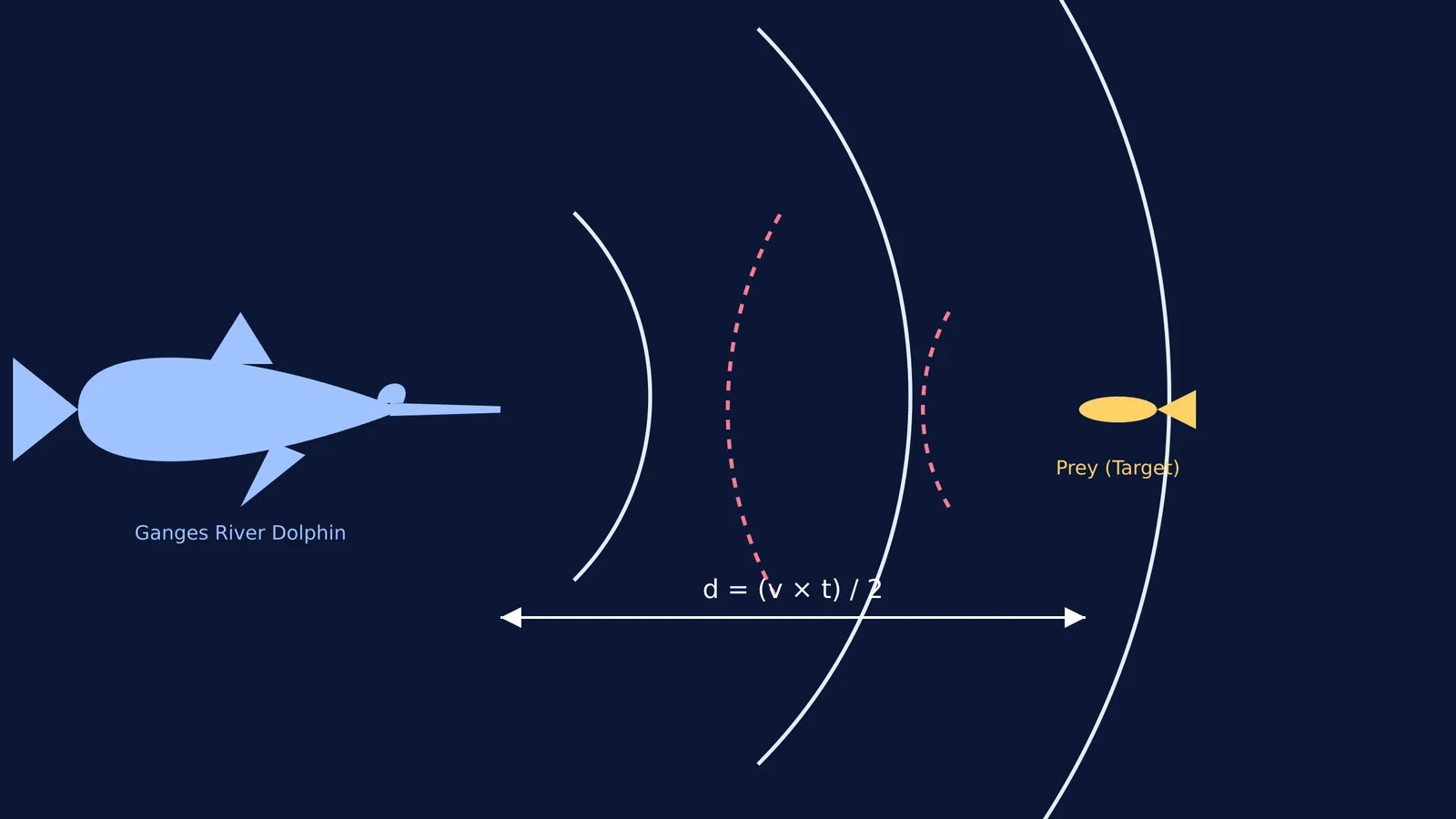
To compensate for its lack of sight, the Ganges river dolphin relies entirely on echolocation. It hunts by emitting ultrasonic sounds, which bounce off of fish and other prey, enabling it to "see" an image in its mind.
These continuous ultrasonic clicks travel through the water until they hit an object and echo back to the dolphin's lower jaw and inner ear. Because sound travels much faster in water than in air, echolocation provides an incredibly fast, high-resolution 3D map of the riverbed. The dolphin uses a special fatty structure in its forehead to focus these sound waves into a directed beam, much like shining a flashlight in a dark room.
When the sound wave hits a fish, a portion of the energy is reflected back as an echo. The dolphin's brain processes the time delay between the click and the echo, as well as the subtle changes in the sound's frequency, to determine the exact size, shape, speed, and direction of the prey.
If you are studying the physics of waves for an exam, the Fermi Concept Library has a lesson on the principles of sound wave reflection and how velocity changes across different mediums.
What are the main threats to the Ganges river dolphin?
Despite its perfect adaptation to muddy rivers, this national aquatic animal is highly endangered. The estimated population of the Ganges river dolphin is between 3,500 and 5,000 individuals (WWF). They face a barrage of human-made threats that disrupt their specialized lifestyle.
Dams and barrages: Infrastructure projects are the single biggest threat. The population is divided into isolated groups by the construction of more than 50 dams and other irrigation-related projects (WWF). This isolation makes them susceptible to inbreeding and prevents them from escaping polluted waters or finding new food sources during dry seasons.
Severe pollution: The Ganges basin supports a large human population, and the river absorbs massive amounts of chemical runoff. Each year, 9,000 tons of pesticides and 6 million tons of fertilizers are used in the vicinity of the river (WWF). This intense agricultural runoff causes severe water quality degradation. As top predators in the river ecosystem, the dolphins accumulate high levels of these persistent toxic chemicals in their bodies through a process called biomagnification. When they eat contaminated fish, the toxins build up in their fat stores, which ultimately harms their immune systems and reproductive success.
Fishing nets: Because they hunt in the same slow-moving currents that fishermen favour, Ganges river dolphins often drown after accidentally being caught in fishing nets, a fatal problem known as bycatch. Some are also still targeted and hunted for their meat and oil.
How is the species being protected?
Recognising the severe decline in numbers, conservationists and the Indian government have launched targeted efforts to protect the species. Initiatives aim to monitor populations, regulate industrial runoff, and restore the natural flow of the river ecosystem. Conservation organisations also work closely with local fishing communities to promote sustainable practices and develop safe methods to release dolphins that accidentally become entangled in nets.
Because the dolphin is an apex predator, its health reflects the state of the entire river. A thriving dolphin population signals a clean river system that benefits both wildlife and the millions of people who depend on the water.
You can learn more about how other marine mammals navigate in our guide on how dolphins use echolocation to see with sound. To understand what happens when species cannot adapt to human threats, read about why the dodo, quagga, thylacine and Steller's sea cow went extinct.


