

On this page
Put a scarecrow in a field and the birds keep their distance. Leave it standing in the same spot, in the same clothes, and before long they are back on the crop as if it were a fence post.
The Bird Dispersal Techniques guide from USDA Wildlife Services (2016) says it plainly: birds quickly learn that effigies left in the same location over a long period are not a threat. The same guide notes that scarecrows have been used for hundreds of years but are usually of limited value unless they are given movement or combined with other control measures.
The birds have not become braver. They have learned something: this shape, in this place, never chases, shouts or hurts. That kind of learning has a name.
What is habituation, in simple terms?
Habituation is a drop in response to a repeated stimulus that is not explained by tired senses or muscles. That is the definition in Habituation revisited, a 2009 review in Neurobiology of Learning and Memory, which updated the nine characteristics first listed by Thompson and Spencer in 1966 and added a tenth, on long-term habituation. The authors note that habituation is termed "the simplest form of learning", and that researchers in the field see it as what lets animals filter out irrelevant stimuli and focus on the important ones.
Four of those characteristics explain almost everything about a scarecrow:
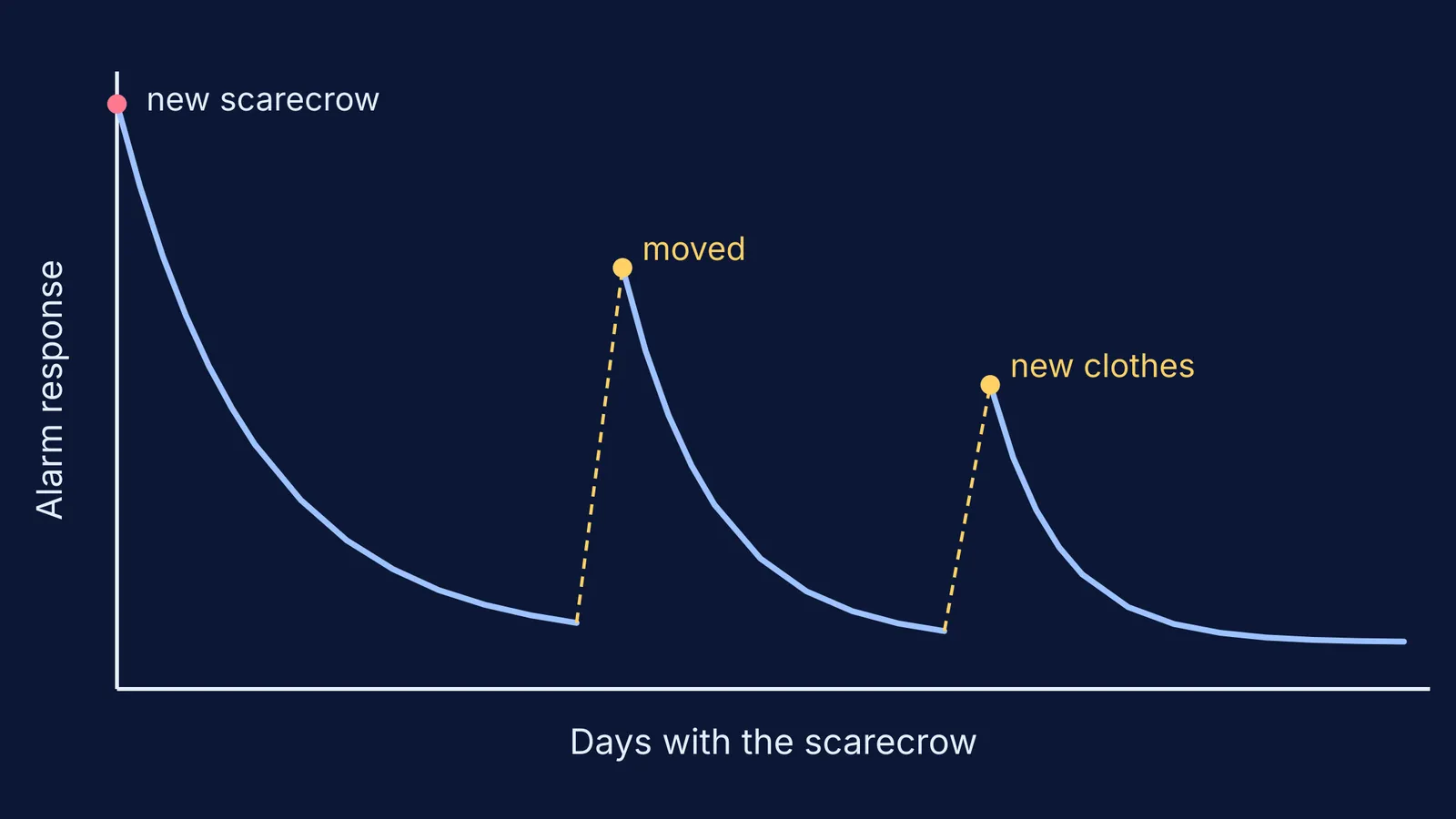
Stimulus specificity: the response fades to the repeated thing, not to everything. A crow that ignores the old scarecrow still reacts to something new.
Spontaneous recovery: if the stimulus is taken away for a while, the response comes back, at least partly.
Dishabituation: a different stimulus can bring back the faded response to the original one. Repeat that different stimulus, though, and its effect also wears off.
Frequency: the more often the stimulus repeats, the faster the response fades.
Why are city pigeons and temple monkeys so bold?
The same lesson, repeated over and over, shows up in animals that live around people. A 2015 meta-analysis in Nature Communications of birds, mammals and lizards found that populations exposed to more human disturbance tolerate humans more than less disturbed populations. Among birds, urban populations were more tolerant than rural or suburban ones, and large birds more than small ones.
Think of the pigeon on a railway platform that walks around your feet. The study measured tolerance, not how each animal came by it, but a city bird meets harmless people all day, so the scarecrow lesson on repeat is a likely part of the story.
Temple monkeys take it further. At Uluwatu Temple in Bali, long-tailed macaques are fed daily by temple staff and are described as fully habituated to human presence, according to a 2021 paper in Philosophical Transactions of the Royal Society B. They snatch visitors' glasses and other objects and hand them back in exchange for food. For bird learning beyond habituation, read how crows remember faces, use tools and solve problems.
How do farmers keep a scarecrow working?
The USDA guide warns that a technique that worked at first may fail later as birds habituate, and that changing techniques and using several together is essential. For loud propane cannons it advises moving them periodically, firing them only when birds are present, and adding other scare tactics to delay habituation. A plan for a field or garden:
Move it. The same spot teaches the same lesson.
Make it move. Loose cloth or ribbon that flaps in the breeze adds movement, which the guide says makes a scarecrow more useful.
Change how it looks. New clothes or a new shape make a new stimulus, and stimulus specificity means the birds have not yet learned to ignore it. Expect each fresh trick to wear off too.
Do not run scare devices nonstop. The guide says switching sound devices on only when birds are present may make them work for longer.
Back it with something real. The guide says birds ignore objects they do not see as a threat, and notes that birds do recognise trained dogs as threats.
Combine methods. The guide says there is no silver bullet.
How can you tell habituation from tiredness?
The 2009 review gives you the tests for an exam question about an animal that stops responding:
Show something new. If the animal still reacts to a different stimulus, its senses and muscles are fine. That points to habituation.
Take the stimulus away, then bring it back. A partial return of the response is spontaneous recovery.
Add a different stimulus, then repeat the old one. If the old response jumps back, that is dishabituation.
Habituation is non-associative: the animal learns about one stimulus on its own. Conditioning links two things together, which our Class 11 psychology guide to conditioning walks through. If habituation, sensitisation and conditioning still blur together, the Fermi Concept Library gives every concept in biology its own lesson and its place in the map, so you can see how they connect.


