

On this page
Humans like to think of themselves as uniquely clever, but corvids—the family of birds that includes crows, rooks and jays—regularly pass cognitive tests designed for primates. Far from just reacting to instinct, crows have a mental map of their world. They remember who matters, understand how physical objects interact, and plan steps ahead for things they want.
Do crows remember human faces?
In a 2006 study, John Marzluff, a wildlife biologist at the University of Washington, began testing whether American crows could distinguish between individual humans. His team trapped and banded seven crows while wearing a "dangerous" caveman mask. Later, researchers walked the campus wearing either the caveman mask or a "neutral" Dick Cheney mask.
The crows completely ignored the neutral mask but immediately recognized the caveman face, scolding and dive-bombing the person wearing it. Remarkably, this grudge spread through the population. Crows that had never been trapped learned to attack the caveman mask by watching the original seven, and they passed this knowledge down to their offspring. The memory proved incredibly durable, persisting for over seven years as the number of reacting crows continued to grow. This kind of long-term associative learning is a hallmark of complex brains (read more about how associations form in Eric Kandel and the biology of memory: what sea slugs taught us).
How do crows solve physical problems?
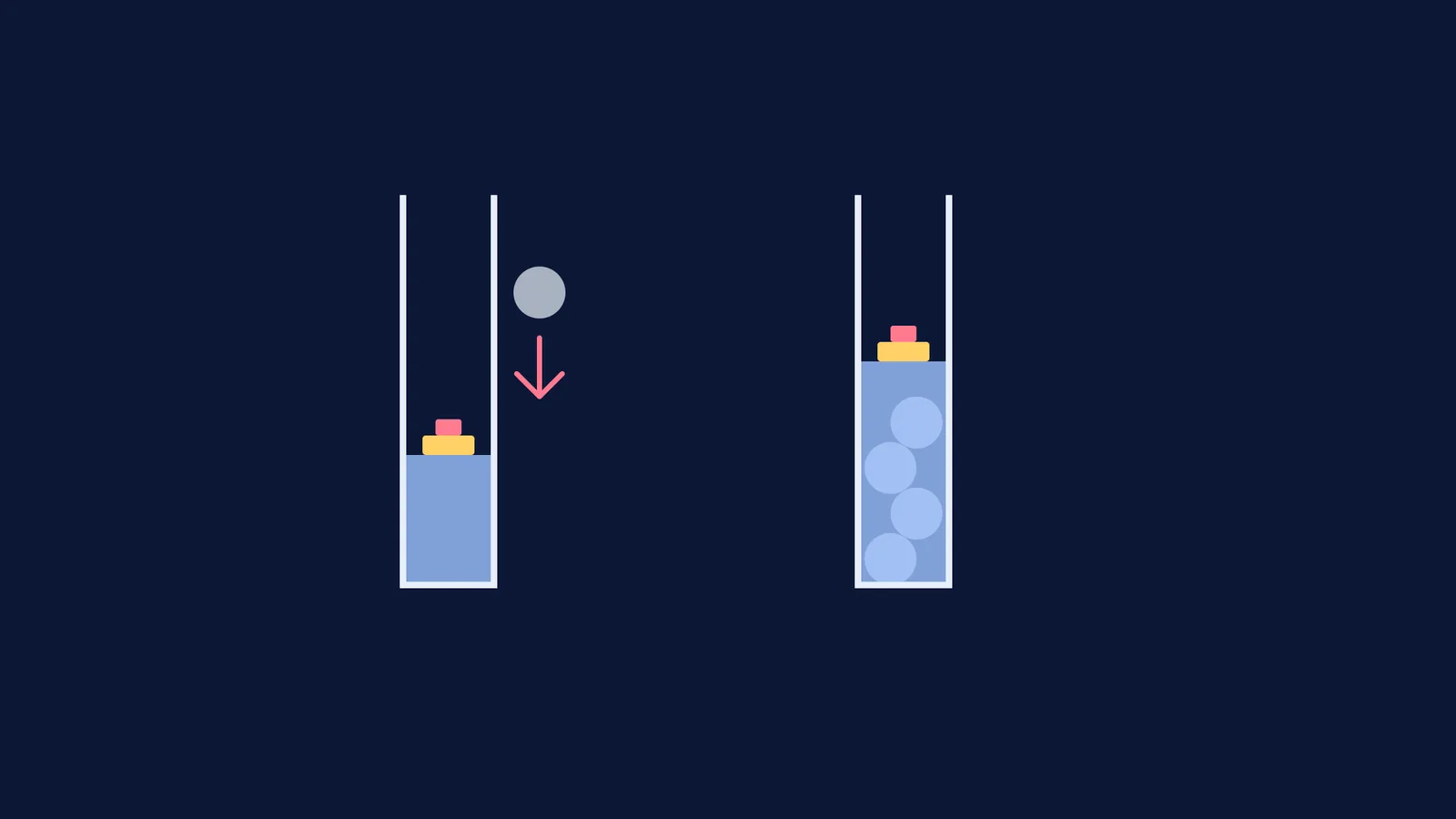
For centuries, Aesop's fable about a thirsty crow dropping pebbles into a pitcher to raise the water level was seen as a moral allegory. A 2014 study led by Sarah Jelbert on New Caledonian crows proved it is biologically plausible.
Researchers presented the birds with a floating meat reward in a tube, out of reach. To get it, the crows had to drop objects in to raise the level. They successfully chose water over sand (understanding that sand absorbs rather than displaces) and preferred solid objects over hollow ones. The study concluded that their understanding of volume displacement is comparable to that of a 5- to 7-year-old human child.
These birds do not just memorize a sequence of actions; they understand the causal principle behind them. When students learn physics, the goal is similarly to build a working mental model rather than just memorising formulas. For the ideas that are easier to see than to read, the Fermi Simulation Lab provides interactive simulations so you can test how changing one variable affects the whole system.
Can crows plan ahead?
Planning for the future—often called "mental time travel"—was once thought to be exclusive to humans and great apes. However, a November 2020 study by Boeckle et al. in the *Proceedings of the Royal Society B* showed that New Caledonian crows plan for specific future tool use.
The crows were shown an apparatus that required a specific tool, then taken to a different room. Five minutes later, they were offered a choice of tools alongside an immediate, low-value food reward (an apple). The crows consistently ignored the apple and chose the correct tool, holding onto it for another 10 minutes until they were allowed back to the apparatus to retrieve a high-value meat reward.
In a separate 2019 study, Romana Gruber found that crows can hold a sequence of three distinct behaviours in their mind before executing them, keeping the entire plan in their working memory. When you are stuck on a multi-step maths or physics problem, writing down the logic of your plan is crucial. If you need help with this process, the Fermi Problem Library has worked problems with a step-by-step solver that explains the reasoning rather than printing an answer.
How to study like a crow
We can draw a few practical lessons from how corvids approach their environment:
Focus on the mechanism, not the rule. Crows know that sand will not raise the water level. When you learn a new concept, ask yourself why it works, not just what the final equation is. Exploring these "why" questions is central to studying behaviour (as seen in Niko Tinbergen and the four questions of animal behaviour).
Delay gratification for a better result. The crows ignored the immediate apple to secure a tool that would win them meat later. In your own routine, put away the immediate distraction of a phone to secure the long-term reward of focused study.
Map the problem before you start. Before picking up a tool, crows look at the whole puzzle. Before you start calculating, pause and write down the three or four steps you will need to take to reach the final answer.


