

On this page
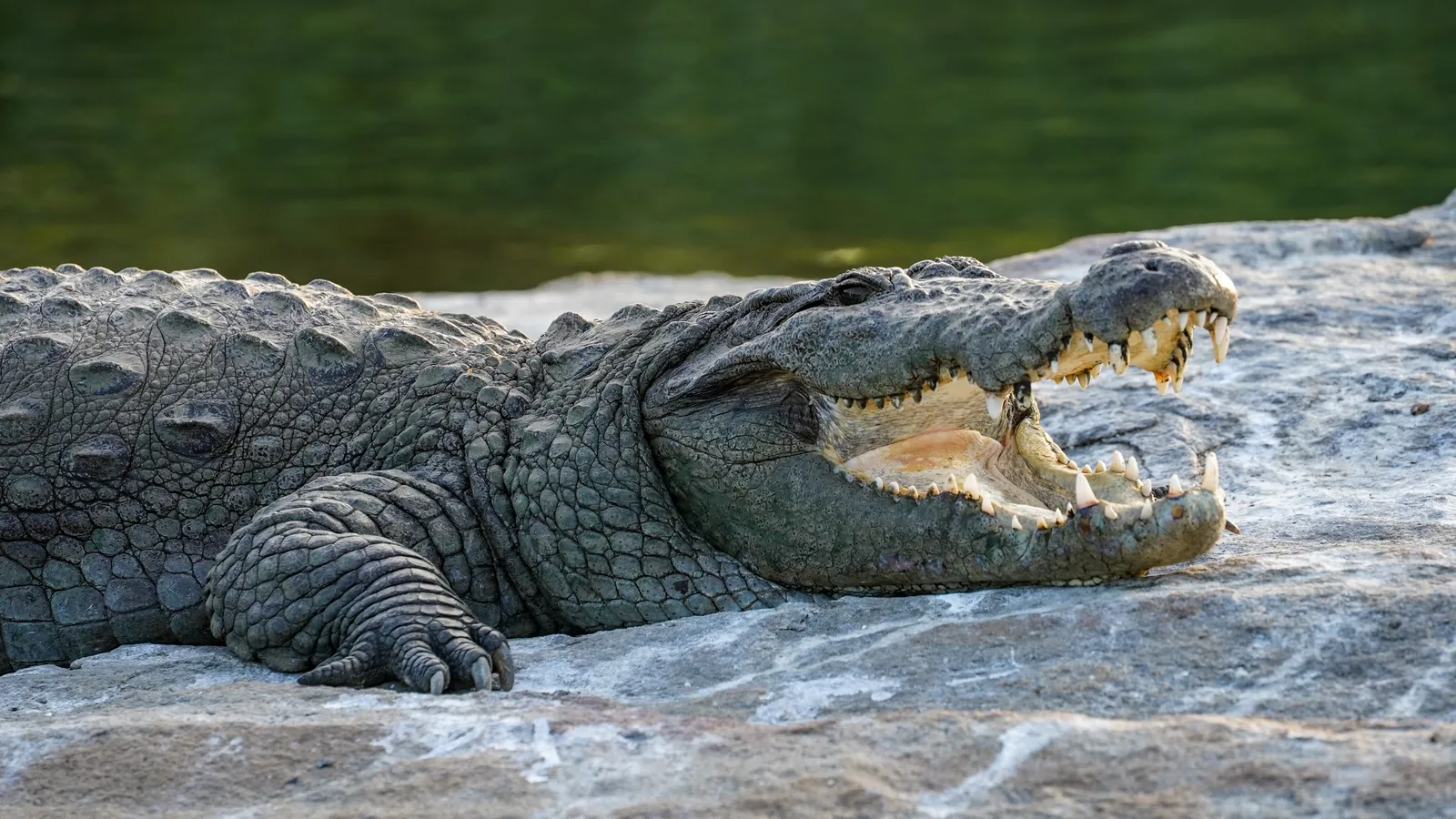
You may have seen it at a river in Karnataka or a lake in Gujarat: a mugger crocodile lying on a rock, perfectly still, jaws wide open. Scientists call it gaping, and the best-supported reason is heat control, with a few possible side jobs.
Why do crocodiles keep their mouth open while basking?
Crocodiles are ectotherms ("cold-blooded"): most of their body heat comes from their surroundings, not from burning food. Crocodilians have a preferred body temperature of about 30–33 °C, which they reach by shuttling between warm and cool places, as a 2021 field study of muggers in Gujarat summarises.
Gaping fine-tunes one body part: the head. The inside of the mouth is wet, and when air moves over it, evaporating water carries heat away, the same physics that cools you when sweat dries. A 2016 study of blood vessels in crocodilian heads by William Porter, Jayc Sedlmayr and Lawrence Witmer notes that gaping implies evaporative cooling inside the mouth, and maps rich networks of vessels in the nose, around the eyes and in the palate.
Does gaping really cool a crocodile down?
Partly. The classic test is a 1977 paper in Nature by James Spotila, Kenneth Terpin and Peter Dodson. In lab and field experiments on American alligators exposed to strong light at moderate air temperatures, gaping reduced the rate at which the head gained heat, and the effect grew with body size. But gaping had little effect on body temperature and did not lower the final temperature the head settled at.
So gaping is a brake, not an air conditioner: the head, with the brain and eyes, warms more slowly, but once the crocodile has had enough heat it still has to move into water or shade.
What did a study of mugger crocodiles in Gujarat find?
Urvi Dave and Nikunj Bhatt recorded 40 muggers at Pond Deva in Anand district from December 2018 to March 2019 (Reptiles & Amphibians, 2021). They found:
In December and January, crocodiles began basking at 8–9 am, when it was 14–20 °C, and basking peaked between 1 and 2 pm.
In February and March, large crocodiles usually lay fully on land in the morning, at around 25 °C, but between 2 and 4 pm, when temperatures peaked around 40 °C, most basked while gaping.
In March, air temperatures sometimes passed 45 °C, and crocodiles moved back into the water to cool down.
Smaller crocodiles spent more time in water, especially when larger ones were nearby; the researchers repeatedly saw large crocodiles chase smaller ones off the best basking spots.
The authors sum it up simply: as temperatures rose, crocodiles were more likely to be in the water and more likely to gape.
Why do crocodiles gape at night or in the rain?
Heat cannot explain all gaping. A 2020 study in the Journal of Herpetology by Noah Carl, Heather Stewart and Jenny Paul watched captive crocodilians of 24 species at a Florida zoo park, described unprovoked gaping as widespread across the group, and recorded a rare night-time case. The three muggers there were seen gaping at air temperatures as low as 6.1 °C. The authors concluded that gaping is a complex behaviour without one clear cause.
Other proposed explanations, from earlier work and the authors' own sightings:
Drying the mouth and killing parasites such as leeches.
A threat display towards other animals.
Showing dominance to other crocodiles.
Responding to changes in the weather.
How do cold-blooded reptiles balance sun and shade?
The same logic runs through every basking reptile, from the lizard warming up on your garden wall to the mugger. Heat comes in from sunlight and warm ground; it leaves through water, shade, wind and evaporation. The animal shifts position until the two balance near its preferred temperature. For the bigger picture, see our guide to cold-blooded and warm-blooded vertebrate classes and why a crocodile is a reptile, not an amphibian.
That balance has limits. A 2025 Current Biology study that tracked 203 estuarine crocodiles in Queensland, Australia found their average body temperature had risen over 15 years, and that their diving performance fell at body temperatures above 31–33 °C.
A five-minute gaping log you can try
At a sanctuary or lake with muggers, run a mini version of the Gujarat study:
Note the time and the air temperature from a weather app.
For each crocodile, record whether it is on land, partly in water or floating.
Record whether its mouth is open or closed, and whether its head is in sun or shade.
Repeat a few hours later, say at 9 am and 2 pm.
Compare: did more mouths open when it was hotter and heads were in the sun?
If gaping rose with heat and sun, your data fit the cooling idea. Gaping in shade or cool weather is the puzzle researchers are still working on. Watch from behind barriers and keep a safe distance.
If terms like ectotherm, evaporation or heat balance feel shaky, the Fermi Concept Library covers every concept in biology and physics, each with its own lesson and its place in the map.


