On this page
A lizard pressed flat against a sunny wall at 8 a.m. is not being lazy. It is warming its muscles so it can hunt. That one habit explains most of what "cold-blooded" means, and why a sparrow on the same wall does not need to do it.
What does cold-blooded actually mean?
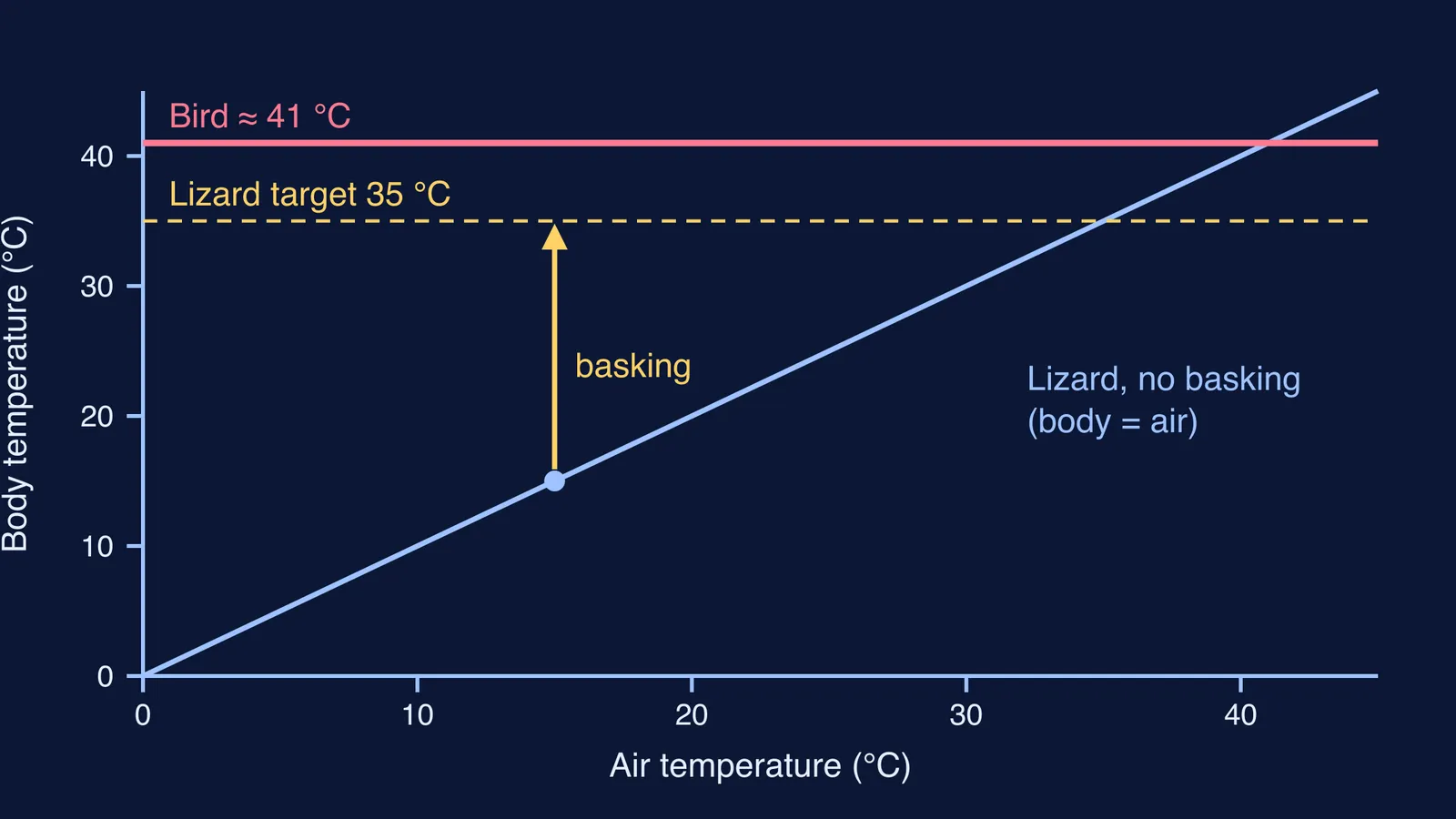
Biologists say ectotherm: an animal whose body heat comes mainly from its surroundings rather than from its own metabolism. Birds and mammals are endotherms, which make their own heat. The everyday term misleads, because an ectotherm is not necessarily cold. In the western fence lizard, sprint speed was highest at its preferred body temperature of 35 °C, according to Marsh and Bennett in the Journal of Experimental Biology. That is warm.
What a lizard cannot do is hold that temperature by burning food. It has to take heat from the sun, a warm rock or a sun-baked wall, and it loses that heat again when the air cools. So a lizard's body temperature follows its surroundings unless it moves.
Why do lizards bask in the sun before hunting?
Because muscles run on chemistry, and chemistry slows down in the cold. In the same Marsh and Bennett study, lizards at 35 °C sprinted at 3.23 metres per second, and warming them to 40 °C made no significant difference. Between 25 and 35 °C, speed changed only a little with temperature. Below 25 °C, speed became much more sensitive to temperature, and lizards at 10 °C were largely incapacitated. Comparing these runs with muscle measurements, the authors suggest that below about 23 °C stride frequency is limited by how fast the muscle can twitch.
A cold lizard is a slow lizard, which means missed insects and a better chance of being eaten. Basking fixes that.
Lizards are also precise about it. In a study of the lizard Psammodromus algirus in a Mediterranean evergreen forest,Díaz and Cabezas-Díaz found that the lizards' body temperatures stayed on average 0.7 °C from their preferred range, while the temperatures available around them were on average 8.3 °C off. Choosing between sunny and shady patches was important in the early-morning basking period, and in summer the lizards stayed active at midday by picking shade. Basking is not just lying in the sun; it is moving between sun and shade to hold a target temperature.
Worked example: how much speed does a cooler lizard lose?
Biologists describe temperature sensitivity with Q10: how many times faster a process runs when temperature rises by 10 °C. Marsh and Bennett measured a Q10 of 1.23 for running speed between 25 and 35 °C (study).
Top speed at 35 °C: 3.23 m/s.
Going down 10 °C divides speed by Q10: 3.23 ÷ 1.23 ≈ 2.63 m/s at 25 °C.
As a fraction: 2.63 ÷ 3.23 ≈ 0.81, so the lizard keeps about 81% of its top speed.
Now the trap. You cannot divide by 1.23 again to estimate speed at 15 °C, because the paper says temperature sensitivity rises sharply below 25 °C. A Q10 holds only over the range where it was measured.
For more calculations like this, the Fermi Problem Library has worked problems with a step-by-step solver that explains the reasoning rather than printing an answer.
How are birds different from lizards?
A bird makes its own heat and keeps it. A review of bird thermoregulation by Ruuskanen, Hsu and Nord, citing a survey by Prinzinger and colleagues, gives the average body temperature of birds at rest during their active phase as 41.02 °C. Birds keep it fairly stable across very different climates through physiological, structural and behavioural adjustments; birds that stay in temperate regions through winter can face air up to 80 °C colder than their bodies.
That costs fuel. Resting and maximal oxygen use in endotherms exceeds that of ectotherms by an average of five- to tenfold, according to Bennett and Ruben in Science.
So the trade is simple. A bird can feed at dawn on a cold day but must eat a lot. A lizard eats far less but has to wait for the sun. Related reads: why a bat is a mammal, not a bird, hibernation vs aestivation and why a lizard drops its tail and grows it back.
How do you write the difference in a biology exam?
A four-point comparison works for most "distinguish between" questions:
Source of heat: ectotherms such as lizards take it from their surroundings; endotherms such as birds produce it by metabolism.
Body temperature: a lizard's changes with its surroundings unless it moves between sun and shade; a bird's stays high and fairly steady.
Energy cost: endotherms use on average five to ten times more oxygen, at rest and at peak (Bennett and Ruben).
Behaviour: lizards bask before activity and seek shade when hot; birds can stay active in the cold.
Write "ectotherm" rather than "cold-blooded" in an answer, and give one example on each side. If ectotherm, endotherm and thermoregulation still blur together, the Fermi Concept Library gives every concept in biology its own lesson and shows its place in the map.