

On this page
When a predator grabs a lizard, the lizard often leaves its tail behind. The detached tail wriggles, distracting the predator while the lizard escapes. This dramatic escape trick, called autotomy, is followed by an even more impressive feat: growing the tail back. Here is how the biology of fracture planes and stem cells makes this possible, and why it is a key example when studying regeneration for school exams.
Why does a lizard drop its tail?
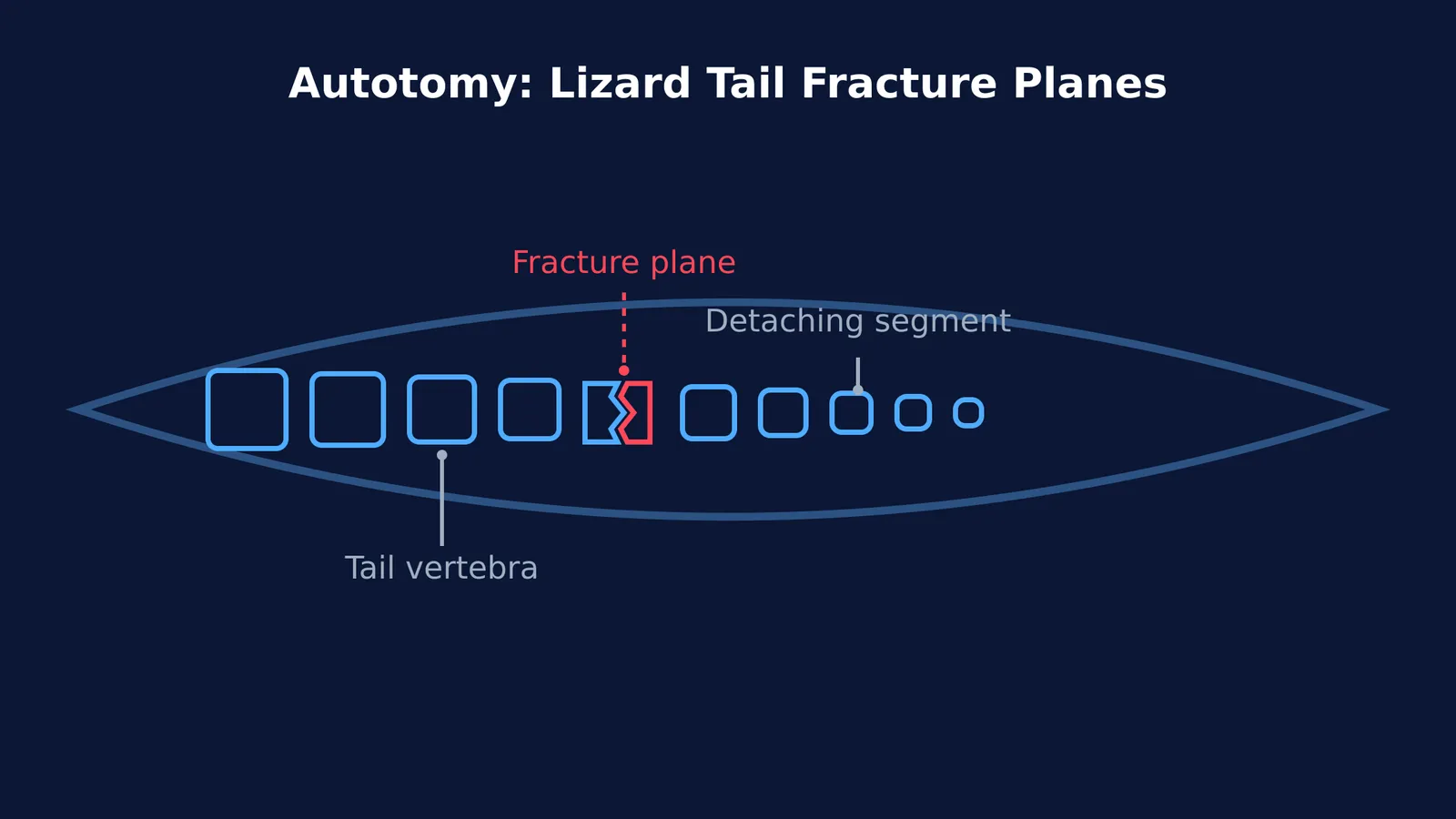
Lizards do not simply tear their tails off by accident; the process, known as autotomy, is an evolved defense mechanism built directly into their anatomy. The tail vertebrae contain specialized "fracture planes"—transverse zones of weakness where the bone and surrounding connective tissue are structurally designed to break under stress. When a predator strikes, the lizard's muscles contract violently at one of these specific planes, snapping the tail off cleanly.
The detached tail continues to wriggle on the ground, powered by independent nerve impulses, which distracts the predator long enough for the lizard to escape. Immediately after the drop, the lizard's blood vessels at the stump constrict rapidly to prevent excessive bleeding. The skin then heals over the wound in a scar-free manner, creating a clean slate for the regrowth process to begin.
How does a lizard grow its tail back?
Once the stump has healed, the biological engine of regeneration kicks into gear. A small mass of undifferentiated, rapidly dividing cells called a blastema forms at the site of the wound. This is the same structure that forms in amphibians like salamanders when they regrow limbs.
The cells in the blastema are sourced in two ways. First, local adult stem cells residing in the tissues near the stump are activated. Second, some mature cells undergo dedifferentiation, meaning they revert from their specialized state (like muscle or fat) back into a primitive, stem-like state. Over several weeks, this mass of cells multiplies and differentiates into new muscle, skin, and blood vessels.
If you are struggling to picture the cellular mechanisms behind these changes, the Fermi Simulation Lab offers interactive simulations for the ideas that are easier to see than to read.
Is the regenerated tail identical to the original?
While the new tail might look similar on the outside, its internal architecture is fundamentally different. A natural lizard tail contains a bony vertebral column that encloses a complex spinal cord. The regrown tail, however, is supported by a simple, unsegmented cartilaginous tube and contains only a simplified nerve cord.
For decades, scientists wondered why lizards could not regrow the intricate bone structure of their original tails. A 2021 study published in *Nature Communications* found the answer: the regenerating adult tail naturally secretes cartilage-inducing signals from all sides, forcing the entire structure to become cartilage instead of bone. By using CRISPR-Cas9 to gene-edit embryonic neural stem cells, making them unresponsive to these signals, and implanting them into adults, the researchers successfully induced lizards to regrow "perfect" tails. These engineered tails possessed proper dorsoventral patterning, with skeletal and nerve tissue on the top and cartilage on the bottom.
How does lizard regeneration differ from Planaria?
The concept of regeneration features prominently in the NCERT Class 10 Science syllabus, particularly in the chapter on how organisms reproduce. In simple multicellular organisms like *Planaria* (a flatworm) or *Hydra*, regeneration acts as a method of asexual reproduction. If a *Planaria* is cut into pieces, specialized cells in each piece rapidly proliferate and differentiate, eventually forming complete, independent flatworms.
Lizards, on the other hand, are complex animals with highly specialized and organized tissues. They cannot grow a whole new lizard from a severed tail. In higher animals, regeneration is strictly a repair mechanism rather than a reproductive one. A lizard can replace a lost appendage, much like humans can regenerate a top layer of skin or parts of the liver, but it cannot generate a completely new organism from the detached part.
When preparing for exams, keeping this distinction clear is crucial. Examiners frequently ask students to compare the regenerative capabilities of simple organisms with those of complex ones. For more examples of how organisms adapt and grow, you can review our guides on phototropism, geotropism and other tropic movements in Class 10 or explore stem modifications: tendrils, thorns, rhizomes and more.


