

On this page
When you study animal taxonomy, one of the most fundamental divides is how an animal manages its body heat. Biologists traditionally group the five main vertebrate classes into two categories: cold-blooded and warm-blooded.
However, "cold-blooded" does not mean their blood is actually cold or freezing. A snake basking on a hot rock in the midday sun can have a body temperature significantly higher than a human's. Instead, these terms describe *how* the animal gets and maintains its heat. This single physiological trait determines where an animal can live, how much it must eat, and how its internal organs, especially the heart, are built.
Which classes are poikilotherms (cold-blooded)?
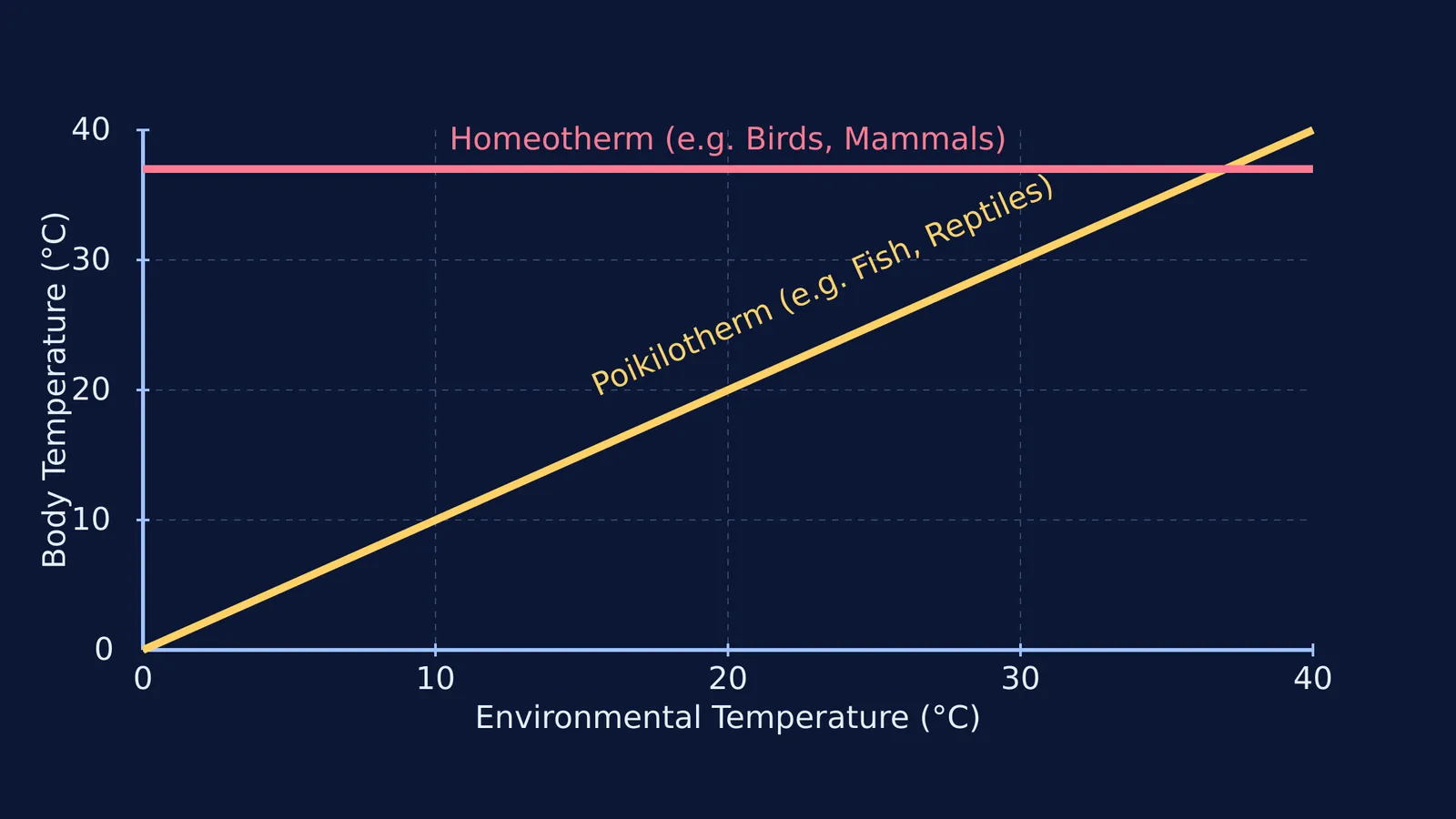
Animals that cannot generate their own internal heat are scientifically called poikilotherms (or ectotherms). Their body temperature is not fixed; rather, it fluctuates, rising and falling with the ambient temperature of their surroundings.
Three of the five vertebrate classes fall into this category:
Fish (including jawless, cartilaginous, and bony fishes)
Amphibians (such as frogs, salamanders, and toads)
Reptiles (including snakes, lizards, turtles, and crocodiles)
Because they rely entirely on external sources like the sun and the warm air or water to heat up their bodies, poikilotherms are highly dependent on their habitat. In cold weather, their chemical reactions and overall metabolism slow down dramatically, making them sluggish and vulnerable to predators. This is exactly why you rarely find reptiles in the freezing Arctic, and why frogs often hibernate buried deep in mud during the winter months.
However, this reliance on the environment is an incredibly energy-efficient survival strategy. Because they do not burn precious calories just to keep a baseline temperature, cold-blooded animals can go for days, weeks, or sometimes even months between meals.
Which classes are homeotherms (warm-blooded)?
Animals that maintain a constant, warm internal body temperature, regardless of whether there is a blizzard or a heatwave outside, are called homeotherms (or endotherms). They act as their own biological furnaces, burning the food they eat to generate heat from within.
Only two of the vertebrate classes have evolved to be warm-blooded:
Birds (Aves)
Mammals (Mammalia)
This internal heating system provides an incredible evolutionary advantage. It allows birds and mammals to remain highly active at night when temperatures drop, and to thrive in extreme global environments, from polar ice caps to freezing high-altitude mountain ranges. But this freedom comes with a massive, constant energy bill. According to research on vertebrate metabolism, endotherms require a resting metabolic rate approximately five to ten times higher than that of ectotherms of the exact same size (Bennett & Ruben, 1979). To fuel this furnace, birds and mammals must forage and eat constantly. While a snake might eat a large meal once a month, a small bird might actually starve if it goes a single cold day without finding food.
How does temperature link to the heart?
The intense need for metabolic energy directly drives the evolution of an animal's anatomy. Because warm-blooded animals burn so much fuel at all times, they need a highly efficient circulatory system to constantly deliver fresh oxygen to their cells.
This is why we see a clear progression in the vertebrate heart as we move through the classes. Fish, with their lower metabolic needs, have a simple two-chambered heart that pumps blood in a single circuit. Amphibians and most reptiles possess a three-chambered heart, which allows for some mixing of oxygen-rich and oxygen-poor blood. However, birds and mammals have evolved a fully divided four-chambered heart. This perfect anatomical separation ensures that only highly oxygenated blood is sent out to the body, fully supporting their demanding metabolic rates.
If you have concept gaps about how these different heart structures evolved, the Fermi Concept Library has a lesson for every concept in biology and its place in the map.
How to remember this for exams?
If you are preparing for a biology exam, you can use a simple memory trick to quickly recall the vertebrate thermoregulation groups during a stressful test:
FAR (Fish, Amphibians, Reptiles) = Cold-blooded. They are "far" from being warm on their own.
BM (Birds, Mammals) = Warm-blooded. Think of them having a "basic metabolism" that constantly keeps them warm.
Understanding these broad evolutionary patterns makes the rest of animal physiology much easier to grasp. For instance, knowing an animal's metabolic rate and water requirement helps explain its waste products, as seen when comparing ammonotelic, ureotelic and uricotelic animals. It also ties directly into the speed at which their bodies synthesize complex molecules, relying heavily on the six enzyme classes to keep their high-energy reactions running at an optimal 37 °C. Even the incredible complexity and computing power of the parts of the human brain is only possible because of the constant, reliable temperature our mammalian bodies provide.


