

On this page
Cortisol is a steroid hormone made by the adrenal glands, and the amount in your blood changes a lot over each day. That swing explains why a "stress hormone" is highest when you have barely got out of bed.
What does the 24-hour cortisol curve look like?
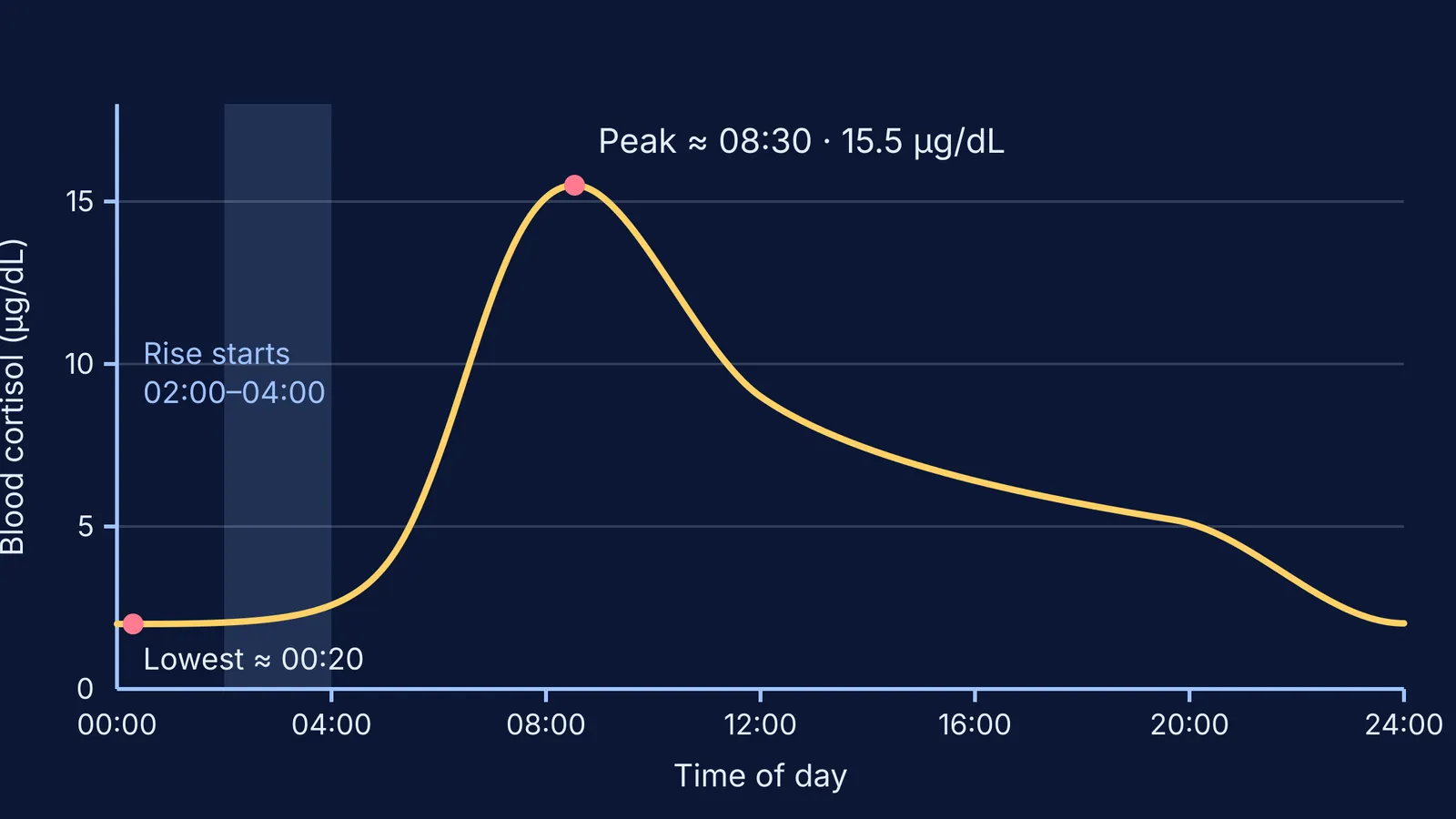
The clearest picture comes from a 2009 study in the Journal of Clinical Endocrinology and Metabolism, in which Debono and colleagues took blood samples every 20 minutes for 24 hours from 33 healthy volunteers aged 17 to 57. They found that:
cortisol began to climb between 02:00 and 04:00, while people were still asleep
it peaked at about 08:32, at an average of 15.5 µg/dL
it then fell through the rest of the day, with two smaller bumps around mealtimes
it reached its lowest point, under 2 µg/dL, at about 00:18
Here is a worked example. Divide the peak by the low point: 15.5 ÷ 2 is about 7.8. So in that study, cortisol in the morning was more than seven times its midnight level.
Why is cortisol highest in the morning?
The short answer is that your brain's master clock schedules it. A 2017 review in Endocrine Reviews by Oster and colleagues describes the cortisol rhythm as having "a daily peak around the time of the habitual sleep-wake transition and minimal levels in the evening and early part of the night." The same review says this rhythm partly reflects a master pacemaker, the suprachiasmatic nucleus (SCN) in the hypothalamus. It adds that the adrenal glands have their own clock, built from the same molecular machinery.
Why would the body want a cortisol surge at dawn? The review lists glucocorticoids such as cortisol as modulators of energy metabolism, stress responses, immunity and cognition, which are all things you need once the active part of the day begins. The rhythm also works as a timing signal. Oster's review calls it "a major internal synchronizer" of the body's clocks. A 2010 review by Chan and Debono notes the suggestion that cortisol acts as a messenger between the central clock and the clocks in other organs.
Cortisol also holds back the immune system; we explain how in how cortisol suppresses the immune system.
What does waking up add to the morning peak?
On top of the rise driven by the clock, there is a second effect tied to waking itself. Researchers call it the cortisol awakening response. Expert consensus guidelines published in Psychoneuroendocrinology in 2016 define it as "the marked increase in cortisol secretion over the first 30-45 min after morning awakening."
How big is it? Pooling four studies with 509 adults, Wüst and colleagues (2000) found that cortisol in saliva rose by about 50% on average within 30 minutes of waking. They also reported that age, smoking and using an alarm clock did not substantially change the response.
Light matters too. In a small 1999 experiment, Scheer and Buijs had 14 healthy men spend an hour after waking either in darkness or in 800 lux of light. Light raised cortisol by roughly a further 35%, but the same light in the late evening had no effect. Light only moves cortisol at certain times of day, and that timing is also why jet lag is harder when you fly east.
How can a student plan mornings around the cortisol rhythm?
You cannot change this rhythm, but you can stop working against it. Here is a five-step plan of everyday habits, not treatment.
Keep a steady wake time. The peak lines up with your usual sleep-wake transition, so a wake time that jumps by three hours between school days and Sundays keeps moving the target. Teenage body clocks already run late, as we explain in why teenagers feel sleepy later at night.
Get daylight in the first hour. Open the curtains, eat breakfast near a window or step outside.
Allow 30-45 minutes before hard work. The awakening response plays out over that window. Use it to wash, eat breakfast and do light revision rather than starting a mock test cold.
Keep late nights for sleep. Cortisol stays near its lowest from late evening into the early hours, the part of the curve that belongs to sleep, so plan hard study for earlier in the day.
Rehearse exam timing. If your exam is in a morning slot, sit practice papers at the same clock time for a couple of weeks, waking as you will on the day.
If the hormone chain from hypothalamus to pituitary to adrenal cortex is still hazy, the Fermi Concept Library covers every concept in biology, each with its own lesson and its place in the map. For your first study block of the day, Fermi's AI tutor can work out what you already know and build a plan for the session, so you start with a clear next step instead of a blank page.
Tomorrow, try steps 1 and 2: wake at your usual time and get some daylight within the hour.


