

On this page
You land at 2 pm local time and your body insists it is the middle of the night. That mismatch has a clear biological cause, and once you understand it you can shorten it.
What causes jet lag?
The CDC Yellow Book chapter on jet lag defines it as a sleep disorder caused by rapid travel across time zones, which leaves your internal biological clock temporarily out of step with local time. Symptoms include poor sleep, daytime sleepiness, slower thinking and stomach upsets.
Your body clock is a roughly 24-hour rhythm that times sleepiness, body temperature and hormones such as melatonin, which the CDC notes is released by the pineal gland during darkness. The clock cannot jump to a new time zone; it shifts gradually, and light is its main cue. The CDC says light helps synchronise the internal clock to the environment even when you are not travelling.
Why is flying east harder than flying west?
The human body clock runs a little long: left to itself, its cycle is slightly more than 24 hours. A 1999 study in Science by Charles Czeisler and colleagues found that the intrinsic period of the human circadian pacemaker averages 24.18 hours, in both young and older adults, when measured under tightly controlled lighting.
That extra fraction of an hour matters. Flying west makes your day longer, which suits a clock that already wants to run late. Flying east makes your day shorter, so the clock has to move earlier, against its natural tilt.
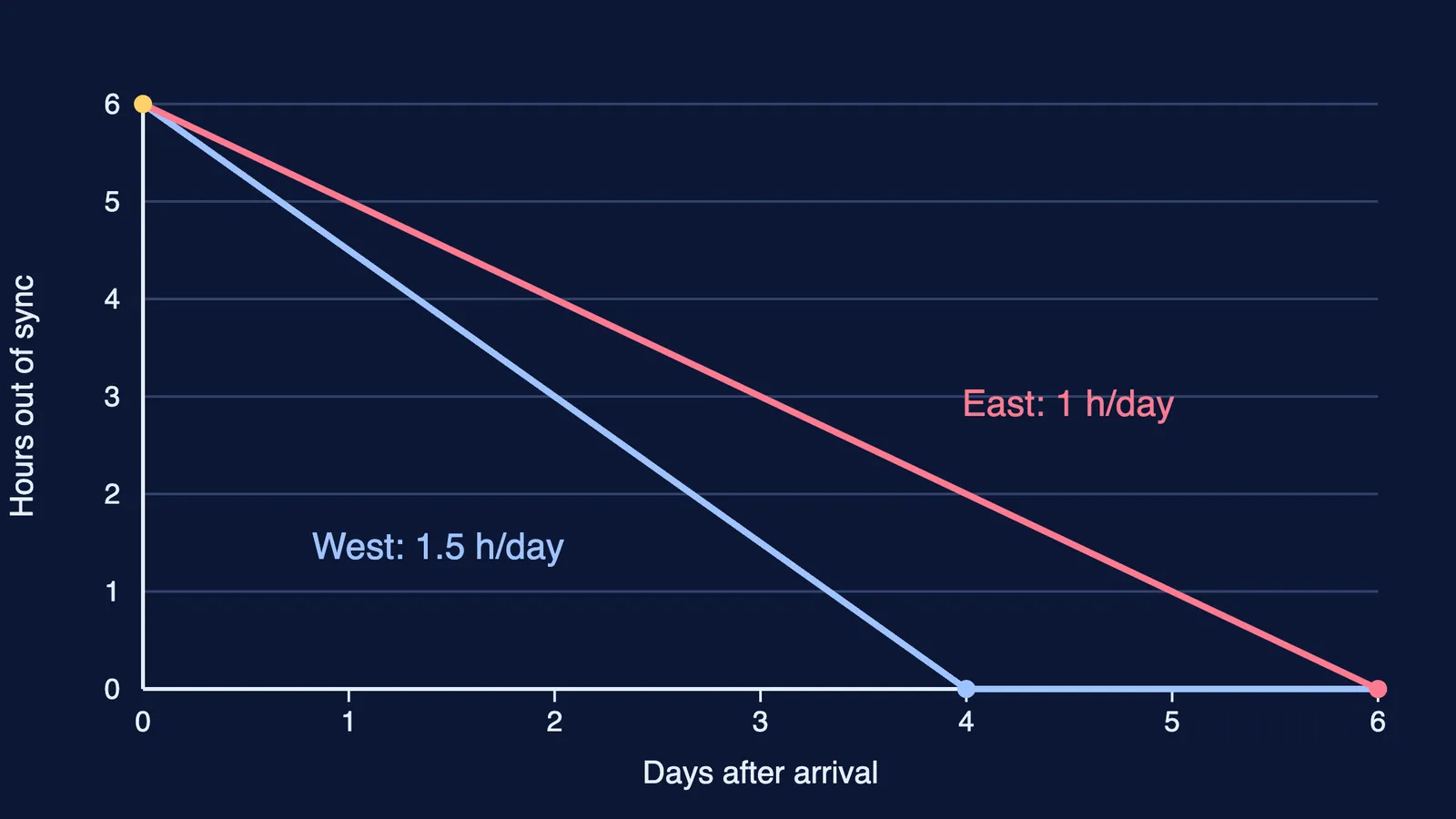
The numbers show the gap. According to the CDC Yellow Book, people adapt at an average of 1.5 hours per day after westward travel and 1 hour per day after eastward travel, because it is easier to delay the circadian rhythm than to advance it.
For many Indian students the hard direction is the trip home: returning from Europe or the Middle East to India means flying east.
How does light reset your body clock?
The timing of light decides which way the clock moves. In a 2003 study in The Journal of Physiology, Sat Bir Khalsa and colleagues gave 21 healthy volunteers a long bright-light session at different points in their body clock's cycle and found that light before the core body temperature minimum delayed the clock, while light after it advanced the clock.
The CDC chapter places the body clock's low point roughly 2 to 4 hours before your usual wake-up time: bright morning light after it shifts the clock earlier, and evening light generally shifts it later. In practice:
After flying east, seek bright morning light at your destination and avoid bright light late in the evening.
After flying west, avoid bright early-morning light (sunglasses help) and get daylight in the afternoon and evening.
The best timing depends on your direction and how many time zones you cross, so the CDC suggests a jet lag calculator for a plan fitted to your trip.
Some travellers use melatonin tablets to nudge the clock, but the CDC notes there is limited data on how melatonin interacts with other medicines. A teenager should ask a doctor before taking it.
How do you get over jet lag faster?
Here is a plan for an eastward trip, such as flying home to India before exams, built from the CDC Yellow Book's travel advice.
Two to three days before you fly, go to bed and wake up about 1 hour earlier each day. The CDC says this may cut the time you need to adjust.
On the flight, switch your watch and meals to destination time, and go easy on caffeine and alcohol so you can sleep.
On arrival, get outside in daylight. If you are sleepy in the day, keep naps short: the CDC suggests 20 to 30 minutes, since longer naps can spoil night sleep.
For the first few days, put hard thinking (a mock test, a tough chapter) in your late morning and keep evenings dim and calm.
At the CDC's eastward average, expect roughly one day of recovery per hour of time difference, and plan revision around it.
Sleep also affects what you remember, so a jet-lagged week before exams costs more than tiredness; see how sleep after studying helps memory consolidation. Evening light matters at home too, one reason families debate whether a teenager should keep the phone in the bedroom at night.
If a trip has scrambled your revision, Fermi's AI tutor can work out what you already know and build a plan for the session, so you pick up where you left off.


