

On this page
Halfway through a lesson with the door and windows shut, the room feels heavy. You are not imagining it, and you can estimate why with one research table and Class 11 arithmetic.
Why does a closed classroom feel stuffy?
Every breath out adds carbon dioxide, water vapour, heat and body odours, which researchers call bioeffluents. Carbon dioxide (CO2) is the easiest to measure, so it marks them all.
At classroom levels, CO2 alone does not seem to be the problem. In a 2017 chamber study in Indoor Air, 25 people given pure added CO2, up to 3,000 ppm, showed no significant effects on perceived air quality, symptoms or test performance. When CO2 reached 3,000 ppm because their own breath was building up, bioeffluents included, they rated the air worse and reported more headache, fatigue, sleepiness and difficulty thinking clearly.
The UK Department for Education's ventilation guidance for schools says it plainly: "Poorly ventilated spaces can often feel stuffy and may have unpleasant odours." It is not oxygen running out; see how much oxygen is left in exhaled air.
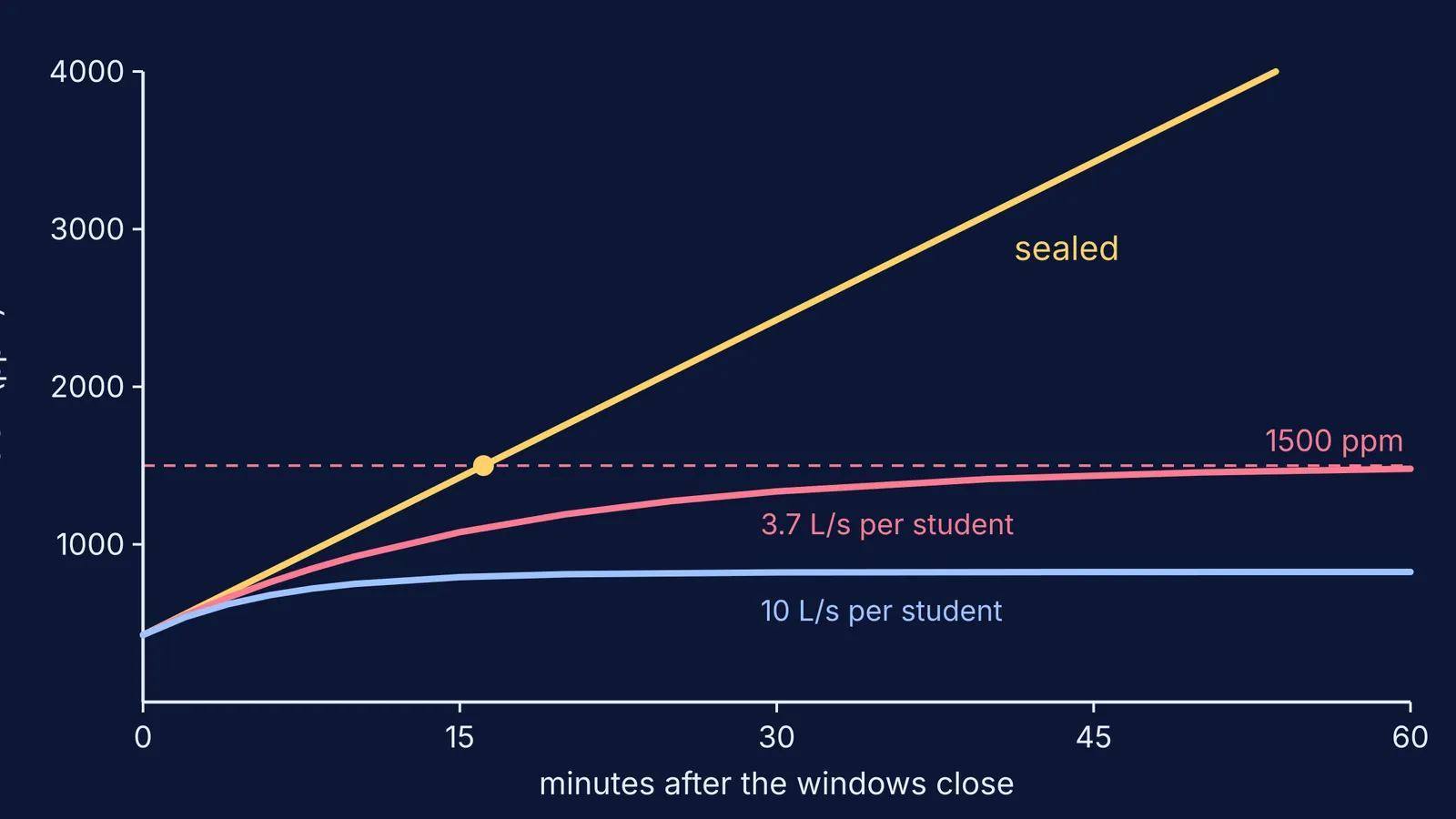
How fast do 40 students raise CO2 in a closed room?
A 2017 paper by A. Persily of the US National Institute of Standards and Technology and L. de Jonge gives a table of CO2 generation rates by age and activity. At 1.2 met, roughly sitting quietly, boys aged 11 to 15 breathe out 0.0041 litres of CO2 per second and girls 0.0035 L/s; at 16 to 20 the figures are 0.0045 and 0.0036 L/s. We round to 0.004 L/s per student.
The estimate:
Room: 8 m by 6 m with a 3 m ceiling, so 144 m³, or 144,000 litres.
Outdoor air: about 425 ppm CO2; NOAA's global monthly mean for August 2026 was 424.68 ppm.
CO2 added: 40 × 0.004 L/s = 0.16 L/s, or 9.6 litres a minute.
Rise per minute: 9.6 ÷ 144,000 ≈ 0.0000667, about 67 ppm.
Time to 800 ppm: about 6 minutes. Time to 1,500 ppm: about 16 minutes.
End of a 40-minute period: about 3,100 ppm.
If step 4 feels shaky, see calculating ppm and converting it to percent, or count the same gas per person in how many moles of CO2 you exhale in a day.
Real rooms leak, so measured readings climb more slowly. The point is the scale: a full, shut room is minutes, not hours, from poor air.
What do ventilation guidelines say about classroom CO2?
The UK school guidance uses three bands: under 800 ppm is good ventilation, 800 to 1,500 ppm is adequate, and over 1,500 ppm is poor.
The WHO's 2021 roadmap on indoor ventilation, written for COVID-19, sets a minimum of 10 litres of outdoor air per second per person for non-residential settings, which include schools.
Persily and de Jonge give the steady-state link: indoor CO2 = outdoor CO2 + (CO2 per person ÷ fresh air per person). With 0.004 and 10 L/s, the excess is 400 ppm, so the room settles near 825 ppm. Staying under 1,500 ppm needs at least 3.7 L/s per student. For 40 students, the WHO figure means 400 litres a second: about ten room volumes an hour.
Does it matter for learning? A 2020 review in Building and Environment by Pawel Wargocki and colleagues pooled classroom studies and predicted that cutting CO2 from 2,100 ppm to 900 ppm would make tests and school tasks 12% faster, with 2% fewer errors. These are pooled predictions, not a promise for one class.
How do you know when to open the windows?
This check uses the UK school guidance and the WHO roadmap.
Measure the room: length × width × height in metres.
Apply the 4.5 rule. If the answer is shorter than your period, a shut room will not last.
With a CO2 monitor: under 800 ppm, fine; 800 to 1,500 ppm, open windows a little more; consistently above 1,500 ppm, ask the school for a fix.
No monitor? Step out for two minutes and walk back in. If it smells stale, it needs air.
Open windows on opposite walls; the WHO prefers cross ventilation to single-sided. Partly opening higher windows reduces draughts.
Air the room between lessons: the UK guidance suggests windows open 10 minutes an hour during breaks.
Two Indian realities matter. Where outdoor air pollution is high, the WHO roadmap notes that filtering air may suit better than more ventilation, so follow your school's smog-day advice. And mosquito screens may reduce natural ventilation significantly, so screened windows need to open wider or longer.
For more rate problems like this, the Fermi Problem Library has worked problems with a step-by-step solver that explains the reasoning rather than printing an answer.
Next time the room feels heavy, measure it, divide, and open a window before the 16 minutes are up.


