

On this page
Every breath you let out carries carbon dioxide made by your cells. Turning a day's worth into moles and litres is one of the cleanest mole-concept problems in Class 11 chemistry. Here it is with real numbers.
Where does the 1 kg a day figure come from?
A well-documented figure comes from spacecraft design, where engineers must remove the CO2 a crew breathes out. NASA's Life Support Baseline Values and Assumptions Document (Anderson, Ewert and Keener, January 2018) lists, in its Table 4-1, a nominal value of 1.037 kg of carbon dioxide generated per crew member per day.
The same table gives 0.818 kg of oxygen consumed per crew member per day, and says the values were calculated from metabolic rates with a respiratory quotient assumed to be 0.92.
The figure is an average, not a constant. The same NASA table gives a lower rate of 0.622 kg per day during sleep and an upper rate of 7.178 kg per day at 75 percent of maximal oxygen uptake, a hard-exercise rate rather than a realistic daily total. So "about 1 kg" is a fair round number; your own total depends on your size and activity.
How many moles of CO2 is 1 kg?
The molar mass of carbon dioxide is 44.0095 g/mol, according to the NIST Chemistry WebBook.
Convert to grams: 1 kg = 1000 g.
Divide by molar mass: n = 1000 g ÷ 44.0095 g/mol = 22.72 mol.
For NASA's exact figure: n = 1037 g ÷ 44.0095 g/mol = 23.56 mol.
So a person exhales roughly 23 moles of CO2 a day. To count molecules, multiply by the Avogadro constant, which is exactly 6.02214076 × 10^23 per mole according to NIST's CODATA values. That gives 22.72 × 6.022 × 10^23 ≈ 1.37 × 10^25 molecules of CO2 from 1 kg.
How many litres of CO2 is that at room temperature?
Treat CO2 as an ideal gas, the standard school approximation, and use V = nRT/p. The molar gas constant R is 8.314462618 J per mol per K (NIST), and one standard atmosphere is exactly 101325 Pa (NIST).
Take room conditions as 25 °C (298.15 K) and 1 atm. The volume of one mole is then:
Vm = (8.314462618 × 298.15) ÷ 101325 = 0.024465 m³ = 24.47 L per mol.
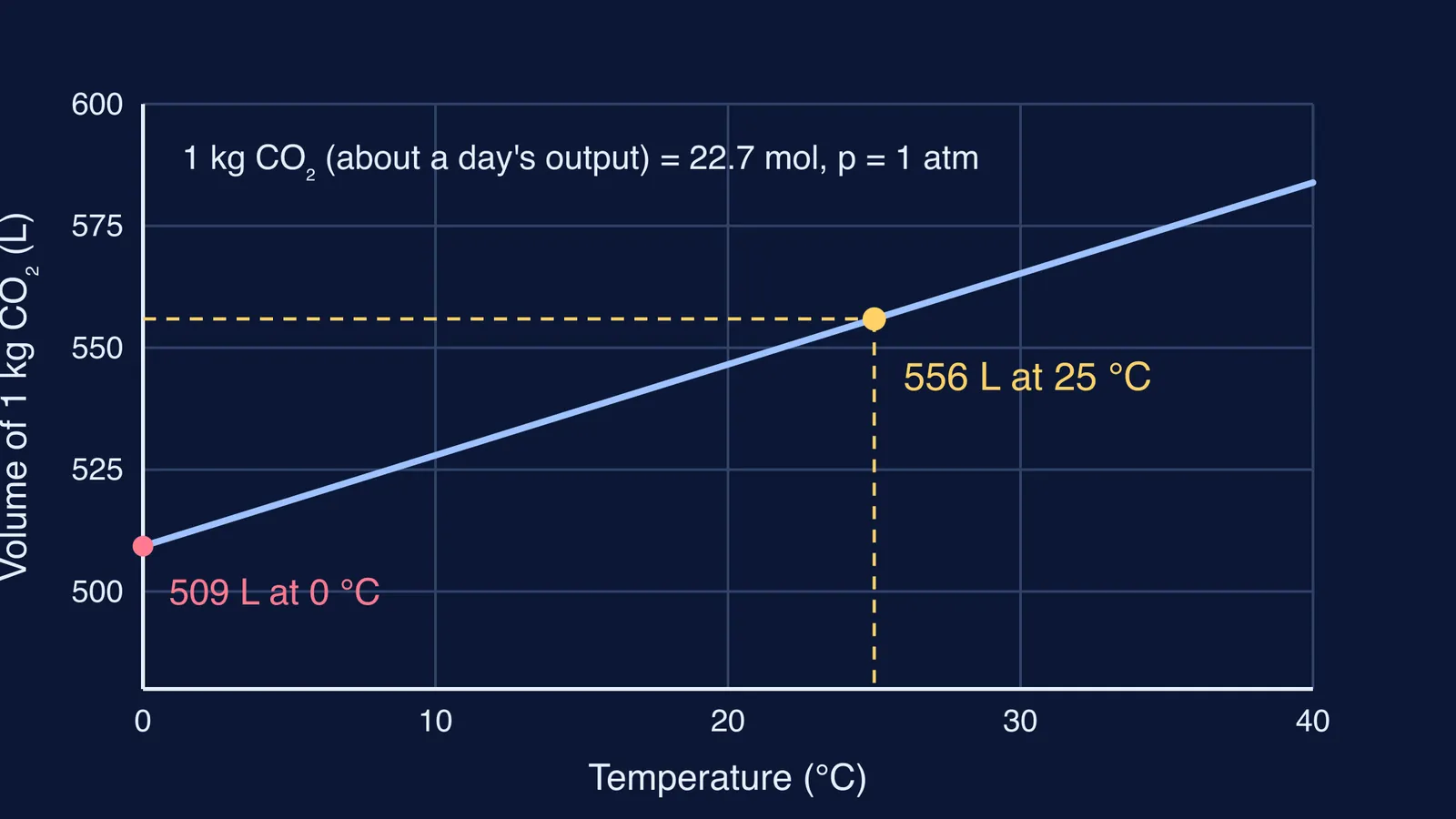
Now multiply: 22.72 mol × 24.47 L/mol ≈ 556 L for 1 kg. With NASA's 1.037 kg the answer is about 576 L.
If your textbook question uses 0 °C (273.15 K) and 1 atm instead, the same formula gives 22.41 L per mol, and 1 kg of CO2 takes up about 509 L. Only the volume changes with conditions. If you are unsure which value of R fits your units, our guide on choosing the right value of the gas constant R walks through it.
Does the answer make sense?
Check the result from another direction, using the NASA baseline and the NIST molar mass.
Per hour: 22.72 mol ÷ 24 ≈ 0.95 mol, or about 23 L of CO2 at room conditions.
Per minute: 556 L ÷ 1440 ≈ 0.39 L, a little under half a litre.
As a shape: 556 L is 0.556 m³, a cube about 82 cm on each side, or about 278 two-litre bottles.
The neatest check uses oxygen. NASA's 0.818 kg of oxygen divided by the molar mass of O2, 31.9988 g/mol (NIST Chemistry WebBook), is 25.56 mol of O2 a day. Then 23.56 mol of CO2 ÷ 25.56 mol of O2 ≈ 0.92, matching the respiratory quotient NASA assumed. The respiratory quotient is the ratio of CO2 produced to O2 used. For glucose alone, C6H12O6 + 6O2 → 6CO2 + 6H2O gives 6 ÷ 6 = 1, so a value a little below 1 means the assumed fuel mix includes more than just glucose.
How do you set out a question like this in an exam?
Seven steps work for any mass-to-volume problem:
Write the given quantity with its unit.
Convert the mass to grams.
Divide by the molar mass to get moles.
Read the temperature and pressure from the question; convert to kelvin and pascals.
Pick R in units that match.
Multiply moles by the molar volume, or use V = nRT/p directly.
Round sensibly and run one sanity check.
The same chain runs in reverse when a reaction produces a gas, as in our worked example on the volume of gas produced at STP from the mass of a reactant. For a related calculation that starts from fuel instead of food, see how much CO2 burning 1 kg of methane produces.
If you keep getting the setup wrong rather than the arithmetic, try more problems in the Fermi Problem Library, which has worked problems with a step-by-step solver that explains the reasoning rather than printing an answer. If the mole idea itself still feels shaky, the Fermi Concept Library gives each concept in chemistry its own lesson.
Next time you see your breath on a cold morning, remember: about a mole of CO2 leaves you every hour.


