

On this page
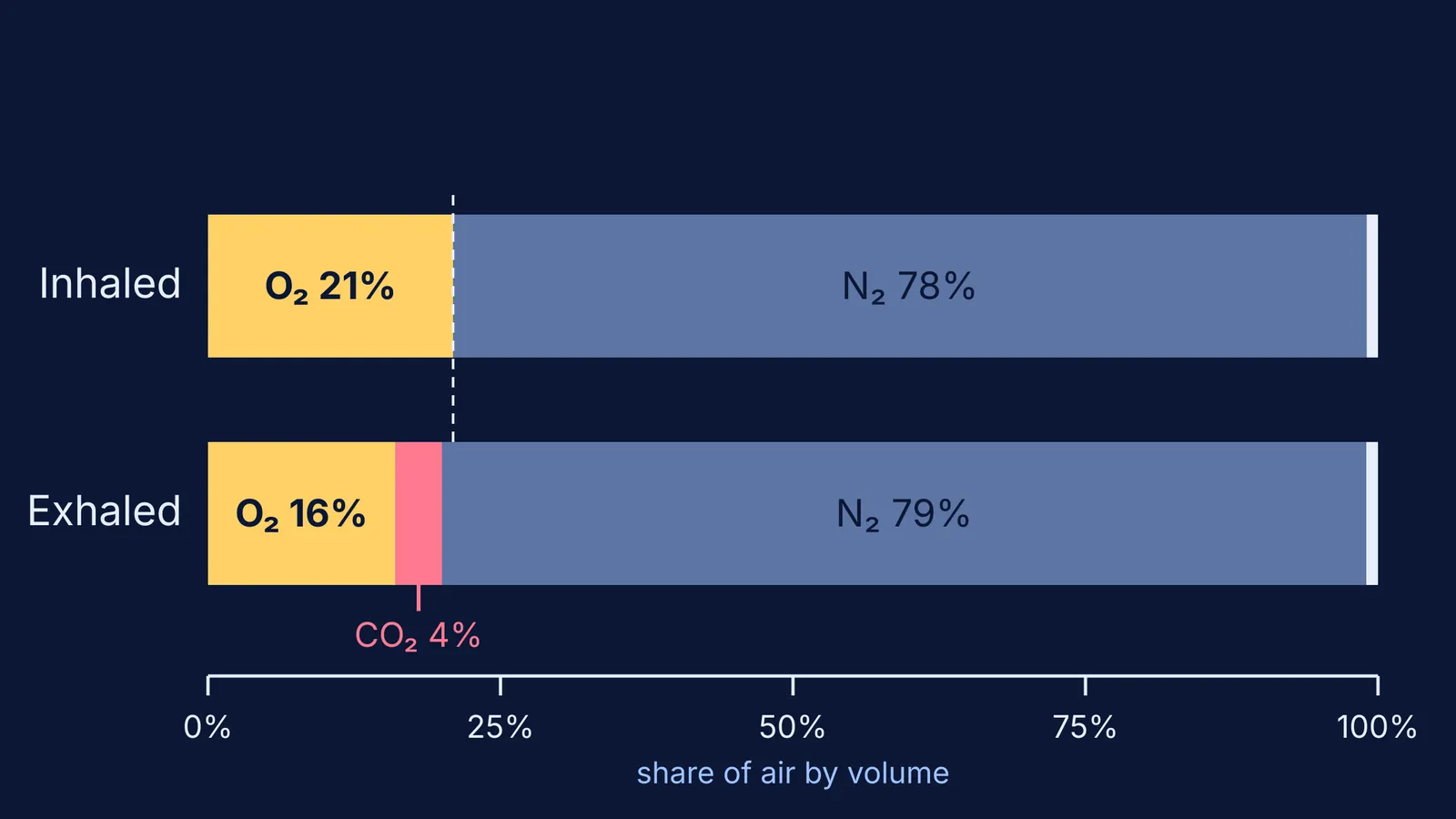
We breathe in oxygen and breathe out carbon dioxide: true in direction, misleading in amount. Your breath out is still mostly the air you breathed in, with a little less oxygen and a little more carbon dioxide. That leftover oxygen is why one person's breath can keep another alive.
How much oxygen is in inhaled and exhaled air?
Dry air at Earth's surface is 78.08% nitrogen and 20.95% oxygen by volume, with about 420 parts per million of carbon dioxide, according to the NASA Earth fact sheet. That 420 ppm is about 0.04%.
Exhaled breath is roughly 79% nitrogen, 16% oxygen and 4% carbon dioxide, with about 1% other substances, as summarised in a 2025 survey of exhaled breath analysis. These are rounded figures.
So the change is about 5 percentage points of oxygen down and about 4 points of carbon dioxide up. The body does not use nitrogen, so it passes through the lungs without being taken up.
Why does exhaled air still have about 16 percent oxygen?
Three things leave oxygen in your breath.
Some air never reaches the alveoli. The anatomical dead space is the volume of the conducting airways, from the nose and mouth down to the terminal bronchioles. In adults it is usually about 150 mL, roughly a third of a resting breath of 450-500 mL, as described in this overview of dead space). That air leaves with the same oxygen it came in with. Our explainer on anatomical dead space and why deep breaths beat shallow ones works through this in detail.
Alveolar air is never fully emptied of oxygen. The lungs never empty completely, so fresh air mixes with stale air, and alveolar oxygen settles below that of outside air, as we explain in why alveolar oxygen is lower than air.
Blood only takes what it can carry. Gas moves from the alveoli into the blood by diffusion, down a difference in partial pressure. Once the blood leaving the lungs has picked up its oxygen, the rest of the oxygen in the alveoli simply goes back out.
How much oxygen does one breath give you? Take about 21% oxygen in (NASA), 16% out (breath survey) and a resting breath of about 500 mL.
Oxygen breathed in: 0.21 x 500 mL = 105 mL.
Oxygen breathed out: 0.16 x 500 mL = 80 mL.
Oxygen kept by the body: about 25 mL.
Share kept: 25 / 105 = about 24%, so roughly three quarters of the oxygen you inhale goes straight back out.
It is an estimate, since breaths in and out differ slightly in volume, but a breath out is still rich in oxygen.
Is exhaled air enough for rescue breaths?
Yes, for a short time. The Resuscitation Council UK's Advanced Life Support chapter on airway management says that expired air ventilation (rescue breathing) is effective, but the rescuer's expired oxygen concentration is only 16-17%, so it must be replaced as soon as possible by ventilation with oxygen-enriched air.
The figure has also been measured in simulated CPR. In a 2007 manikin study in Resuscitation, Eisenburger and colleagues analysed the expired air of 14 rescuers and found end-tidal oxygen of 15.9% at a 15:2 compression-to-ventilation ratio, rising to 16.3% at 30:2 and 17.0% at 100:10 (abstract on PubMed, DOI). The idea is old: in 1954, James Elam and colleagues reported in the New England Journal of Medicine on paralysed patients ventilated by an operator's expired air.
What does this mean if you ever need to help someone?
The Resuscitation Council UK's 2025 adult basic life support guidelines say:
If you have been trained to provide rescue breaths, alternate 30 chest compressions with 2 rescue breaths.
If you are not trained to provide rescue breaths, perform continuous chest compressions without interruptions.
When providing rescue breaths, deliver just enough air to make the chest start to rise, and avoid excessive ventilation.
This is general information, not training. In an emergency, call your local emergency number and follow the call handler's instructions; to be ready, take a hands-on first aid course from a recognised organisation.
How do you write this in an exam answer?
A four-line answer covers the key points (figures from NASA, the breath survey and the Resuscitation Council UK):
Inhaled air: about 21% oxygen, about 0.04% carbon dioxide.
Exhaled air: about 16% oxygen, about 4% carbon dioxide; nitrogen is not used by the body.
Reason oxygen remains: dead-space air is not exchanged, alveoli are never fully emptied, and blood takes only part of the alveolar oxygen.
Consequence: a rescuer's breath still carries 16-17% oxygen, which is why rescue breathing can be effective.
If you want to test the carbon dioxide half of this at home or in the lab, try our piece on which breath turns limewater milky faster. If dead space, partial pressure or diffusion still feel shaky, the Fermi Concept Library gives each concept in biology and chemistry its own lesson and shows where it sits in the map, so you can fill one gap at a time.


