

On this page
You have two test tubes of fresh limewater. Into one you pump ordinary room air with a syringe. Into the other you gently blow your own breath through a straw. Which one goes milky first, and by how much? Make your guess before you read on, and write down one reason. That prediction is the most useful part of the whole experiment.
Which turns limewater milky faster, inhaled or exhaled air?
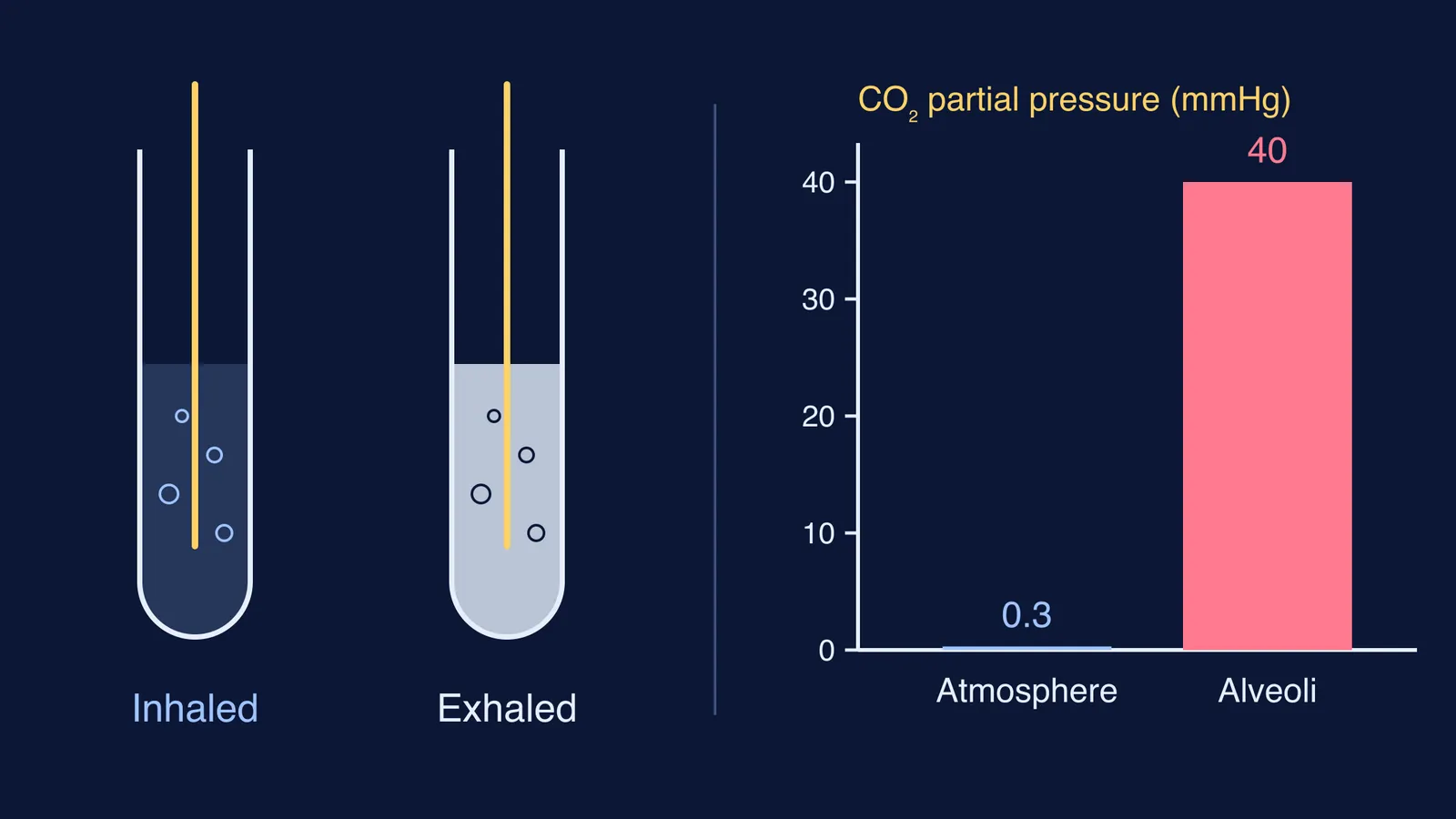
Exhaled air wins, and usually by a wide margin. This is Activity 5.4 in the NCERT Class 10 science chapter Life Processes: blow air through fresh limewater and note how long it takes to turn milky, then pass air through another tube with a syringe or pichkari and time that too. The textbook ends with the question that matters: what does this tell us about the amount of carbon dioxide in the air we breathe out?
The room-air tube may stay almost clear for a long time. The breath tube usually clouds much sooner. If you predicted the opposite, good: a wrong prediction you can explain afterwards teaches more than a lucky right one.
How do you do the limewater test fairly?
A fair test changes one thing only, the source of the air. Here is a simple plan.
Pour the same volume of freshly prepared limewater into two identical test tubes. Old limewater has already absorbed carbon dioxide from the air and gives a weaker result.
Tube A: push room air in with a syringe or pichkari, one full stroke at a time, counting strokes.
Tube B: blow gently through a clean straw, one normal breath at a time, counting breaths.
Stop each tube the moment you can no longer read print through it, and record the count.
Repeat once more with fresh limewater and take the average.
Only ever blow out through the straw. Never suck, wear eye protection, and do it with a teacher or parent present, because limewater is a solution of calcium hydroxide, an alkali.
Here is a worked prediction sheet you can copy into your notebook.
Prediction: Tube B goes milky first.
Reason: my cells make carbon dioxide, so my breath should contain more of it.
What would prove me wrong: Tube A clouding in fewer strokes than Tube B takes breaths.
Result: write both counts.
Explanation: link the result to respiration, in one sentence.
Why does exhaled air contain more carbon dioxide?
Your body makes it. The same NCERT Life Processes chapter shows glucose being split into pyruvate in the cytoplasm, and pyruvate then being broken down using oxygen in the mitochondria into carbon dioxide, water and energy. Blood carries that carbon dioxide to the lungs. To see where the energy goes, read our explainer on how many ATP one glucose molecule gives.
The NCERT Class 11 chapter Breathing and Exchange of Gases gives the numbers in Table 14.1. Carbon dioxide has a partial pressure of 0.3 mmHg in atmospheric air and 40 mmHg in the alveoli. That is roughly 130 times higher in the air sacs of your lungs than in the air around you.
Outside air is only a tiny fraction carbon dioxide. NOAA's global record put the monthly average at 426.10 parts per million in July 2026, about 0.04 percent.
The air you breathe out is a little less rich than pure alveolar air, because the last part of each breath you take in stays in your airways, never reaches the alveoli, and comes back out mixed with alveolar air. Our post on anatomical dead space and why deep breathing beats shallow explains that gap.
Why does limewater go clear again if you keep blowing?
The milkiness is a solid. Carbon dioxide reacts with calcium hydroxide to form insoluble calcium carbonate, the white cloud you see. A Purdue University chemistry demonstration shows the next step: with excess carbon dioxide, the precipitate redissolves as soluble calcium hydrogencarbonate.
First: Ca(OH)2 + CO2 gives CaCO3 + H2O, so the solution turns milky.
With excess gas: CaCO3 + CO2 + H2O gives Ca(HCO3)2, so it turns clear again.
That is why you stop at the first clear sign of milkiness. It is also why limewater alone cannot always tell carbon dioxide apart from other gases; see how to distinguish CO2 and SO2 beyond limewater.
What should you try next?
Change one variable and predict again. Blow into fresh limewater after a minute of skipping instead of at rest, and decide in advance whether the count should go up or down, and why. Or try NCERT's next activity, which bubbles the gas from yeast and sugar solution through limewater.
If the gas exchange in the alveoli is hard to picture, the Fermi Simulation Lab has interactive simulations for the ideas that are easier to see than to read. Make a prediction first, then check it, just as you did with the test tubes.


