

On this page
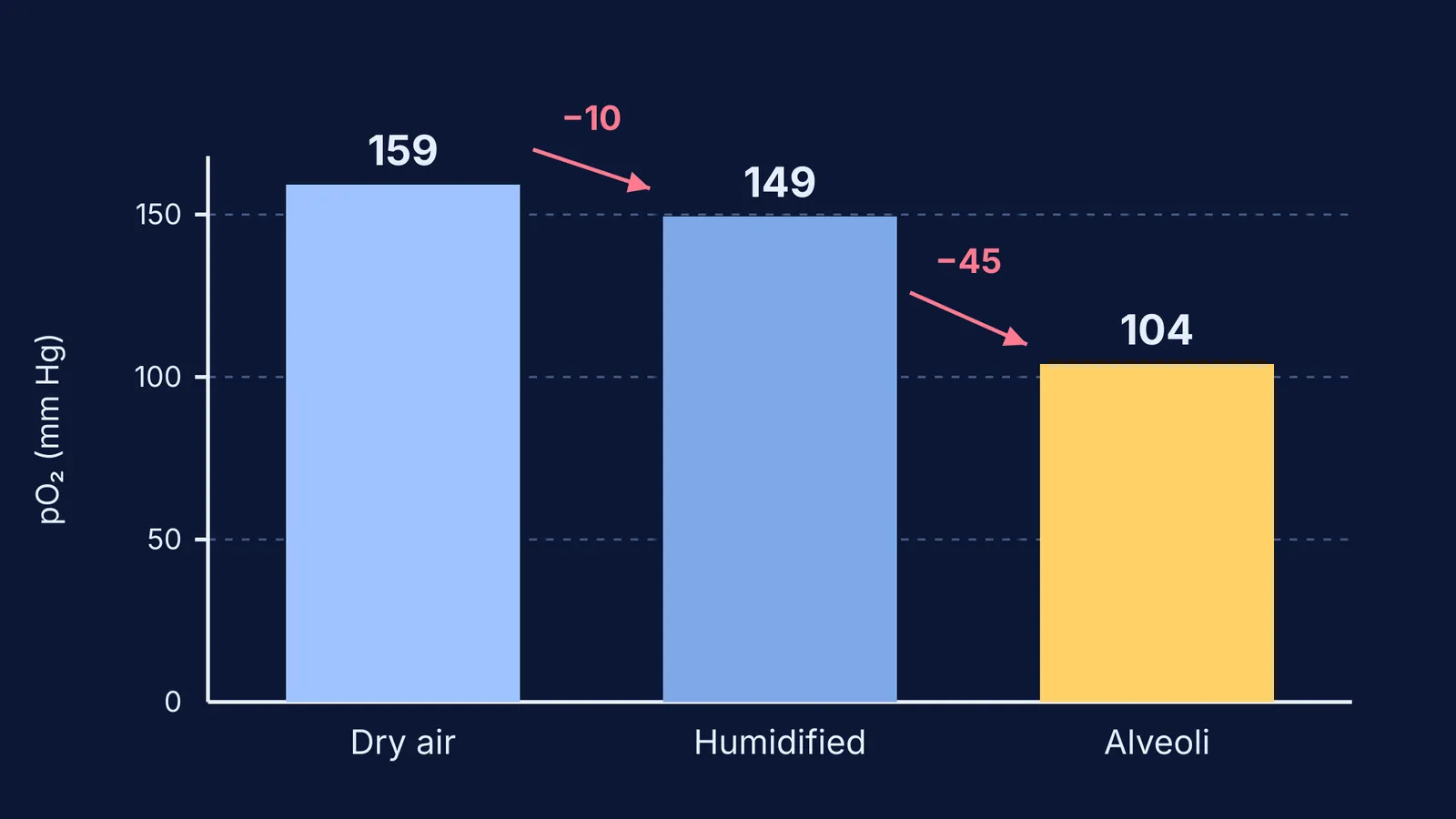
NCERT Class 11 Biology gives oxygen as 159 mm Hg in air and 104 mm Hg in the alveoli. But where did the missing 55 mm Hg go? You can work it out with one subtraction, one multiplication and one idea about mixing.
Where do 159 and 104 come from?
Both numbers are in Table 14.1 of NCERT Class 11 Biology, Chapter 14, Breathing and Exchange of Gases, which gives pO2 as 159 mm Hg in atmospheric air and 104 mm Hg in the alveoli, and pCO2 as 0.3 mm Hg and 40 mm Hg. The same chapter defines partial pressure as the pressure contributed by an individual gas in a mixture of gases.
The 159 is simple arithmetic. Dry air is 20.95% oxygen by volume, according to the NASA Earth fact sheet. One standard atmosphere) is 760 mm Hg. So the partial pressure of oxygen in air is 0.2095 × 760 = 159.2 mm Hg. This is Dalton's law of partial pressures at work: each gas pushes in proportion to its share of the molecules.
How much oxygen pressure does water vapour take away?
NCERT notes that the conducting part of the airway humidifies the air and brings it to body temperature (Chapter 14). At a body temperature of 37 °C, the saturated vapour pressure of water is 47 mm Hg (Breathing, Wikipedia).
Total pressure stays about 760 mm Hg, so the dry gases share what water vapour leaves:
Pressure left for dry gases: 760 − 47 = 713 mm Hg
Oxygen's share: 0.2095 × 713 = 149.4 mm Hg
Drop caused by water vapour: 159.2 − 149.4 ≈ 10 mm Hg
So humidifying costs about 10 mm Hg of oxygen before the air reaches an alveolus. Subtract water vapour from the total first, then take oxygen's share. It is the same step chemistry students use when subtracting water vapour from a gas collected over water.
Why does mixing with residual air lower it further?
Your lungs never empty. NCERT gives a tidal volume of about 500 mL, an expiratory reserve volume of 1000 to 1100 mL and a residual volume of 1100 to 1200 mL (Chapter 14). Functional residual capacity is ERV + RV, so after a normal breath out about 2100 to 2300 mL of air is still inside.
Not all of the 500 mL you breathe in reaches the alveoli. The anatomical dead space, the air left in the conducting tubes, is usually about 150 mL in adults (Dead space, Wikipedia)). That leaves roughly 350 mL of fresh air joining about 2200 mL of old air, so each breath renews only about one-seventh of the gas (350 ÷ 2550 ≈ 0.14).
Because so little new air mixes in, alveolar gas composition stays fairly constant (Breathing, Wikipedia). And blood keeps pulling oxygen out of it and pushing carbon dioxide in, holding alveolar pCO2 at about 40 mm Hg (NCERT Table 14.1).
Can you calculate 104 mm Hg yourself?
Yes, with the alveolar gas equation. It was the focus of a classic 1946 paper by Wallace Fenn, Hermann Rahn and Arthur Otis, as Douglas Curran-Everett describes in Advances in Physiology Education (2006). In its simplified form, alveolar pO2 = FiO2 × (760 − 47) − pCO2 ÷ R, where FiO2 is the oxygen fraction and R is the ratio of carbon dioxide produced to oxygen used (Alveolar gas equation, Wikipedia).
The worked example:
Oxygen in dry air: 0.2095 × 760 = 159.2 mm Hg
After humidification: 0.2095 × 713 = 149.4 mm Hg
If blood added exactly as much CO2 as it removed O2 (R = 1): 149.4 − 40 = 109.4 mm Hg
With the commonly used R = 0.8: 40 ÷ 0.8 = 50, so 149.4 − 50 = 99.4 mm Hg
NCERT's 104 mm Hg sits between these; it would match R ≈ 0.88 (40 ÷ 45.4)
Because R is below 1, the oxygen drop is larger than the 40 mm Hg rise in carbon dioxide. Books use slightly different inputs and rounding, so you will see alveolar values from about 100 to 105 mm Hg.
If a step like the R correction trips you up, the Fermi Problem Library has worked problems with a step-by-step solver that explains the reasoning rather than printing an answer.
What should you check before the exam?
159 or 160? Using 21% oxygen gives 0.21 × 760 = 159.6, so you may also see 160. NCERT uses 159 (Table 14.1).
Subtract 47 mm Hg from 760 first, then multiply by the oxygen fraction. Never subtract 47 from 159.
Alveolar is not arterial. NCERT gives 104 mm Hg in the alveoli but 95 mm Hg in oxygenated blood.
The gradient that drives diffusion is alveolar 104 against 40 mm Hg in deoxygenated blood, a difference of 64 mm Hg.
To practise reading these values off a figure, try our NEET diagram-based questions on breathing and exchange of gases. If partial pressure itself still feels shaky, the Fermi Concept Library gives every concept in physics, chemistry, biology, mathematics and computing its own lesson.


