

On this page
On a hot afternoon, the shrill buzz from one tree can drown out the road beside it. Cicadas are among the loudest insects measured, and the physics is worth knowing.
How does a cicada make such a loud sound?
Only the males call. "The loud noise we hear is the male's mating call — females are silent," Gene Hall, manager of the University of Arizona Insect Collection, said in a University of Arizona explainer. The sound comes from tymbals, a pair of ribbed membranes on the abdomen that collapse inwards when muscles inside contract, as Australia's CSIRO explains.
A 1995 study by D. Young and H. C. Bennet-Clark filled in the details (Young and Bennet-Clark, 1995). A stiff plate on the tymbal acts as a lever, so the surface moves more than twice the distance the muscle shortens. The ribs then buckle one after another into a V shape, and each buckle gives a loud click at around 4 kHz. Think of pressing a steel tiffin-box lid until it pops, repeated so fast the pops blur into a buzz.
Why does a hollow abdomen make cicadas louder?
A tiny membrane alone pushes very little air. But a male cicada's abdomen holds a large air sac. Bennet-Clark and Young built a model shaped like the abdomen of the Australian cicada Cyclochila australasiae and found that it resonated at 4.3 kHz, that species' natural song frequency (Bennet-Clark and Young, 1992).
They concluded that the abdomen works as a Helmholtz resonator, with the air sac as the cavity and the thin eardrums (tympana) as its neck. It is the same physics as the note you get by blowing across a bottle. Because the tymbal clicks near the air sac's tuned frequency, the two ring together; the 1995 tymbal paper says this provides "the pressure transformation between muscle power and sound power that is desirable for efficient sound radiation".
Why do cicadas call in hot summer months?
Cicadas are cold-blooded, and their song changes with body temperature. P. J. Fonseca and M. A. Revez recorded three Portuguese species between 24 and 38.5 degrees C and found that the song's syllable rate, set by the tymbal cycle, depended strongly on temperature (Fonseca and Revez, 2002). Basking in sunlight could raise a small cicada's body temperature by more than 10 degrees C.
Heat may also be safer: CSIRO notes that in hot, oppressive weather most predators are too busy keeping cool to hunt. It adds that some cicadas spend up to seven years underground, then get a week or two as adults to find a mate. Crickets show a similar link, covered in why crickets chirp faster in the heat.
How loud is a cicada compared with city noise?
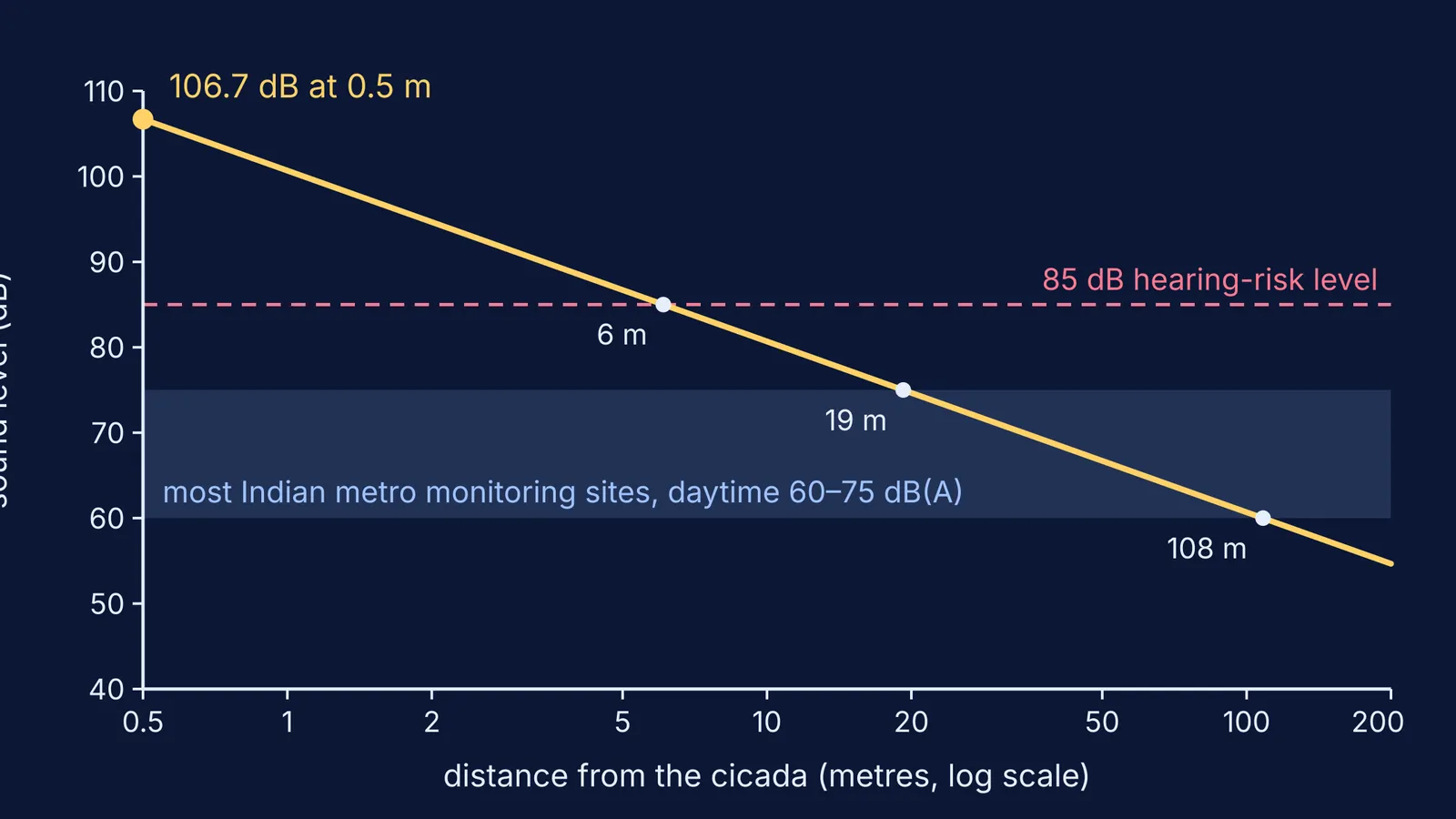
Guinness World Records lists the shrill thorntree cicada, Brevisana brevis, as the loudest insect, at a mean 106.7 decibels at 50 cm.
On India's national noise-monitoring network, 49 of 70 sites in seven metro cities recorded daytime levels between 60 and 75 dB(A) in 2019 (Garg, Gandhi and Gupta, Applied Acoustics). The legal daytime limit for residential areas is 55 dB(A) (Noise Pollution Rules, 2000, via Nyaaya).
Decibels are logarithmic: 90 decibels sounds twice as loud as 80, according to New York City's health department. The US NIDCD says long or repeated exposure at or above 85 dBA can cause hearing loss. Our guide to sound intensity level in decibels walks through the formula.
To see how fast the roar fades, treat one cicada as a point source in open air. Intensity falls as 1/r squared, so the level drops by 20 log10(2), about 6 dB, each time distance doubles (see the inverse-square law when distance is doubled). Starting from the Guinness record of 106.7 dB at 0.5 m:
1 m: about 100.7 dB
2 m: about 94.7 dB
4 m: about 88.7 dB
8 m: about 82.6 dB
16 m: about 76.6 dB
32 m: about 70.6 dB
So a record-breaking cicada falls below 85 dB at about 6 m and drops to 75 dB, the top of that monitoring range, at about 19 m. But cicadas often call in groups. N equal callers add 10 log10(N) dB, so ten cicadas are 10 dB louder than one, the same as standing about three times closer.
If waves spreading out are hard to picture, the Fermi Simulation Lab has interactive simulations for ideas that are easier to see than to read.
Can you test this yourself?
Yes, with a phone sound-meter app. Phone microphones are not calibrated, so compare readings rather than trusting exact values.
Note the time and air temperature.
Take a reading 2 m from a calling tree, then at 8 m. Two doublings should cost about 12 dB.
Take a reading at the roadside.
Repeat on a cooler morning and note whether fewer cicadas call.
Explain the gaps: walls and ground reflect sound, and many callers add up.
Keep your distance from very loud sources while you measure. If logarithms still feel shaky, the Fermi Concept Library gives each concept in physics, chemistry, biology and mathematics its own lesson.


