On this page
Sit outside on a warm evening and the crickets sound busy. On a cool night the same chorus slows down. It is chemistry, muscles and a bit of physics working together, and you can measure it with a phone timer.
Why do crickets chirp faster when it is warm?
A cricket is an ectotherm, an animal whose body temperature depends on the temperature of its surroundings, as NOAA's education office explains. You and I hold our bodies near a steady temperature. A cricket cannot, so when the air warms, the cricket warms with it.
Male crickets make the chirp, and they use it to attract mates. They make the sound by rubbing their wings together, and NOAA notes that a warmer cricket can do this faster. Every chirp depends on nerve signals firing and muscles contracting, and both rely on chemical reactions. Warmer molecules move faster and collide more often, so those reactions run quicker.
In 2001, James Gillooly and colleagues published a model in Science, based on principles of biochemical kinetics and allometry, describing how temperature and body mass affect metabolic rate. It fitted microbes, ectotherms, endotherms and plants at temperatures from 0 to 40 °C. Their conclusion: temperature and body size are primary determinants of "biological time". Their study did not look at crickets, but a cricket's song is a good everyday example of the same idea.
What is Dolbear's law?
In November 1897 the physicist A. E. Dolbear published a short note called "The Cricket as a Thermometer" in The American Naturalist. His claim was that you could work out the air temperature from how fast crickets chirp. The relationship is now called Dolbear's law.
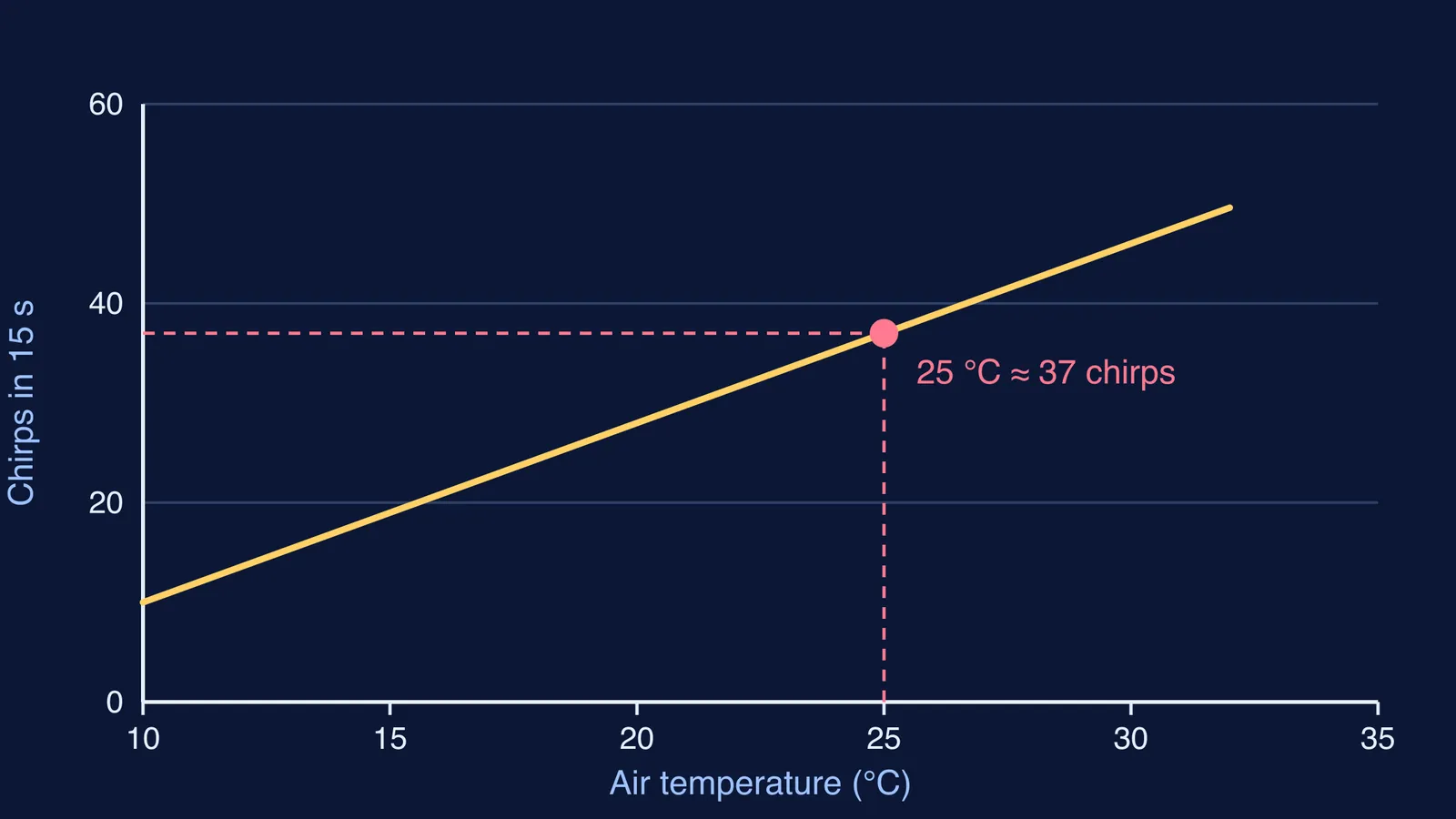
The version NOAA gives is easy to remember: temperature in °F equals the number of chirps in 15 seconds plus 40. The snowy tree cricket, found in eastern North America, is nicknamed the "thermometer cricket" for its accuracy, according to NOAA and a Penn State fact sheet.
Here is a worked example using the NOAA formula. Take a warm evening at 25 °C. In Fahrenheit that is 25 × 9/5 + 32 = 77 °F. Subtract 40 and the formula predicts about 37 chirps in 15 seconds. Drop to 15 °C (59 °F) and the prediction falls to 19 chirps. On this formula, a 10-degree drop roughly halves the song.
Does the cricket thermometer always work?
No, and the limits are as interesting as the rule.
It depends on the species. NOAA notes that different species may need different formulas, and that a cricket near a warm building or in a different region may not match. The snowy tree cricket lives in eastern North America, so if you live elsewhere, the crickets outside your window are probably a different species and may need their own formula.
The line can flatten. In a 1985 study in the Journal of Experimental Biology, John Doherty found that in the cricket *Gryllus bimaculatus*, chirp and syllable rates rose in a straight line between 15 and 24 °C, but temperature had no effect on them between 24 and 33 °C.
Not everything speeds up. In the same study, syllable duration, syllables per chirp and the dominant frequency (pitch) of the song stayed relatively unaffected by temperature.
Doherty also found that females tested at 15, 22 and 30 °C responded best to songs matching what a male would sing at that same temperature.
How can you test it yourself?
This makes a good weekend investigation for a Class 9 to 12 student, or a parent and child together. Here is a plan.
Pick one spot where you hear a single cricket clearly, ideally the same one each night.
Note the temperature from a thermometer or a local weather report at the time you count.
Count chirps for 15 seconds. Repeat three times and take the average.
Do this on at least five evenings with different temperatures, early and late at night.
Plot chirps on the y-axis against temperature on the x-axis and draw the best straight line through your points.
Find the slope and intercept. That is your own local cricket's formula.
Check whether the line flattens at the hot end, as Doherty saw in his crickets.
Before you head outside, the Fermi Simulation Lab has interactive simulations for ideas that are easier to see than to read. And if the link between temperature, reaction rates and metabolism is still fuzzy, the Fermi Concept Library gives each concept in biology, chemistry and physics its own lesson.
What does this teach about temperature and metabolism?
The cricket is a small window into a big idea you will meet again in chemistry (rates of reaction), biology (enzymes and metabolism) and physics (the kinetic theory of gases). On a cool night, a cold-blooded animal's chemistry sets a slower pace. Next time you hear a cricket, count for 15 seconds and you are reading that chemistry out loud.