

On this page
Gravity is the glue that holds the solar system together, but its strength fades rapidly as you move away from an object. If you have ever wondered exactly how much weaker it gets, the secret lies in the denominator of Newton's famous equation.
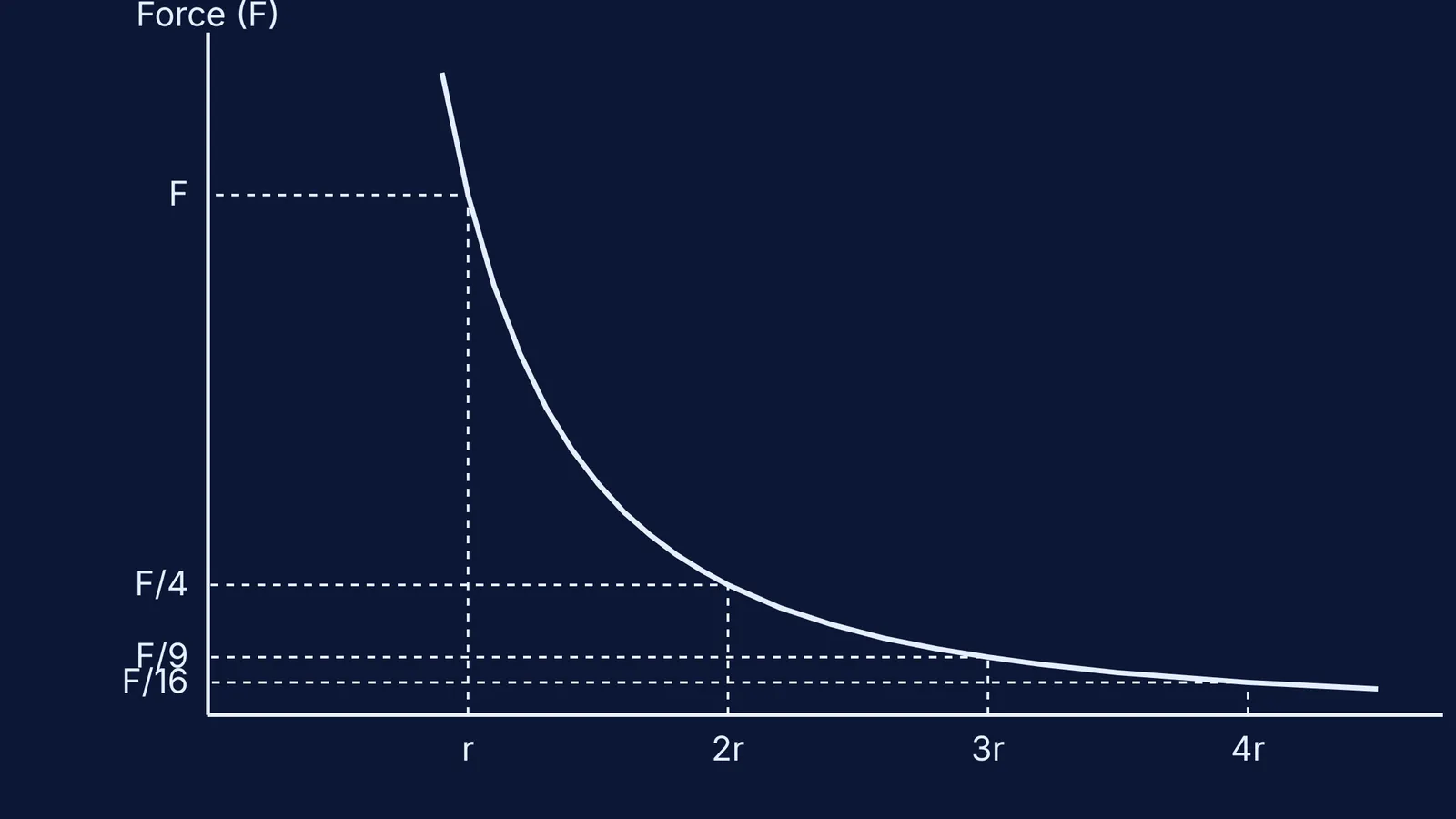
What happens to gravitational force when distance is doubled?
Newton's law of universal gravitation states that the force between two objects is directly proportional to their masses and inversely proportional to the square of the distance between them.
When the distance between two objects is doubled, the gravitational force is reduced to one-fourth of its original value.
This relationship is universal. Whether you are looking at the attraction between two apples on a desk or the pull between the Earth and the Moon, doubling the distance between their centres of mass always cuts the force by a factor of four. It is important to measure from the centre of mass of each object, not their surfaces. For planets, that distance is so large that everyday human movements do not noticeably change the force of gravity we feel.
We can see why by looking at the formula:
F = G × (m₁ × m₂) / r²
If you replace the original distance, r, with twice the distance, 2r, you have to square that entire new value. Squaring 2r gives you 4r². Because that 4 is in the denominator, the original force is divided by four.
What happens when the distance is halved or tripled?
The inverse-square law works in both directions. The factor by which the force changes is always the square of the factor by which the distance changes.
If the distance is halved: The distance becomes 1/2 r. Squaring 1/2 gives 1/4. Dividing by 1/4 is the same as multiplying by 4, so the force increases to four times its original value.
If the distance is tripled: The distance becomes 3r. Squaring 3 gives 9, so the force drops to one-ninth of what it was.
Why is it a square and not just an inverse?
It is easy to memorise the formula, but understanding why the square is there makes it unforgettable. Imagine a light bulb glowing in the centre of a dark room. The light spreads out in all directions, forming an expanding sphere.
Because the surface area of a sphere is 4πr², the same amount of light has to cover an area that grows with the square of the distance. If you stand twice as far away, the light is spread over four times as much area, making it one-fourth as bright. Gravity spreads through three-dimensional space in exactly the same way. The gravitational influence of a mass is 'diluted' over the surface of a sphere, which is why the r² appears in the denominator.
Visualising how these proportionalities work is a core skill in physics. If you want to see how these forces build the architecture of the universe, you can explore every concept in physics, chemistry, biology, mathematics and computing in the Concept Library, each with its own lesson and its place in the map.
How to solve problems when masses change at the same time
In exams like JEE Main and NEET-UG, you will rarely be asked to just double the distance. A typical question asks what happens if you double the distance *and* double one of the masses at the same time in Newton's law of universal gravitation.
Let's walk through an example. Suppose you double the mass of the first object (m₁ becomes 2m₁) and you also double the distance (r becomes 2r).
Put the mass change on top: 2
Put the squared distance change on the bottom: 2² = 4
Divide them: 2 / 4 = 1/2
The new force will be exactly half of the original force.
Consider a second scenario: what if the distance is halved (r becomes 1/2 r) and one mass is tripled (m₁ becomes 3m₁)?
Put the mass change on top: 3
Put the squared distance change on the bottom: (1/2)² = 1/4
Divide them: 3 / (1/4) = 12
The new force is exactly 12 times stronger. Working through changes methodically like this prevents careless errors.
Exams test your ability to separate the variables. When reading a question, underline exactly which parameters are changing. Does it say the distance is increased *by* 2r, or increased *to* 2r? Increasing *by* 2r means the new distance is 3r, which drops the force to one-ninth. Increasing *to* 2r means the new distance is just 2r, dropping the force to one-fourth. Paying attention to these prepositions is just as critical as knowing the formula.
If you find yourself dropping factors in your working, the Problem Library has worked problems with a step-by-step solver that explains the reasoning rather than printing an answer. Fermi's AI tutor notices where a student is stuck, and decides whether to explain, ask, or show.
Once you are comfortable scaling forces between two point masses, you can take the same logic further. It is the first step to understanding how planetary orbits work—like deriving Kepler's second law from angular momentum—or figuring out the gravity inside a hollow shell and a sphere with a cavity.


