

On this page
Your grandmother's advice to chew every mouthful has a neat chemistry reason behind it. Digestion happens where enzymes touch food, and chewing decides how much food they can touch.
What does chewing actually do to food?
Chewing is mechanical digestion. As OpenStax Concepts of Biology puts it, food "is broken into smaller particles by mastication, the chewing action of the teeth." Saliva moistens those particles, and its enzyme, salivary amylase, begins converting starch into maltose, a sugar.
Amylase cannot reach starch buried inside a lump of chapati; it acts on the surface that saliva can wet. So the real question is how much surface chewing creates.
Why does more surface area mean faster digestion?
OpenStax Chemistry 2e states that the rate for smaller particles is greater "because the surface area in contact with the other reactant phase is greater", the same reason sawdust burns faster than a log. We cover the classroom version in why powder reacts faster than lumps.
A worked example with a cube
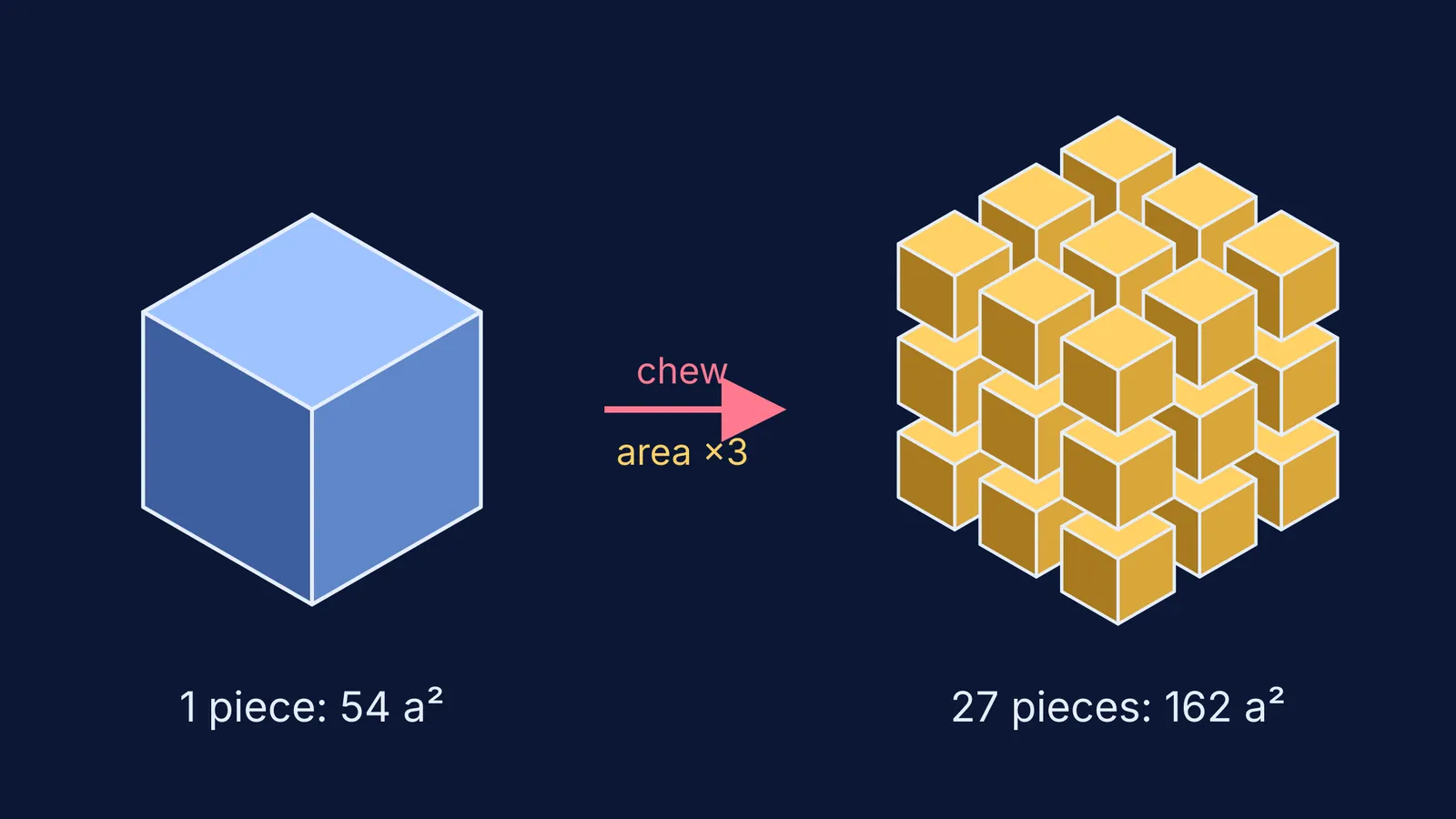
Take a cube of food with side 3a. Its surface area is 6 × (3a)², which is 54a².
Now "chew" it into 27 small cubes of side a. Each has area 6a², so together they have 27 × 6a², which is 162a².
The volume is unchanged, but the area has tripled. Cut it into pieces one-tenth of its side and you get 1,000 pieces with ten times the area.
What do studies say about chewing more?
The surface-area idea shows up in real meals. In a 2014 study in the European Journal of Clinical Nutrition, 15 healthy young adults ate rice chewed either 15 or 30 times per mouthful. Rice chewed 30 times had a glycaemic index of 88, against 68 when chewed 15 times, along with a larger and higher blood-glucose response, which fits faster starch digestion. Authors of a 2021 paper in Current Research in Food Science summarise earlier work the same way: "smaller bolus particles encourage more rapid starch digestion."
Chewing also changes how much people eat. In a 2011 trial in The American Journal of Clinical Nutrition with 16 lean and 14 obese young Chinese men, participants ate 11.9% less when they chewed each bite 40 times instead of 15, and had lower post-meal levels of ghrelin, a hormone linked to hunger.
Faster is not automatically better: a quicker rise in blood glucose matters to people managing diabetes, so take diet questions to a doctor or registered dietitian.
How can you test this with sugar cubes at home?
Dissolving is a physical change, not digestion, but it obeys the same rule: water can only pull sugar off the exposed surface. You need two sugar cubes from the same box, two identical steel tumblers, room-temperature water, a spoon, a sheet of paper and a phone stopwatch.
Fill both tumblers halfway from the same jug, so amount and temperature match.
Fold one cube inside the paper and crush it with the back of the spoon. Keep every grain.
Drop the whole cube into tumbler A while a partner tips the crushed sugar into tumbler B. Start the stopwatch.
Stir both at the same gentle pace, or leave both unstirred. Change only one thing.
Stop the clock for each tumbler when no grains are visible, and note both times.
Repeat with fresh water and cubes and average your runs.
Predict first. Then add a third tumbler with a cube broken into four chunks and see where its time lands. In this model:
Whole cube, chunks, grains: a bite swallowed unchewed, chewed a little, chewed until soft
Water: saliva and digestive juices
Time to dissolve: how quickly enzymes can work through the food
For the enzyme side, read our explainer on salivary amylase, pH and temperature. To watch surface area change on screen rather than imagine it, the Fermi Simulation Lab has interactive simulations for ideas that are easier to see than to read.
So how should you chew your food?
The chew counts in those studies were test conditions, not targets; there is no magic number. Habits that follow from the science:
Take smaller bites, so each starts with more surface per gram.
Chew until the food is soft and evenly mashed.
Put your spoon down between bites.
Eat away from a screen, so you notice when food is ready to swallow.
You can even taste amylase at work: bread turns sweeter as you chew, as we explain in why bread tastes sweet after chewing. If chewing or swallowing hurts, see a dentist or doctor.
If digestion and reaction rates feel like separate chapters, the Fermi Concept Library gives each concept its own lesson and its place in the map. Run the sugar test tonight, then chew your next bite of roti slowly.


