

On this page
Put a small piece of plain roti in your mouth and keep chewing without swallowing. At first it tastes of flour and not much else. After a minute or two, many people notice a faint sweetness. Nobody added sugar. Your saliva made it.
Why does bread taste sweet after chewing for a long time?
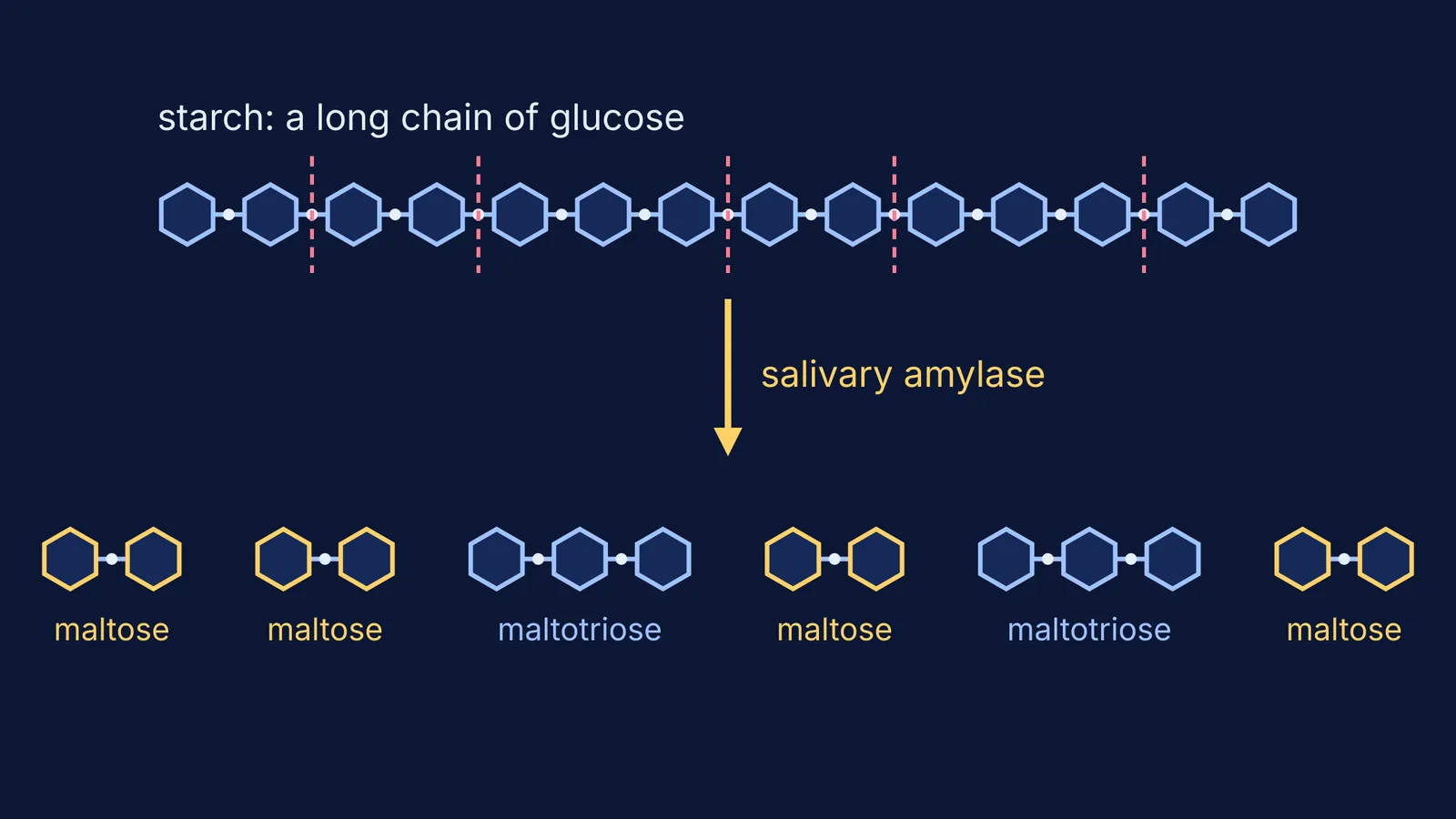
Roti and bread are mostly starch. Starch is a long chain of glucose units joined together, and a chain that long does not register as sweet on your tongue. Saliva carries an enzyme, salivary amylase, that cuts the chain into short pieces.
The CBSE Class XI reading material on digestion states that about 30 per cent of starch is hydrolysed in the mouth by salivary amylase (optimum pH 6.8) into a disaccharide, maltose. Hydrolysis means a bond is broken with the help of a water molecule.
Maltose is two glucose units joined by an α-1,4 glycosidic bond, according to LibreTexts Chemistry. It is a real sugar, but a mild one: the same LibreTexts table gives maltose a sweetness of 0.33 where table sugar (sucrose) is 1. That is why chewed roti tastes faintly sweet, not like a laddoo.
A 2010 study in PLoS ONE by Abigail Mandel, Paul Breslin and colleagues describes salivary amylase as breaking starch into maltose, maltotriose and larger oligosaccharides, and notes that the enzyme makes up 40 to 50% of the protein in human saliva.
Is it the sugar, or something else you taste?
The longer fragments behave differently. In a 2016 study in Chemical Senses, Trina Lapis, Michael Penner and Juyun Lim found that people could detect short glucose chains (averaging 7 and 14 units) even when the sweet taste receptor was blocked, and described them as "starchy" rather than sweet. A longer chain averaging 44 units could not be tasted at all.
So chewing gives you a mix: tasteless long chains, starchy medium ones, and sweet small pieces such as maltose. The longer you chew, the more starch reaches the small end.
How do you test it at home?
Your mouth works as a ready-made test tube: the enzyme is already in your saliva, and the CBSE reading material gives its optimum pH as 6.8. You need a small piece of plain roti (no ghee, no sugar) or plain bread, a slice of cucumber, a glass of water, a timer and a notebook. Skip the wheat version if you have a wheat allergy or coeliac disease; a spoonful of plain boiled rice works the same way.
Rinse your mouth with water and wait one minute.
Put a coin-sized piece of roti in your mouth and start the timer.
Chew slowly and steadily. Try not to swallow the food.
At 0, 30, 60, 90 and 120 seconds, score the sweetness from 0 (none) to 5 (like a sweet biscuit) and write it down.
Spit or swallow, rinse, wait a minute, then repeat with the cucumber.
Ask someone else at home to do the same test and compare notes.
Sample notes (made-up scores, to show the format):
Roti: 0, 0, 1, 2, 2
Cucumber: 1, 1, 1, 1, 1
Conclusion: the roti got sweeter with time; the cucumber stayed the same, so the change came from the starch.
Three things keep the test fair:
Read the bread label. Many packaged breads contain added sugar, so they taste sweet from the first bite. Roti made from atta and water is the cleaner test.
Keep the piece size and chewing speed the same for every food you compare.
Use the cucumber as a control. It has little starch, so its taste should not change much.
Why do some people taste it sooner than others?
People make different amounts of amylase. In the Mandel study, the number of copies of the salivary amylase gene, AMY1, ranged from 1 to 11 among participants. People with more amylase reported a thick starch solution thinning faster in their mouths.
A 2007 study in Nature Genetics by George Perry and colleagues found that more AMY1 copies went with more amylase protein in saliva, and that people from populations with high-starch diets carry, on average, more copies than those from populations with traditionally low-starch diets. So if your brother notices the sweetness before you do, neither of you is doing it wrong.
What should you remember for exams?
The two numbers from the CBSE Class XI reading material (about 30 per cent of starch, optimum pH 6.8) and the product (maltose) are worth memorising word for word. If enzymes still feel abstract, the Fermi Concept Library has a lesson for every concept in biology and chemistry, each with its place in the map.
To go further, see how pH and temperature change salivary amylase activity, run the amylase iodine test to time starch digestion, or read how taste buds detect sweet and the other basic tastes. The Fermi Simulation Lab has interactive simulations for ideas that are easier to see than to read.


