

On this page
Drop a marble chip into dilute hydrochloric acid and it fizzes steadily. Drop the same mass of powdered calcium carbonate in and it froths almost at once. Same substance, same acid, same equation:
CaCO3 + 2HCl → CaCl2 + H2O + CO2
What differs is where the reaction can happen.
Why does powdered calcium carbonate react faster than marble chips?
Calcium carbonate is a solid, so acid can only react with it at its surface. As Chemguide puts it, "any reaction can only take place on the surface of the solid."
Rate depends on how many successful collisions happen each second. Hydrogen ions from the acid can only hit carbonate that is exposed. Powder exposes far more carbonate at once, so more collisions happen each second and carbon dioxide comes off faster.
Research on real calcite fits this picture. In a 1975 study in Chemical Engineering Science, Kasper Lund and colleagues found that at 25 °C, calcite dissolved in hydrochloric acid as fast as fresh acid could reach its surface, even when the sample was spun quickly to stir the acid.
The amount of gas does not change. With the same mass of carbonate and enough acid, both forms give the same total carbon dioxide, as Chemguide notes. The powder just finishes sooner.
How much more surface does powder have?
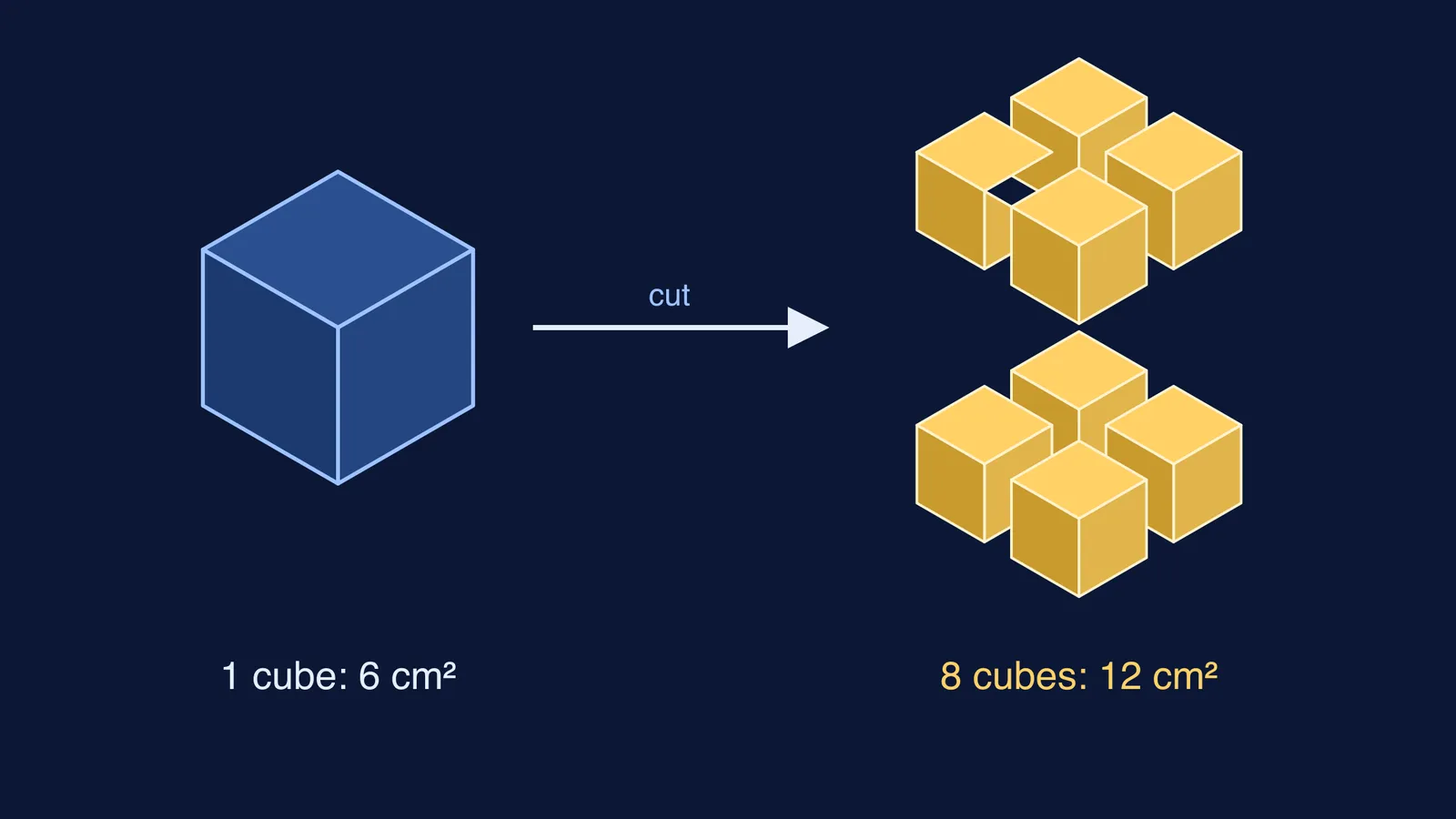
A cube's surface area is 6 × edge², as Wikipedia's cube article gives it, so a 1 cm cube has 6 cm². Cut it into eight 0.5 cm cubes and the total becomes 12 cm², as the diagram at the top shows. Cut it into 1 mm cubes and you get 1,000 pieces with 60 cm² between them: ten times the surface, same mass.
The rule: cutting a cube into n slices along each edge multiplies its surface area by n. Powder grains are far smaller still. Our post on how surface area grows when a cube is cut into smaller cubes has the full working.
How do you measure CO2 loss for chips versus powder?
The usual school method weighs the carbon dioxide as it escapes. Do it only in a school lab, with goggles and your teacher's go-ahead, because hydrochloric acid is corrosive.
Stand a conical flask of dilute hydrochloric acid on a balance.
Add weighed marble chips and plug the neck loosely with cotton wool, which "lets gas out but stops acid spray escaping and counting as lost mass", as Cognito's method notes explain.
Record the mass at regular intervals.
Repeat with the same mass of powder, the same acid and the same temperature.
Plot mass lost against time for both runs on one graph. The rate comes out in grams per second (g/s).
Worked example: what should the final mass loss be?
Say you use 2.00 g of calcium carbonate in each run. PubChem lists molar masses of 100.09 g/mol for calcium carbonate and 44.01 g/mol for carbon dioxide.
Moles of CaCO3 = 2.00 ÷ 100.09 = 0.0200 mol.
One CaCO3 gives one CO2, so 0.0200 mol of CO2 forms.
Mass of CO2 = 0.0200 × 44.01 = 0.88 g.
Check the acid is in excess: you need 2 × 0.0200 = 0.0400 mol of HCl. 25 cm³ of 2.0 mol/dm³ acid holds 0.050 mol, enough. 25 cm³ of 1.0 mol/dm³ holds only 0.025 mol, so that run would stop early.
So both curves should level off near 0.88 g lost. If yours do not, look for escaping spray, unreacted solid or too little acid.
To compare speeds, divide the mass lost in the first 30 s by 30 s: a drop of 0.12 g gives 0.004 g/s. A tangent at time zero is better still, since Chemguide points out that the start is the only point at which you know the concentrations, masses and temperature exactly.
What should the chips and powder graphs look like?
Powder: steep at the start, flattens early.
Chips: gentler at the start, flattens later.
Both: level off at the same final mass loss when the carbonate runs out first, and both slopes fall with time. Our post on why reaction rate falls with time explains why.
How do you write this up in an exam?
Name the factor: larger surface area for the same mass.
Say what it changes: more particles exposed to the acid.
Link it to collisions: more collisions per second.
Finish with rate: more successful collisions per second, so a faster rate.
Say what stays the same: the total CO2 produced.
If surface area and collision theory still feel like separate facts, the Fermi Concept Library gives each concept its own lesson and shows its place in the map. For an interactive version, read how surface area changes the reaction rate of marble and acid. To practise the mole arithmetic, the Fermi Problem Library has worked problems with a step-by-step solver that explains the reasoning rather than printing an answer.


