

On this page
When you drop an effervescent tablet in water or react magnesium with acid, the vigorous bubbling at the start gradually slows to a stop. In chemical kinetics, the rate of a chemical reaction measures how rapidly reactants disappear or products appear per unit volume, as defined in OpenStax Chemistry 2e.
This drop in speed happens because reactants are steadily consumed. In most chemical reactions, the reaction rate depends directly on the concentration of available reactant particles. As chemical bonds break and atoms rearrange to yield products, the number of reactant moles in the vessel drops. Because the volume remains fixed, reactant concentration falls. With fewer reactant molecules present to interact, the reaction proceeds more slowly. Connecting this ongoing drop to lab measurements is key when comparing average and instantaneous reaction rate data.
How does the slope of a concentration-time graph show the slowing rate?
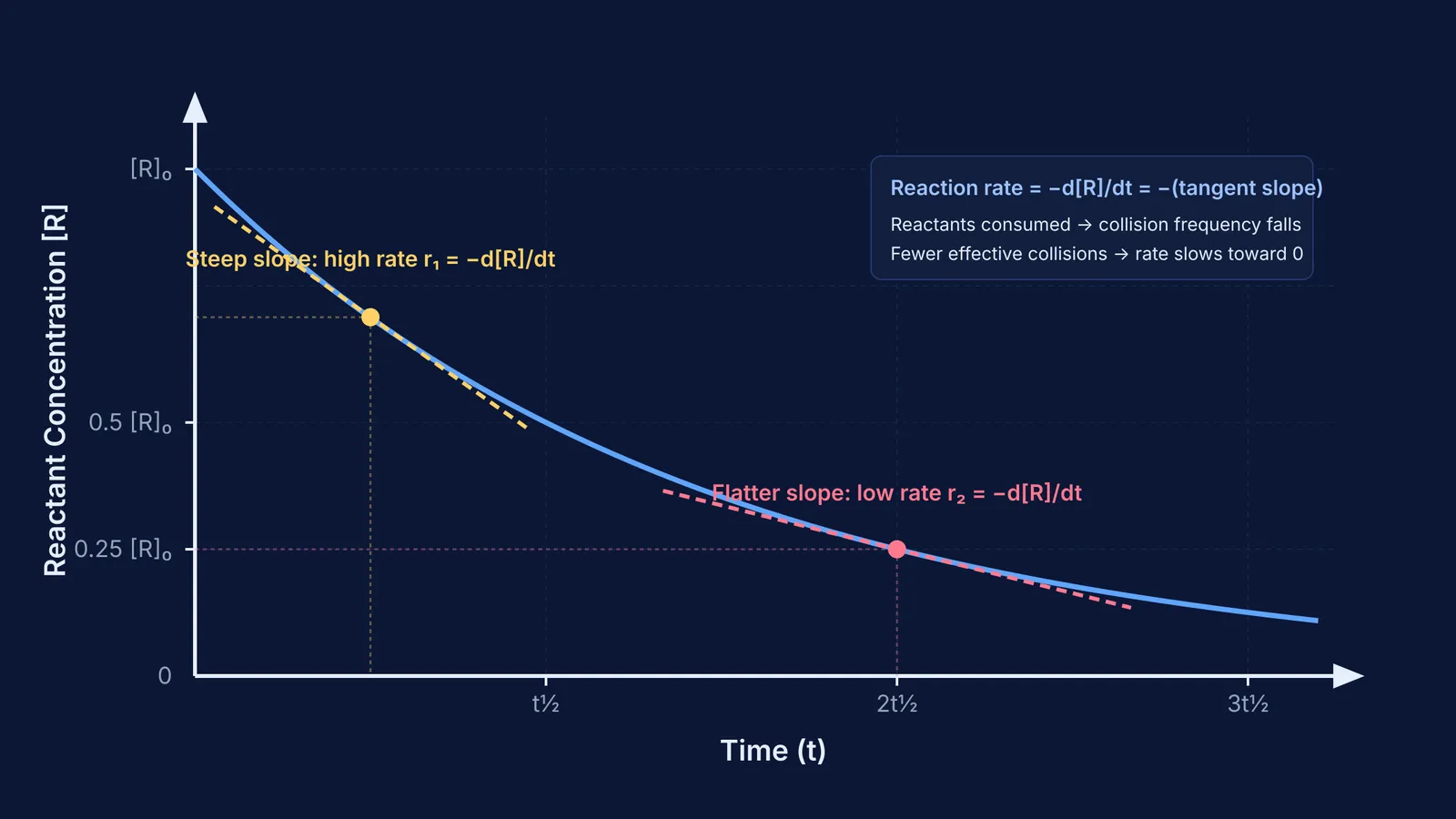
Plotting reactant concentration against time visualises this deceleration. When you plot reactant concentration [R] on the vertical axis against time t on the horizontal axis, the resulting curve starts high and slopes downward.
According to the NCERT Class 12 Chemistry textbook, the instantaneous rate of reaction at any moment t equals the negative slope of the tangent line drawn to the curve:
r_inst = −d[R]/dt
Because [R] decreases over time, the tangent slope d[R]/dt is negative; adding a minus sign ensures the physical reaction rate is positive. At time t = 0, the curve is at its steepest, marking the reaction's maximum speed. As reactants deplete, the curve gradually flattens. The tangent slope gets closer to zero, showing that the rate continuously drops until reactants are exhausted. You can explore how these curves straighten under specific mathematical operations in our guide to integrated rate law graphs.
What happens to molecular collisions as reactants thin out?
To see why the slope flattens, look at the reaction mixture on a molecular level. Between 1916 and 1918, Max Trautz in Zeitschrift für anorganische und allgemeine Chemie and William Lewis in the Journal of the Chemical Society, Transactions formulated collision theory.
Collision theory states that molecules must physically collide to react. To yield a chemical reaction, colliding particles must meet two conditions:
They must possess kinetic energy equal to or greater than the activation energy threshold.
They must collide with proper spatial orientation so bonds can rearrange.
As explained in OpenStax Chemistry 2e and NCERT Class 12 Chemistry, the collision frequency, Z, is the number of collisions per second per unit volume. Collision frequency is directly proportional to reactant concentration. When reactants are consumed, fewer molecules occupy each unit volume. This thins out the particle population, directly lowering collision frequency. With fewer total collisions occurring every second, the absolute number of effective collisions that cross the activation barrier drops, causing the reaction rate to fall.
Worked example: tracking rate drop in a first-order decomposition
Consider a first-order decomposition of reactant A with rate constant k = 0.02 s⁻¹ and initial concentration [A]₀ = 1.00 mol L⁻¹, calculated using the standard rate equations from OpenStax Chemistry 2e. The differential rate law is Rate = k[A].
Here is how the instantaneous rate drops as reactant A is consumed:
At t = 0 s: The concentration is [A] = 1.00 mol L⁻¹. The instantaneous rate is 0.02 s⁻¹ × 1.00 mol L⁻¹ = 0.020 mol L⁻¹ s⁻¹.
At t = 34.66 s: After one half-life (t_1/2 = 0.693 / 0.02 s⁻¹ = 34.66 s), 50% of the reactant has reacted, leaving [A] = 0.50 mol L⁻¹. The rate becomes 0.02 s⁻¹ × 0.50 mol L⁻¹ = 0.010 mol L⁻¹ s⁻¹, exactly half the initial rate.
At t = 69.31 s: After two half-lives, 75% of reactant has reacted, leaving [A] = 0.25 mol L⁻¹. The rate falls to 0.02 s⁻¹ × 0.25 mol L⁻¹ = 0.005 mol L⁻¹ s⁻¹, one-fourth of the starting rate.
This drop illustrates how concentration directly controls the reaction pace. You can examine how half-lives and rate laws connect across other reaction orders in our guide to chemical kinetics rate laws.
Does reaction rate always decrease with time?
Most reactions slow as reactants vanish, but zero-order reactions are an important exception. For a zero-order reaction, Rate = k[A]⁰ = k.
As noted in NCERT Class 12 Chemistry, the decomposition of ammonia on a hot platinum catalyst at high pressure is zero-order. Because ammonia molecules fully saturate the active catalyst sites, changing reactant concentration does not change the reaction speed. The rate remains constant until the ammonia is exhausted, producing a concentration-time graph with a straight, constant slope.
How to master kinetics without getting tangled in formulas
Connecting molecular collisions to graph slopes helps you solve kinetics questions with confidence instead of memorising formulas in isolation.
The Fermi Concept Library maps every concept in physics and chemistry, helping you link collision dynamics to rate laws. When solving numericals, the Fermi Problem Library provides worked problems with a step-by-step solver that explains the reasoning rather than just printing an answer. For ideas that are easier to see than read, the Fermi Simulation Lab provides interactive simulations to observe how molecular collisions change as concentrations shift.


