

On this page
If you take a solid cube and slice it into smaller pieces, something non-intuitive happens: the total amount of space it takes up (volume) stays exactly the same, but the total amount of exposed outside space (surface area) goes up.
This simple geometric rule explains why powdered sugar dissolves faster than a sugar cube, why our intestines have folds, and why cells are microscopic.
Does the volume change when a cube is cut?
No. The volume of an object is a measure of the 3D space it occupies. When you cut a cube, you are simply dividing that same space into smaller compartments. If you start with a solid block of material, you will end up with the exact same amount of material, no matter how many pieces you cut it into.
Why does the surface area grow when a cube is cut?
Surface area increases because every time you make a cut, you expose new faces of the material that were previously hidden on the inside.
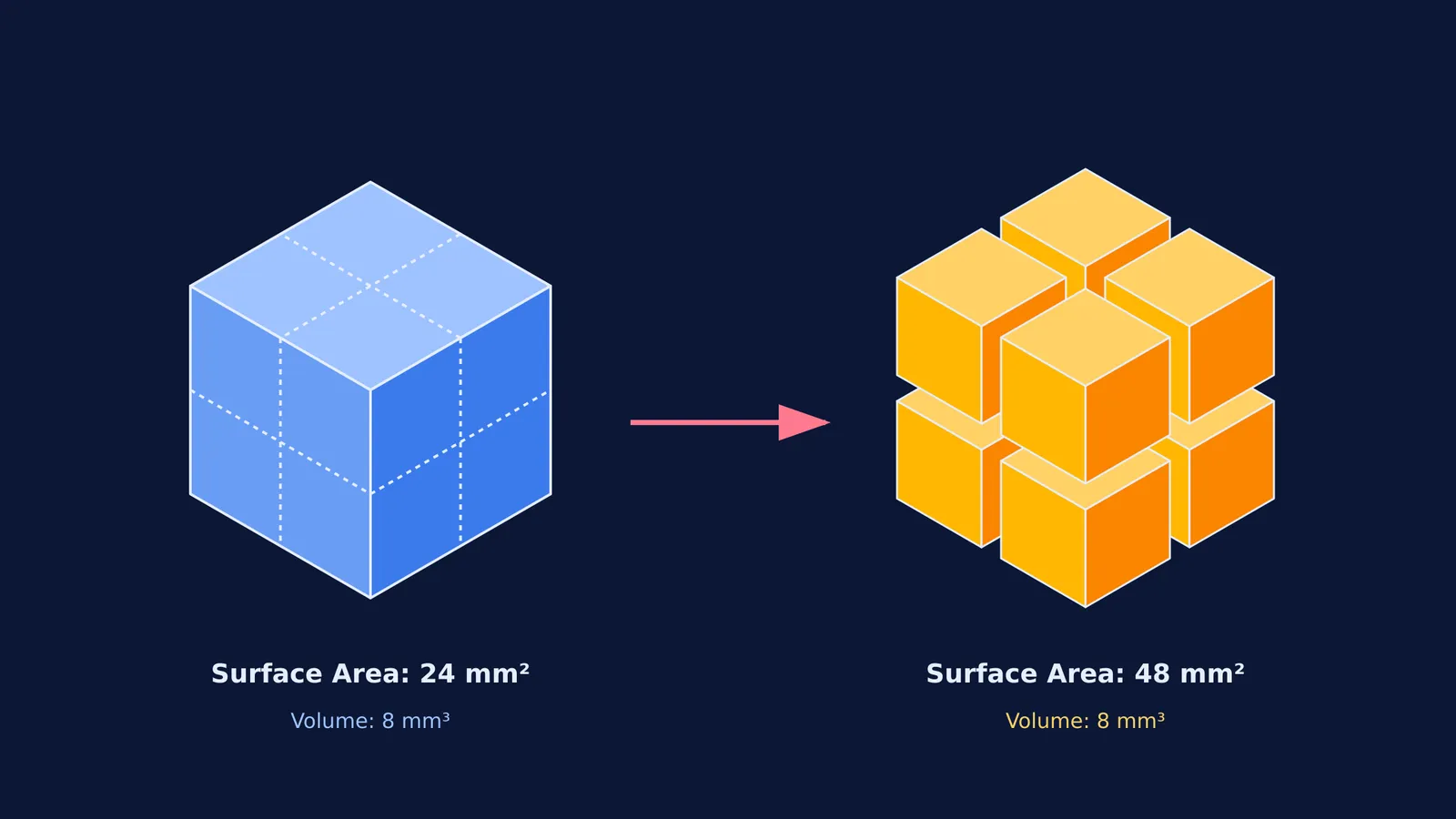
As demonstrated in OpenStax Biology 2e, imagine a cube with a side length of 2 mm.
Its volume is 2 × 2 × 2 = 8 mm³.
Its surface area is 6 × 2² = 24 mm².
Now, cut that cube in half along every axis. You produce 8 smaller cubes, each with a side length of 1 mm.
The total volume of all eight cubes is still 8 × (1 × 1 × 1) = 8 mm³.
The surface area of one small cube is 6 × 1² = 6 mm².
The total surface area of all eight small cubes is 8 × 6 = 48 mm².
By cutting the cube into eight pieces, the total surface area grows from 24 to 48. The new surface area-to-volume ratio is 6:1.
How much does the surface area increase when a cube is cut into n³ smaller cubes?
The increase follows a strict mathematical pattern. If you take a cube and slice each edge into n equal parts, you will create n³ smaller cubes. The total volume remains constant, but the new surface area will be n multiplied by the original surface area.
Cut each side into two equal parts: creating eight smaller cubes multiplies the total surface area by two.
Cut each side into three equal parts: creating twenty-seven smaller cubes multiplies the total surface area by three.
Cut each side into ten equal parts: creating a thousand smaller cubes multiplies the total surface area by ten.
This is why dealing with cubes and cube roots in Class 8 is a foundational skill before moving on to combined solids in Class 10: surface area and volume.
How does surface area affect chemical reactions?
When a solid block of a chemical reactant is dropped into a solution, the reaction can only occur on the outermost boundary. The molecules trapped inside the block cannot participate until the outer layers are eaten away. By crushing the block into a fine powder, you are effectively cutting the cube into microscopic smaller cubes. The total volume of the reactant remains exactly the same, but the total surface area skyrockets. This exposes vastly more molecules to the surrounding solution simultaneously. As a result, the reaction rate increases dramatically. This principle is heavily used in industrial chemistry, the design of catalytic converters, and pharmaceuticals to speed up processes that would otherwise take much longer to complete.
Why is surface area important in biology?
The surface area-to-volume ratio dictates why cells are microscopic. A cell must absorb nutrients and release waste through its surface, which is the cell membrane. If a cell grows too large, its internal volume demands more nutrients than its relatively small surface area can let in. To survive and remain efficient, the cell divides, which immediately increases its overall surface area-to-volume ratio.
This same geometric rule explains why our intestines are lined with many tiny folds and finger-like projections called villi. Instead of a smooth tube, these folds maximize the surface area available for absorbing nutrients from food without requiring the body to be physically larger.
How does surface area affect heat loss in physics?
In physics and zoology, the surface area-to-volume ratio explains how animals regulate their body temperature. Heat is generated by the volume of an animal's body, but it is lost entirely through the surface of its skin.
Small animals, like mice, have a high surface area compared to their total volume. This means they lose heat quickly to their environment and must eat a large amount of food relative to their size to fuel their metabolism and stay warm. Conversely, large animals, like elephants or whales, have a much lower surface area-to-volume ratio. They retain heat much more efficiently. The same mathematical principle of the cut cube applies to them: a single massive object retains its internal heat far better than the same mass divided into smaller shapes.
If you are exploring how these ratios affect reaction rates or cellular biology, the Concept Library covers every concept in physics, chemistry, biology, mathematics and computing, each with its own lesson and its place in the map.


