

On this page
Across rural India, the cattle pulling a plough or cart are often bullocks: males castrated instead of kept as breeding bulls. The reason is in your Class 11 biology book. A bull's testes do not only make sperm. They are also an endocrine gland, and their hormone shapes how the animal behaves and grows.
What do the testes actually do?
NCERT's chapter on chemical coordination says the testis "performs dual functions as a primary sex organ as well as an endocrine gland" (NCERT Class 11 Biology, Chapter 19). The Leydig cells, also called interstitial cells, sit in the spaces between the seminiferous tubules and produce a group of hormones called androgens, mainly testosterone.
The same page lists what androgens do. They stimulate muscular growth, growth of facial and axillary hair, aggressiveness and a low-pitched voice. They act on the central neural system to influence male sexual behaviour (libido), they drive spermatogenesis, and they have anabolic, or building-up, effects on protein and carbohydrate metabolism. NCERT is describing humans, but testes, Leydig cells and testosterone play the same basic role in cattle.
If you mix up the two main cell types of the testis, our explainer on Sertoli vs Leydig cells sorts them out.
Why are bulls castrated to make bullocks?
Because the behaviours testosterone drives are the ones a farmer does not want in a work animal. A 2026 paper from the ICAR-Indian Veterinary Research Institute in Izatnagar, Bareilly, says castration is "routinely performed to reduce aggressive behaviour, make animals more docile and easier to handle, prevent unwanted mating and mounting activities" (Kumar et al., Acta Veterinaria Brno, 2026). A bullock that does not fight or chase cows is easier to yoke and work beside another animal.
The same paper describes the methods. The Burdizzo castrator and elastrator bands cut off the blood supply to the testes without an incision, while surgery removes them. Either way, the testes stop working. It is real surgery, so the ICAR-IVRI team sedated the bulls and gave local anaesthesia and pain relief.
Timing follows local practice. In a study of 404 farms in 12 villages of the Indian central Himalayas, almost all male calves not to be used for breeding were castrated between 2.5 and 4.0 years of age, though not every draught animal in the high-altitude villages was castrated (Singh and Partap, Indian Journal of Animal Sciences, 2002).
How fast does testosterone fall after castration?
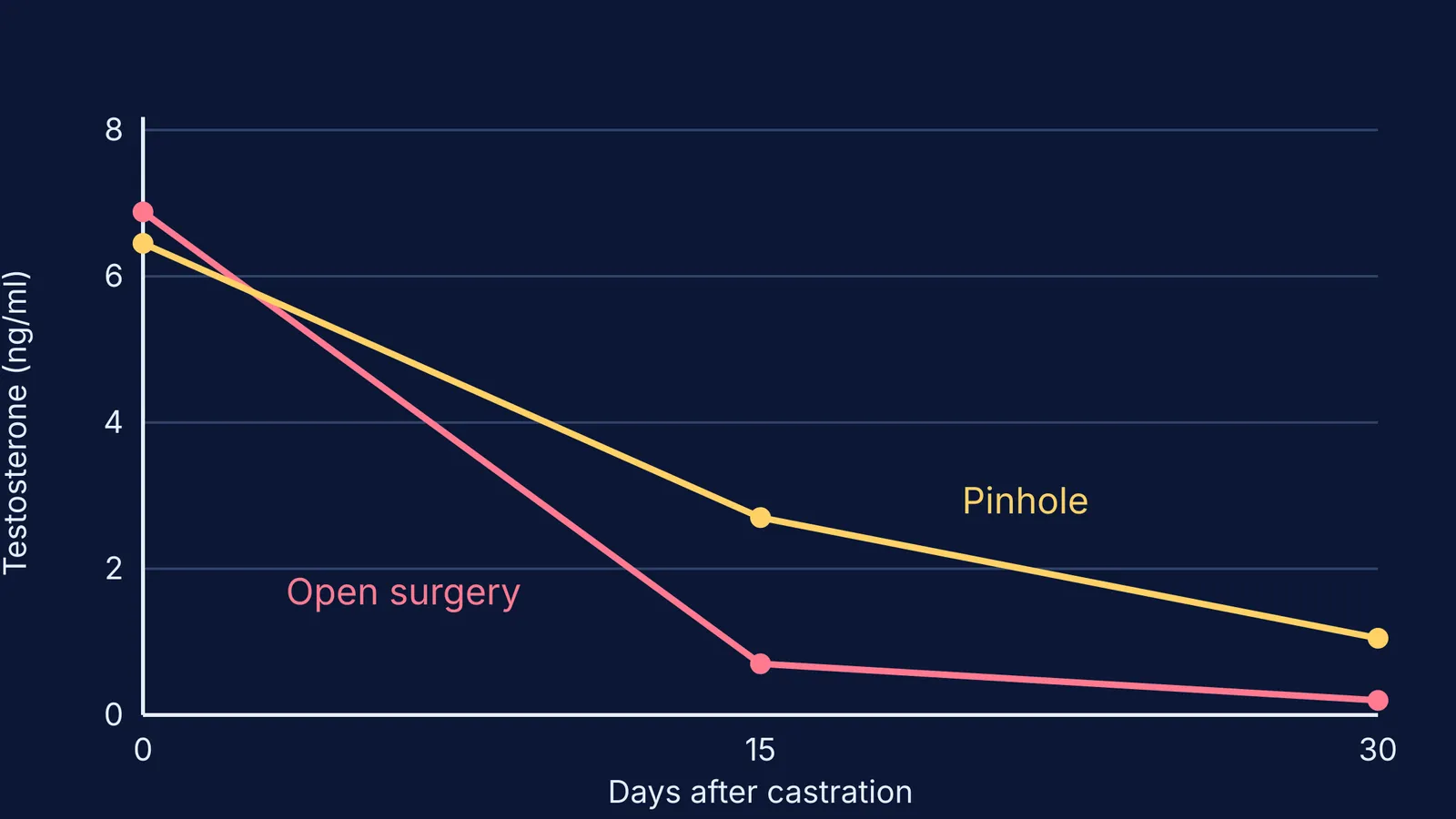
The ICAR-IVRI study measured it. In 12 crossbred bulls castrated by open surgery, mean blood testosterone fell from 6.88 ng/ml just before surgery to 0.70 ng/ml after 15 days and 0.20 ng/ml after 30 days (Kumar et al., 2026). In 12 bulls given a less invasive "pinhole" procedure, which ties off the spermatic cords so the testes waste away, it fell more slowly, from 6.45 to 1.05 ng/ml by day 30. The chart at the top of this page plots both groups.
Behaviour follows the hormone. In one trial with 80 cattle, post-pubertal bulls vaccinated against GnRH (the hypothalamic hormone that starts the chain to the testes) showed falling testosterone, and 5 weeks after the first injection their aggressive behaviour had dropped to the level of steers castrated before puberty (Jago et al., Animal Science, 1999). The authors noted this was likely to cost some weight gain, which fits NCERT's description of androgens as anabolic: take them away and the body builds less.
How do you answer this in a biology exam?
Any "what happens if this gland is removed?" question can be solved with the same four steps. Here they are for the bull:
Name the gland and the cells: testis, Leydig (interstitial) cells.
Name the hormone and its type: androgens, mainly testosterone, a steroid hormone.
List its effects from NCERT: muscular growth, aggressiveness, libido, spermatogenesis, development of accessory sex organs.
Reverse each effect: less aggression, no mating drive, no sperm, a weaker muscle-building signal.
A model two-line answer: "Castration removes the testes, so the Leydig cells no longer secrete testosterone. Without androgens the animal loses aggressiveness and libido and becomes sterile and docile, which makes it a manageable draught animal."
Now test yourself. Use the same four steps on the ovary, then check your list against our guide to the functions of androgens, oestrogens and progesterone. For the history, read how Berthold's rooster experiment first pointed to the testes sending a chemical signal through the blood.
If the hypothalamus, pituitary and gonad chain still feels like a list of names, the Fermi Concept Library gives each biology concept its own lesson and shows its place in the map. To practise questions like the one above, the Fermi Problem Library has worked problems with a step-by-step solver that explains the reasoning rather than printing an answer.


