

On this page
Bone is hard, cartilage is rubbery, and blood flows out of a cut. So when a textbook puts all three in the same family, it feels like a mistake. It is not. Blood is grouped by what it is built from, not by how it looks, and it fits the three-part description textbooks give for connective tissue.
What makes a tissue a connective tissue?
Connective tissues "typically have in common three characteristic components: cells, large amounts of amorphous ground substance, and protein fibers," according to the open textbook OpenStax Anatomy and Physiology 2e, section 4.3.
The same section says the matrix around the cells is a ground substance, often crisscrossed by protein fibres. The usual fibres are collagen, elastic and reticular fibres. It also names three broad classes: connective tissue proper, supportive connective tissue (bone and cartilage) and fluid connective tissue (blood and lymph). One more clue: all connective tissues come from the mesoderm, the middle layer of the embryo.
So the three tests are simple:
Does it have cells?
Do those cells sit in a non-living matrix (the material between the cells)?
Does that matrix carry protein fibres?
How does blood pass the three tests?
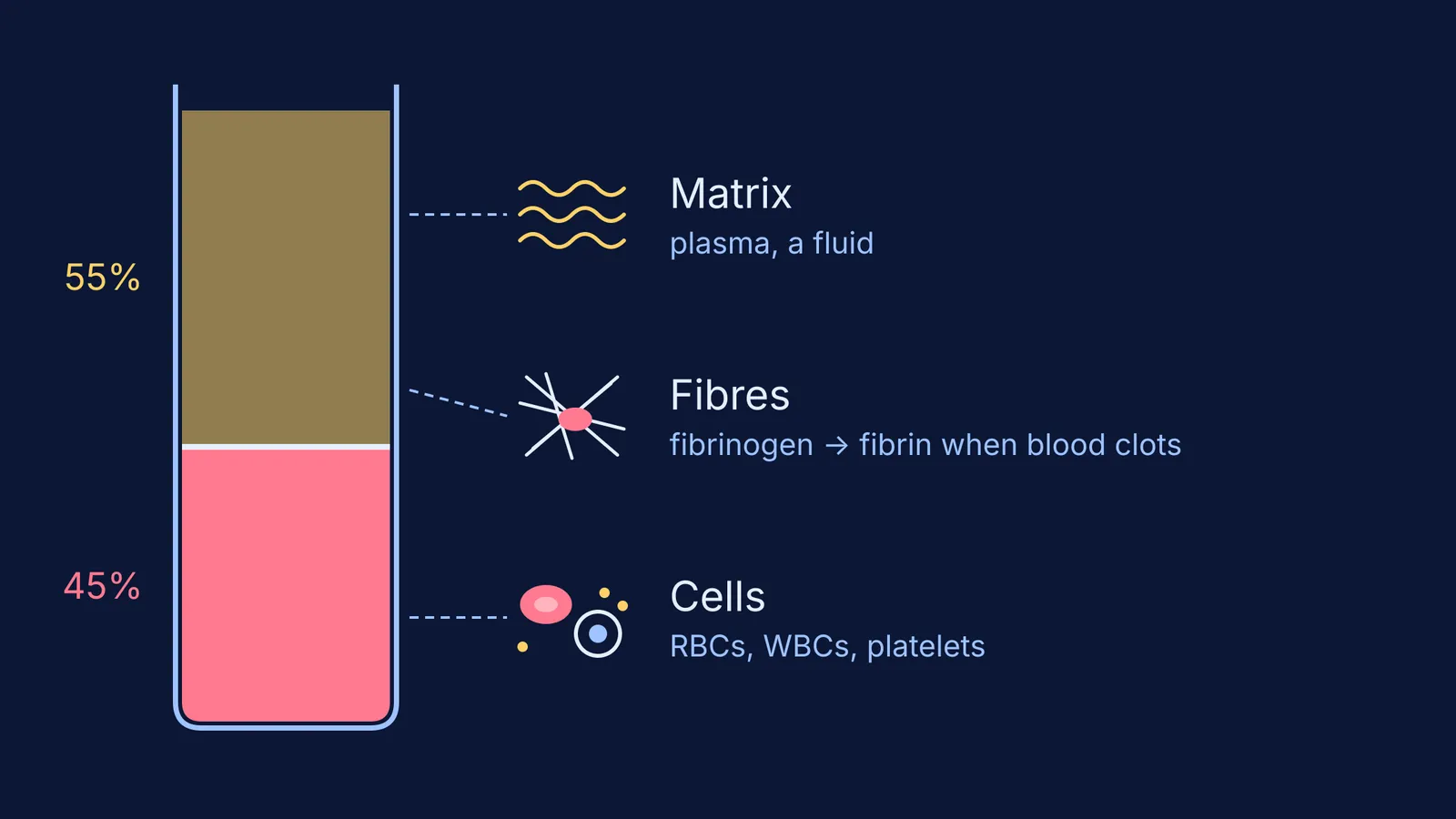
Test 1 is cells. Blood's cellular part is called the formed elements. OpenStax section 18.1 lists them as red blood cells (RBCs), white blood cells (WBCs) and "cell fragments called platelets". In normal blood, about 45 percent of a sample is red blood cells, and the layer of WBCs and platelets is less than 1 percent. All of these formed elements come from haematopoietic stem cells in the bone marrow (OpenStax 4.3). Test passed.
Test 2 is the matrix. The rest of the sample is plasma, and plasma is the matrix. OpenStax states it directly: "blood is a connective tissue. Like all connective tissues, it is made up of cellular elements and an extracellular matrix" (OpenStax 18.1). Plasma is about 92 percent water, and about 7 percent of its volume is proteins. The remainder is ions, dissolved gases, nutrients and wastes. The matrix is liquid, which is why blood is a fluid connective tissue. Test passed.
Test 3 is fibres. This is the test students argue about, because you cannot see fibres in flowing blood. Note that OpenStax's own reason for calling blood a connective tissue rests on cells and matrix, not fibres. What blood does have is a fibre-forming protein kept in dissolved form. "Fibrinogen is soluble in water and is found in high concentrations in the blood," writes David Goodsell in the Protein Data Bank's Molecule of the Month on fibrin. When a clot is needed, fibrinogen is converted to fibrin, "which then assembles into an extended network of fibers." Fibrinogen makes up about 7 percent of plasma proteins (OpenStax 18.1). So blood has no fibres while it flows, only the dissolved protein that forms them when a clot is needed. Count this as a qualified pass.
If you want more on what plasma carries, see our post on why plasma is about 55 percent of blood and our guide to albumin, globulin and fibrinogen.
What is the one-line answer for boards?
Write this when the question asks for one line:
Blood is a connective tissue because it consists of cells (RBCs, WBCs and platelets) suspended in a fluid extracellular matrix, the plasma, and it develops from mesoderm like other connective tissues.
For a 3-mark answer, use this structure:
Define it: connective tissue is made of cells, matrix and fibres.
Map it onto blood: cells are the formed elements, the matrix is plasma, and the fibre-forming protein is fibrinogen, which becomes fibrin threads during clotting.
Classify it: because the matrix is liquid, blood is a fluid connective tissue, along with lymph.
For a 5-mark answer, add one function, such as transporting oxygen, nutrients and wastes between organs. Then draw a labelled sketch of RBCs, a WBC and platelets in plasma.
Which mistakes cost marks?
Calling plasma a cell. Plasma is the matrix, not a formed element.
Saying blood has collagen fibres. Its fibre story is fibrinogen and fibrin.
Calling platelets whole cells. They are cell fragments.
Writing "blood connects organs" as the only reason. The textbook reason is the cells-and-matrix argument.
If the idea of a matrix is still fuzzy, compare blood with its relatives in our post on connective tissue types with examples. The Fermi Concept Library gives every biology concept its own lesson and shows where it sits on the map, so you can see how tissue types connect. To test yourself, the Fermi Problem Library has worked problems with a step-by-step solver that explains the reasoning rather than printing an answer.


