

On this page
Every organ in your body relies on a supporting framework. While epithelial tissue lines the surfaces, it is connective tissue that holds everything together, separating, packing, and binding your systems. Connective tissue binds and supports the body, with Type I collagen making up approximately 25% of the total protein content in mammals (Wikipedia).
In biology curriculums like Class 11 and NEET, connective tissues are classified based on the nature of their extracellular matrix—the ground substance and fibres sitting between the cells.
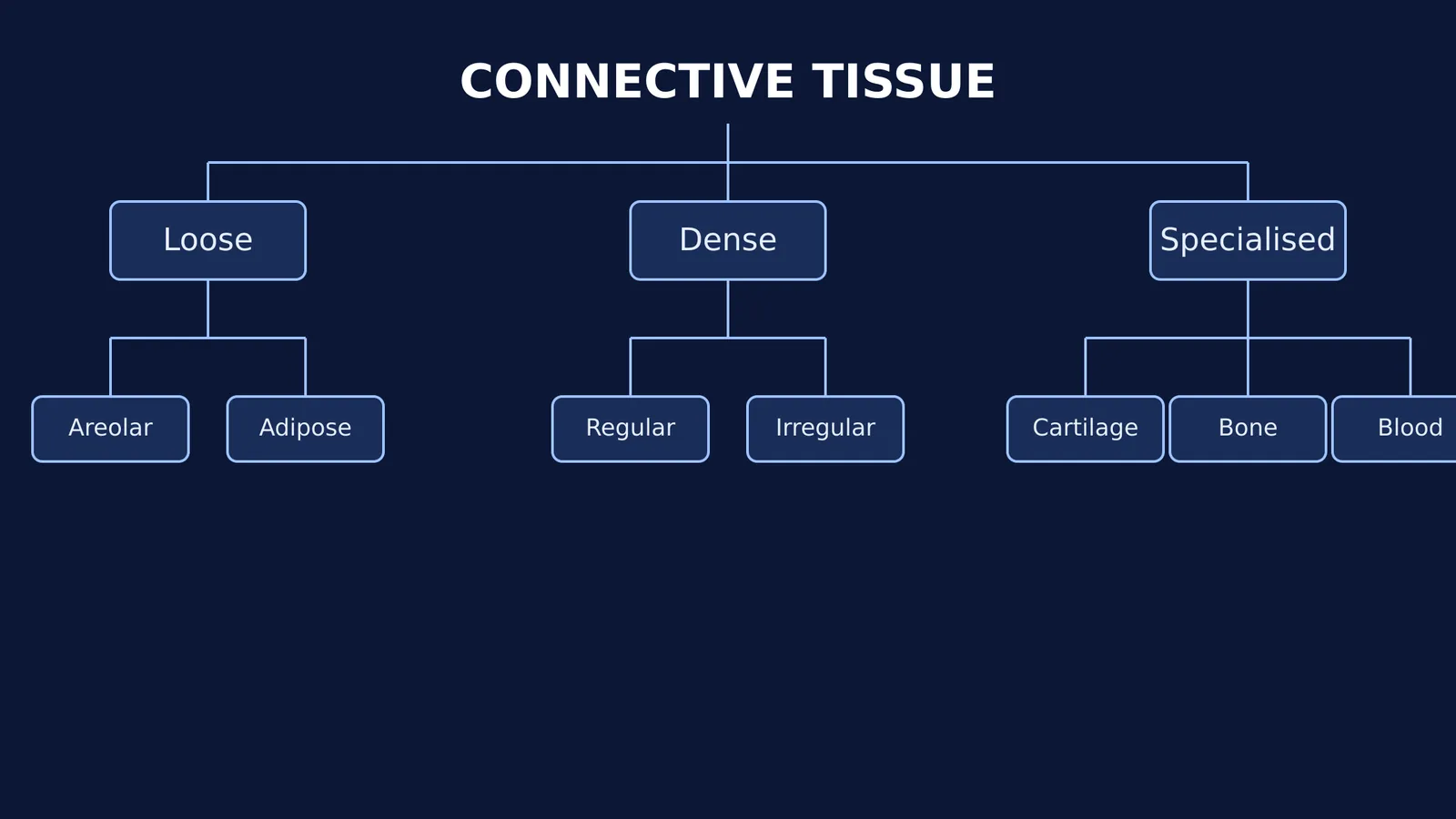
What are the loose connective tissue types?
Loose connective tissue has cells and fibres loosely arranged in a semi-fluid ground substance.
Areolar tissue: This acts as a packing material. It sits beneath the skin and serves as a support framework for epithelium, carrying macrophages and mast cells that help fight infection.
Adipose tissue: This is specialised for storing energy. Human fat contains 61% to 94% lipids (Wikipedia). The cells, known as adipocytes, store excess nutrients as fat, providing both insulation and a mechanical cushion for organs.
What are the dense connective tissue types?
In dense connective tissue, fibres and fibroblasts are tightly packed together. The orientation of these fibres dictates the tissue's strength and role.
Dense regular tissue: Here, the collagen fibres run in parallel rows between many parallel bundles. This creates high tensile strength in one direction. Tendons (which attach skeletal muscles to bones) and ligaments (which attach one bone to another) are the primary examples.
Dense irregular tissue: The fibroblasts and collagen fibres are oriented randomly in thick bundles. This allows the tissue to resist tension from multiple directions. You will find this tissue forming the dermis of your skin.
What are specialised connective tissue examples?
These tissues have a highly modified matrix to serve specific physical and fluid functions.
Cartilage: The intercellular material of cartilage is solid and pliable, resisting compression. Cells called chondrocytes are enclosed in small cavities within the matrix. It forms the tip of the nose, outer ear joints, and the cushioning between spinal bones.
Bone: Bone has a hard and non-pliable ground substance, rich in calcium salts and collagen fibres, which gives it high compressive and tensile strength. Bone tissue stores 99% of the body's calcium and 85% of its phosphorus (Wikipedia). Osteocytes sit in spaces called lacunae, maintaining this rigid framework.
Blood: Unlike the others, blood is a fluid connective tissue containing plasma, red blood cells (RBCs), white blood cells (WBCs), and platelets. Plasma makes up approximately 55% of the total blood volume (Wikipedia). It circulates throughout the body, transporting oxygen, nutrients, and waste products.
How to learn biological classifications
Biology requires holding many categories and examples in your head at once. If you struggle to memorise text-heavy definitions, try organising them visually.
Draw a flowchart mapping the three main branches (loose, dense, specialised) and attach the examples (like areolar or cartilage) to their functional roles. If you find concept gaps blocking your progress, the Fermi Concept Library holds every biology topic in its map, each with its own lesson. Fermi's AI tutor can work out what you already know and build a plan for the session, teaching you rather than just printing an answer.
A quick revision checklist
When reviewing tissues for an exam, verify you can answer these three questions for every tissue type:
What is the matrix like? (Is it fluid, pliable, or hard?)
What are the primary cells? (Fibroblasts, chondrocytes, or osteocytes?)
Where is it found? (Beneath the skin, at a joint, or inside a bone?)


