On this page
If a NEET-UG question asks you to match albumin, globulins and fibrinogen to their jobs, the answer sits in two sentences of NCERT. The harder part is the follow-ups: why tissue fluid has fewer proteins than plasma, and what exactly is missing from serum. Here are the numbers, the three jobs, those two links, and a memory hook for each protein.
What percentage of plasma is protein, according to NCERT?
Chapter 15 of NCERT Class 11 Biology, Body Fluids and Circulation, gives these figures (NCERT Biology Class 11, Chapter 15):
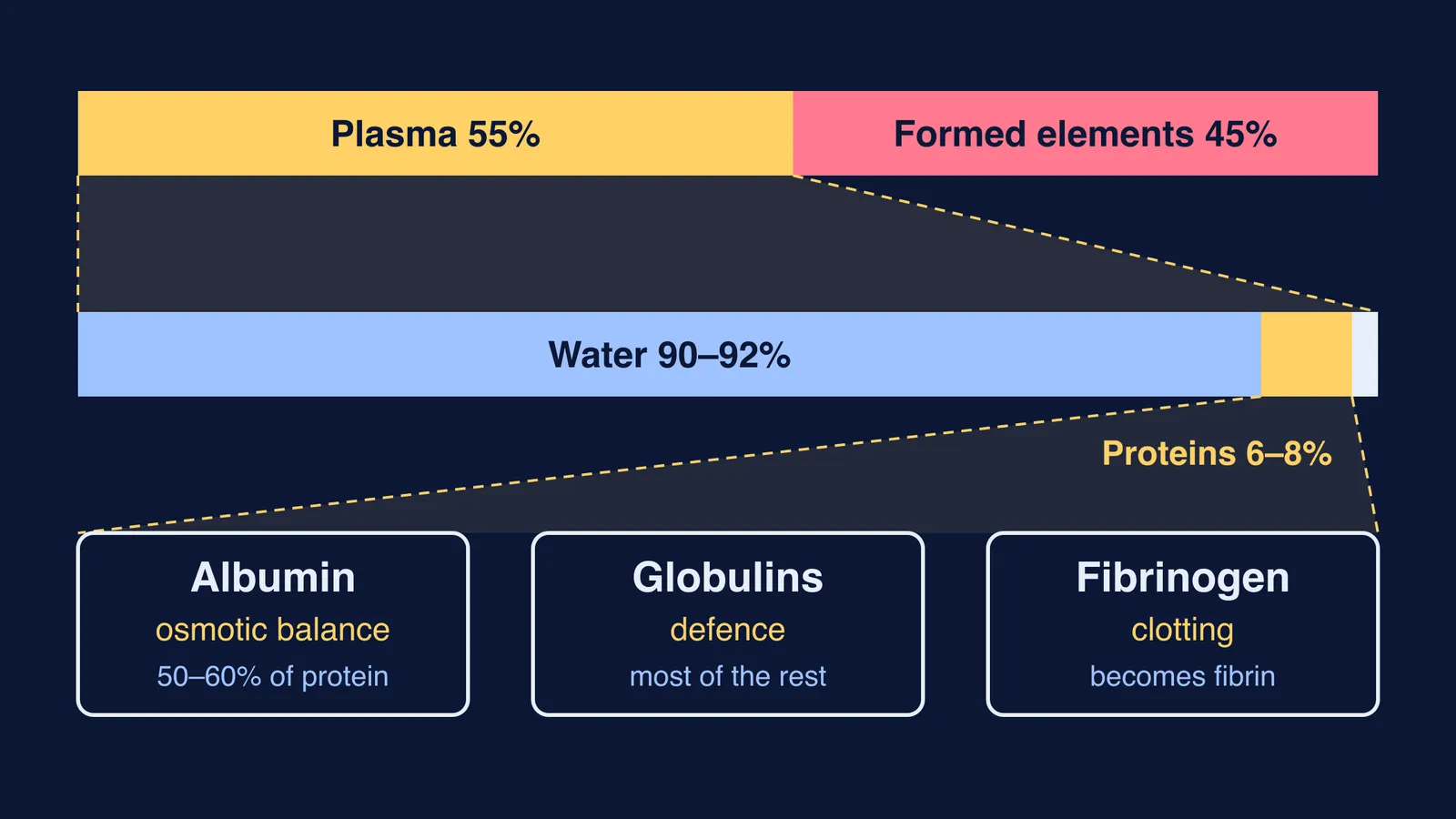
Plasma is a straw-coloured, viscous fluid that makes up nearly 55% of blood.
Water makes up 90–92% of plasma.
Proteins make up 6–8% of plasma.
Formed elements (RBCs, WBCs and platelets) make up nearly 45% of blood.
NCERT names fibrinogen, globulins and albumins as the major plasma proteins but does not split the 6–8% between them. The medical reference StatPearls says albumin is the most abundant plasma protein, at 50% to 60% of total plasma protein, with globulins making up most of the rest (StatPearls, Hypoalbuminemia). That is useful background; in a NEET-UG answer, stick to NCERT's figures.
For the rest of the blood picture, read our explainer on why plasma is about 55% of your blood.
What are the functions of albumin, globulin and fibrinogen?
NCERT gives each protein one job in a single short passage (NCERT Biology Class 11, Chapter 15):
Fibrinogen is needed for clotting or coagulation of blood.
Globulins are primarily involved in the defence mechanisms of the body.
Albumins help in osmotic balance.
A little more depth makes these stick. Osmotic balance means albumin helps hold water inside the blood vessels. StatPearls says albumin accounts for about 80% of the colloid osmotic pressure of plasma, and also carries fatty acids, calcium and hormones such as thyroxine (StatPearls, Hypoalbuminemia).
Fibrinogen is the raw material of a clot. NCERT explains that the enzyme thrombin converts inactive fibrinogen in the plasma into fibrin, a network of threads in which dead and damaged formed elements are trapped (NCERT Biology Class 11, Chapter 15).
How is albumin linked to tissue fluid?
NCERT describes what happens in the capillaries: some water and many small water-soluble substances move out into the spaces between cells, leaving the larger proteins and most of the formed elements inside the blood vessels (NCERT Biology Class 11, Chapter 15). This fluid is called interstitial fluid or tissue fluid, and it has the same mineral distribution as plasma. The lymphatic system collects it and drains it back into the major veins.
Now join the dots. Albumin is one of those larger proteins. Held inside the vessels, it keeps pulling water back; StatPearls describes this as maintaining oncotic pressure within the vascular compartments, which prevents fluid leakage into the spaces outside the vessels (StatPearls, Hypoalbuminemia).
So a clean exam line is: tissue fluid has the same mineral distribution as plasma, but the larger proteins, such as albumin, are mostly left behind in the blood vessels. Our post on lymph, plasma and tissue fluid sets the three side by side.
How is fibrinogen linked to serum?
NCERT defines it in one sentence: plasma without the clotting factors is called serum (NCERT Biology Class 11, Chapter 15). Fibrinogen is the protein the clot is built from, so when blood clots, fibrinogen is turned into fibrin and ends up in the clot, not in the fluid.
That gives you the second exam line: serum is plasma minus fibrinogen and the other clotting factors. Albumins and globulins are not clotting factors, so they stay in serum. If you mix up the two fluids, our plasma vs serum guide walks through the difference.
A two-minute self-test
Cover the answers, say yours out loud, then check.
"Serum contains fibrinogen." False: serum is plasma without the clotting factors.
"Tissue fluid has the same mineral distribution as plasma." True, straight from NCERT.
Which plasma protein helps in osmotic balance? Albumin.
"Proteins make up 55% of plasma." False: proteins are 6–8% of plasma; 55% is plasma's share of blood.
Which protein does thrombin convert into fibrin? Fibrinogen.
Which plasma proteins are mainly involved in defence? Globulins.
If you got any wrong, reread that section once, then try again tomorrow without looking.
If the bigger picture is still blurry, the Fermi Concept Library gives every biology concept its own lesson and its place in the map, so you can see where plasma proteins fit among related ideas. For practice questions, the Fermi Problem Library has worked problems with a step-by-step solver that explains the reasoning rather than printing an answer.