

On this page
Have you ever wondered what the clear, yellowish liquid is when blood separates in a test tube? Whether you are studying for exams or curious about blood tests, the difference between plasma and serum is a fundamental biological concept.
While they look similar and both come from blood, they play different roles in your body and in medical diagnostics. Here is exactly how they differ and why it matters.
What is blood plasma?
Blood plasma is the liquid component of blood that holds all the formed elements of blood—your red blood cells, white blood cells, and platelets—in suspension. It makes up about 55% of your body's total blood volume (Wikipedia).
Plasma is mostly water (up to 95% by volume) (Wikipedia). The rest consists of dissolved substances:
Proteins: These account for 6–8% of plasma. They include albumins (which maintain the osmotic pressure that keeps water inside your blood vessels), globulins (which transport minerals and act as antibodies), and fibrinogen (a crucial clotting factor).
Electrolytes: Ions such as sodium, calcium, magnesium, and bicarbonate, which maintain your body's pH and fluid balance.
Nutrients and waste: Dissolved glucose, hormones, carbon dioxide, and oxygen travelling to and from your cells.
Because it contains clotting factors, plasma is ready to form a clot. In medicine, doctors often rely on storing blood plasma for transfusions in trauma cases.
To see how these components interact, explore the Fermi Concept Library, where you will find every concept in physics, chemistry, biology, mathematics and computing, each with its own lesson and its place in the map.
What is blood serum?
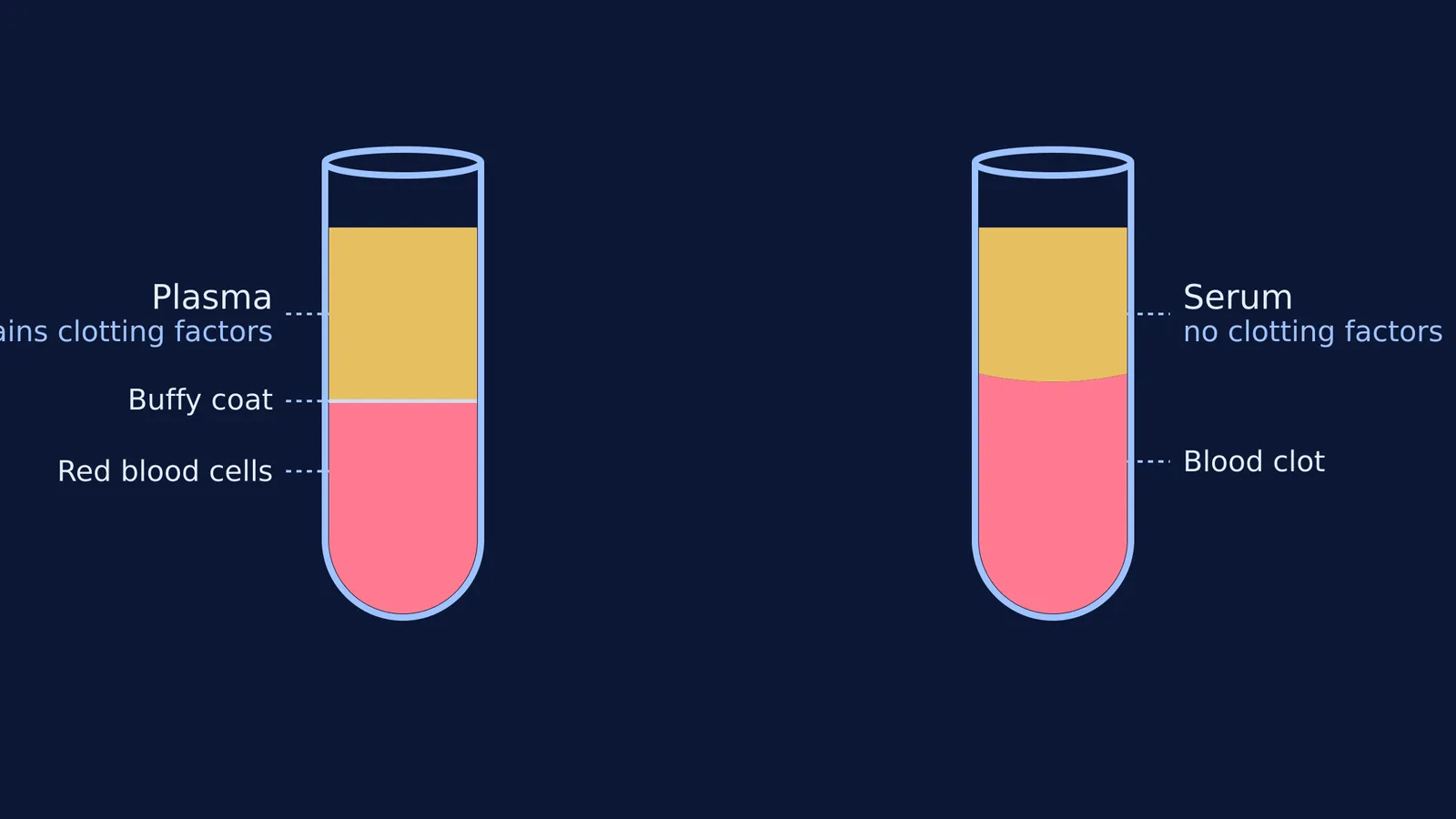
Blood serum is simply blood plasma without the clotting factors.
If you remove the fibrinogen and other proteins involved in coagulation from plasma, what you have left is serum (Wikipedia)). Serum still contains all the other crucial proteins, electrolytes, antibodies, antigens, and hormones found in plasma, just without the elements that cause blood to solidify.
Because it is rich in antibodies, serum from a patient who has recovered from an infection can sometimes be used to treat others with the same disease. This is a form of immunotherapy closely related to the principles of active vs passive immunity. By transferring the convalescent serum, doctors can provide immediate, passive protection against a pathogen.
How do you obtain plasma and serum?
The difference comes from how they are prepared in a laboratory. Both start with a standard blood draw, but the subsequent steps differ.
Obtaining plasma:
A healthcare worker draws whole blood into a collection tube that contains an anticoagulant—a chemical that actively stops the blood from clotting.
The tube is spun rapidly in a centrifuge.
The heavy blood cells sink to the bottom, leaving the clear, uncoagulated plasma at the top. This preparation is quick because there is no waiting time required for the blood to clot.
Obtaining serum:
Whole blood is drawn into a collection tube that does *not* contain any anticoagulant.
The blood sample is left to sit for about 30 minutes to allow a solid clot to form naturally (Wikipedia)). During this resting period, the fibrinogen and other clotting factors are entirely used up to build the clot.
The tube is then centrifuged. The dense clot and the trapped blood cells sink to the bottom, leaving the clear serum resting at the top.
Why do we use both in medical tests?
Diagnostic laboratories use both because each has practical advantages, depending on what the doctor is trying to measure.
Plasma is much faster to prepare because the lab technician does not have to wait for the blood to coagulate. It also yields a 15–20% larger volume of liquid from the exact same amount of drawn blood (Wikipedia). However, the anticoagulants that must be added to plasma tubes (such as EDTA or citrate) can interfere with certain chemical tests. For instance, EDTA works by binding to calcium, but it can also bind to zinc, which is necessary for some enzyme activity tests. If an enzyme needs zinc to function, using a plasma sample with EDTA will ruin the test.
Serum takes considerably longer to prepare, but because it has no added anticoagulants, it provides a much purer sample for a wide variety of chemical and enzyme tests. On the downside, the clotting process itself can sometimes alter the concentration of the molecules being measured. For example, blood cells consume some of the glucose in the blood while the clot is forming, which can inadvertently lower the blood sugar readings in a serum sample.
Understanding these practical differences is a great example of active learning. When you can see exactly how a textbook biological definition dictates a real-world laboratory method, the underlying concept is much more likely to stick. If you are practising for an upcoming exam and want to test your understanding, Fermi's AI tutor works out what you already know, builds a plan for the session, and teaches through it — writing on a board, drawing the figure, running the simulation, and checking understanding as it goes.


