

On this page
Look at a pigeon on your balcony railing or a hen in a village yard and you will see two kinds of skin covering on one animal. The body is feathered. The lower legs and toes are wrapped in small, hard plates that look like a lizard's. That is not a coincidence, and it is a line from the NCERT chapter that NEET-UG biology draws on.
Why do birds have scales on their legs?
The short answer: birds descend from reptiles, and leg scales are one of the clearest leftovers you can see without a microscope.
The NCERT Class 11 Biology textbook says of Class Aves: "The hind limbs generally have scales and are modified for walking, swimming or clasping the tree branches" (NCERT Biology Class 11, Chapter 4, Animal Kingdom). The same chapter describes reptiles as having "dry and cornified skin, epidermal scales or scutes."
Put those two lines side by side and you have the classroom argument: birds share a skin covering with reptiles because they share ancestors with them. We go through the other clues in why birds are called glorified reptiles.
Are bird leg scales the same as reptile scales?
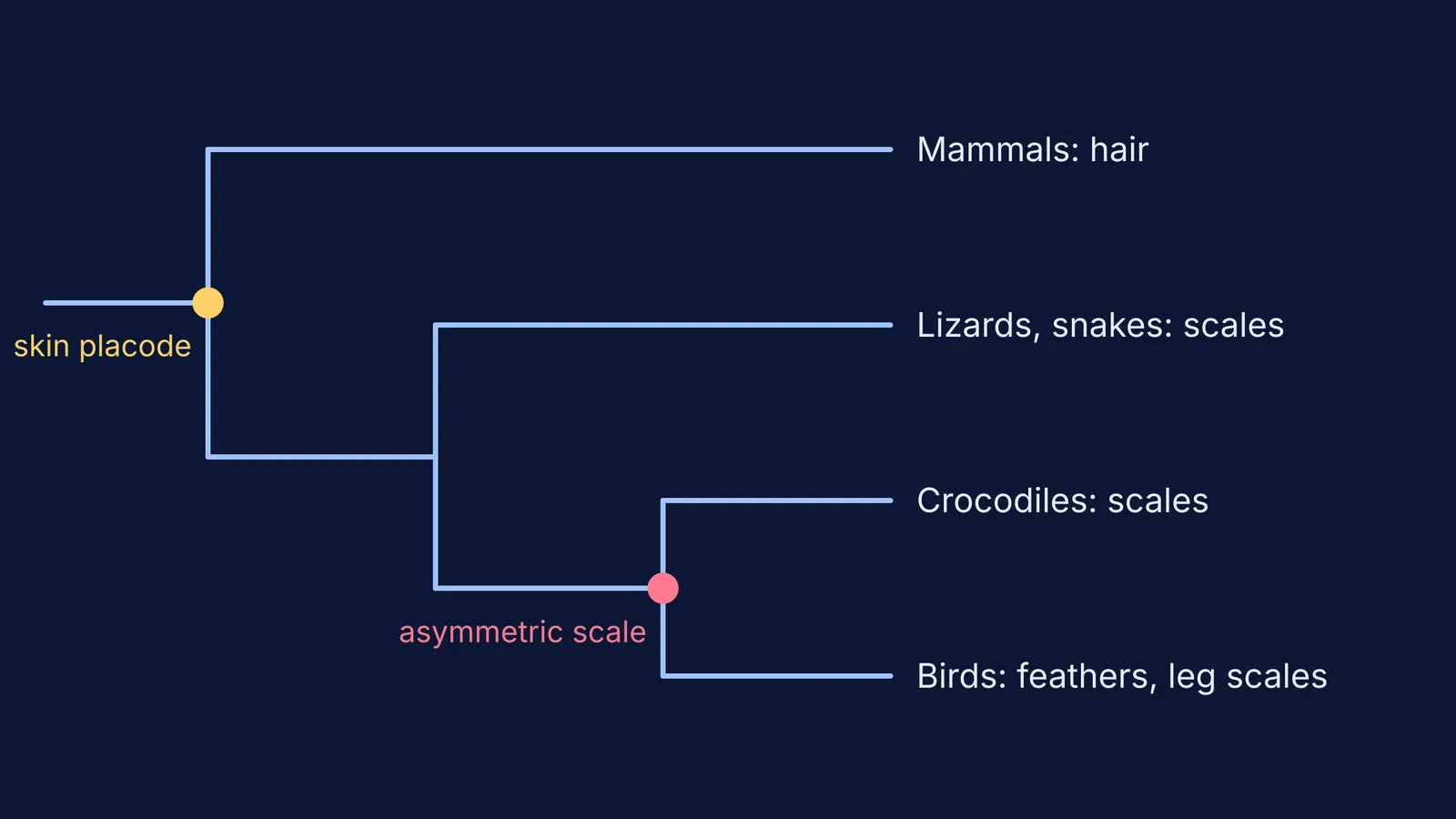
In 2015, Jacob Musser, Günter Wagner and Richard Prum tracked a protein called β-catenin in the developing skin of birds and alligators (Evolution and Development, 2015). Feathers, the overlapping scutate scales on bird feet and alligator scales showed similar early patterns. The authors say this supports the hypothesis that all three are homologous in early development and derive from an asymmetric scale in the archosaur ancestor, the group that includes crocodilians and birds.
A year later, Nicolas Di-Poï and Michel Milinkovitch showed that crocodile, snake and lizard embryos build their scales from an anatomical placode, a thickened patch of skin with features and molecular signals also seen in the placodes of hair and feathers (Science Advances, 2016). Their conclusion: scales, feathers and hair are homologous structures inherited from a shared reptilian ancestor.
There is a twist. Danielle Dhouailly argued that the overlapping scales on the feet of some birds "may have developed later in evolution, being secondarily derived from feathers" (Journal of Anatomy, 2009). So a bird's foot scale may be a feather programme turned back towards scale-making, not a lizard scale passed down unchanged. Either way, the skin machinery traces back to the reptile side of the family tree.
For the chemistry, read whether feathers, hair and scales are made of the same protein.
Can birds grow feathers on their feet instead of scales?
Yes, and that tells you the switch is genetic. Some pigeon breeds have feathered feet. Eric Domyan, Michael Shapiro and colleagues found that this comes from a partial shift of the hindlimb towards forelimb identity, caused by regulatory changes in two genes: Pitx1, which is specific to hindlimbs, and Tbx5, which is specific to forelimbs (eLife, 2016). They also linked Tbx5 to foot feathers in chickens.
The same leg skin can make scales or feathers depending on its instructions, which fits the idea that both grew from one ancestral skin system.
How do you answer exam questions on bird scales?
Learn the line and the reason together, then run this check on any statement about birds.
Find the body part. Forelimbs are modified into wings; hind limbs carry scales. A statement that swaps them is wrong.
Watch the qualifier. NCERT says hind limbs "generally" have scales, so be wary of "always" or "all birds". Feather-footed pigeons show why.
Link it to reptiles. If you are asked which bird feature points to reptilian ancestry, scaly legs are the textbook example.
Here is a practice item we wrote in the style of a NEET statement question (it is not from a past paper).
Which statement about Class Aves is correct?
(a) Forelimbs carry scales and hind limbs are modified into wings.
(b) Hind limbs generally have scales and are modified for walking, swimming or clasping.
(c) The skin has many glands.
(d) The long bones are solid.
Answer: (b). Option (a) swaps the limbs. Option (c) is wrong because NCERT says bird skin is dry, without glands except the oil gland at the base of the tail. Option (d) is wrong because the long bones are hollow with air cavities (pneumatic). All four options come from one section of the NCERT Animal Kingdom chapter.
If you mix up which animals count as reptiles, our explainer on why a crocodile is a reptile and not an amphibian sorts it out.
Where do you go from here?
Words like homologous and placode connect the Animal Kingdom chapter to Evolution in Class 12. If they still feel slippery, the Fermi Concept Library gives every concept in biology its own lesson and its place in the map, so you can see how the two chapters link. When a statement question trips you up, the Fermi Problem Library has worked problems with a step-by-step solver that explains the reasoning rather than printing an answer.
Next time a pigeon lands on the railing, look at its feet: an NCERT line and a piece of reptile history in one place.


