

On this page
Your hair, a pigeon's wing and a snake's back feel very different. Yet they are built in the same basic way, and their differences match the vertebrate family tree you study in Class 11.
Are feathers, hair and scales made of the same protein?
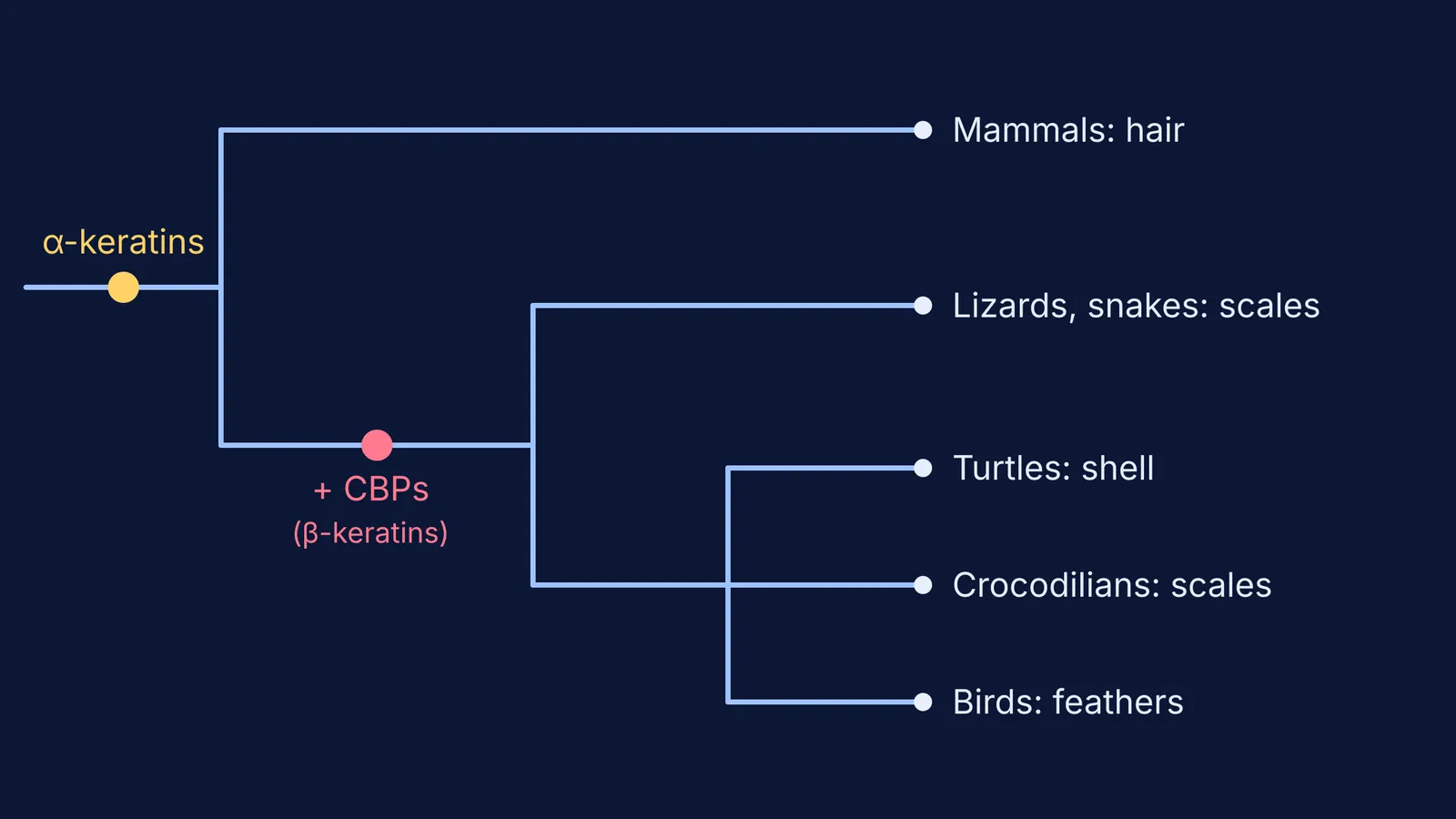
The short answer is: some of the same, some different. Alpha (α) keratins are found in all vertebrates, while beta (β) keratins are found only in reptiles and birds, according to a study of 48 bird genomes by Greenwold and colleagues (2014). The same study found that chicken scales and feathers do make α-keratins, but the number of β-keratin genes switched on, and how strongly they are used, far exceeds the α-keratins.
The name "β-keratin" turned out to be misleading. A 2018 review by Holthaus, Eckhart, Dalla Valle and Alibardi calls them corneous beta-proteins (CBPs) to avoid confusion with true keratins: their genes evolved inside a gene cluster called the epidermal differentiation complex, which has no relationship with the genes for true keratins. The same review notes that mammals' hair, claws, horns and nails contain keratin-associated proteins instead.
Hair (mammals): α-keratins plus keratin-associated proteins, with no CBPs.
Reptile scales and claws: α-keratins plus CBPs.
Feathers (birds): bird-specific CBPs make most of the hard material, alongside some α-keratins.
Why are hair, feathers and scales dead?
They are dead because that is how they are made. Skin cells called keratinocytes go through a form of programmed cell death called cornification, explains a review by Eckhart and colleagues (2013). The cell fills with keratin filaments, its organelles are removed, and proteins at its edge are chemically cross-linked into a tough envelope. In hair and nails, the tight links between these dead cells stay permanent.
A 2025 review by Holthaus and colleagues sums it up in one line: scales, feathers, hair and claws consist of dead epithelial cells tightly packed with structural proteins. Dead cells are also part of why a haircut does not hurt; see why cutting your hair and nails does not hurt.
A 2014 study by Strasser and colleagues links these cross-linked proteins to two jobs on land: building tough surface layers and limiting water loss.
What do keratins tell us about how vertebrates are related?
Four clues stand out.
Only reptiles and birds have CBPs. That points to an ancestor that reptiles and birds share and mammals do not. The 2018 Holthaus review also found that CBPs fall into two groups: one in lizards and snakes, and one in crocodilians, birds and turtles. Birds sit inside the reptile family, which is why they are often called glorified reptiles.
Hair proteins are older than hair. Eckhart and colleagues (2008) found hair keratin-like genes in the green anole lizard (two type I and four type II) and one in the chicken. In the lizard they were most active in the toes, which suggests a role in claws. Their conclusion: the evolution of hair involved reusing proteins that already existed.
The same starting point in the embryo. Hair and feathers begin as a small thickening of the skin called a placode. Di-Poï and Milinkovitch (2016) showed that crocodiles, snakes and lizards form one too for their scales. Lizards with a mutation that leaves them scaleless did not form placodes. The authors concluded that hair, feathers and scales are homologous, inherited with changes from a shared reptile-like ancestor.
Fish and amphibians are outside the group. The 2014 Strasser study found versions of the epidermal differentiation complex in the chicken and the anole lizard, but not in fish or amphibians. It suggests one skin protein, loricrin, arose in the common ancestor of amniotes, perhaps as they moved fully onto land. That is the same group defined by the amniotic egg.
How do you answer a keratin question in an exam?
Run this three-question check on any claw, beak, hoof or scale:
Whose is it? Mammal: α-keratins with keratin-associated proteins. Reptile or bird: α-keratins with CBPs.
Alive or dead? The visible part is dead, cornified cells.
Homologous or analogous? Hair, feathers and reptile scales are homologous: same ancestral origin, different forms.
Worked example. Question: "Are bird feathers and mammal hair homologous? Give one piece of evidence." A strong answer: "Yes. Both begin as an epidermal placode, and reptiles form the same placode for their scales, so all three come from the skin structures of a shared reptile-like ancestor (Di-Poï and Milinkovitch, 2016). Their proteins differ because feathers mostly use corneous beta-proteins, which only reptiles and birds make."
If homology, amniotes or protein structure still feel shaky, the Fermi Concept Library gives every biology concept its own lesson and its place in the map.
Next time you see a pigeon, try the three questions on its feathers, beak and scaly feet.


