

On this page
A pigeon on your balcony picks up a grain of bajra and swallows it whole. It does not chew, yet the grain still gets ground up. Birds still chew in a sense. They just do it in the stomach instead of the mouth.
Why do birds not have teeth?
The short answer is that the ancestor of every living bird lost its teeth, and none of its descendants got them back. In 2014 Robert Meredith, Mark Springer and colleagues compared the genomes of 48 bird species from nearly all living bird orders (Meredith et al., Science, 2014). They checked six genes that build tooth tissue: DSPP for dentine, and AMTN, AMBN, ENAM, AMELX and MMP20 for enamel (ScienceDaily summary of the study).
All 48 species shared several of the same inactivating mutations in these genes, so the mutations most likely happened once, in their common ancestor.
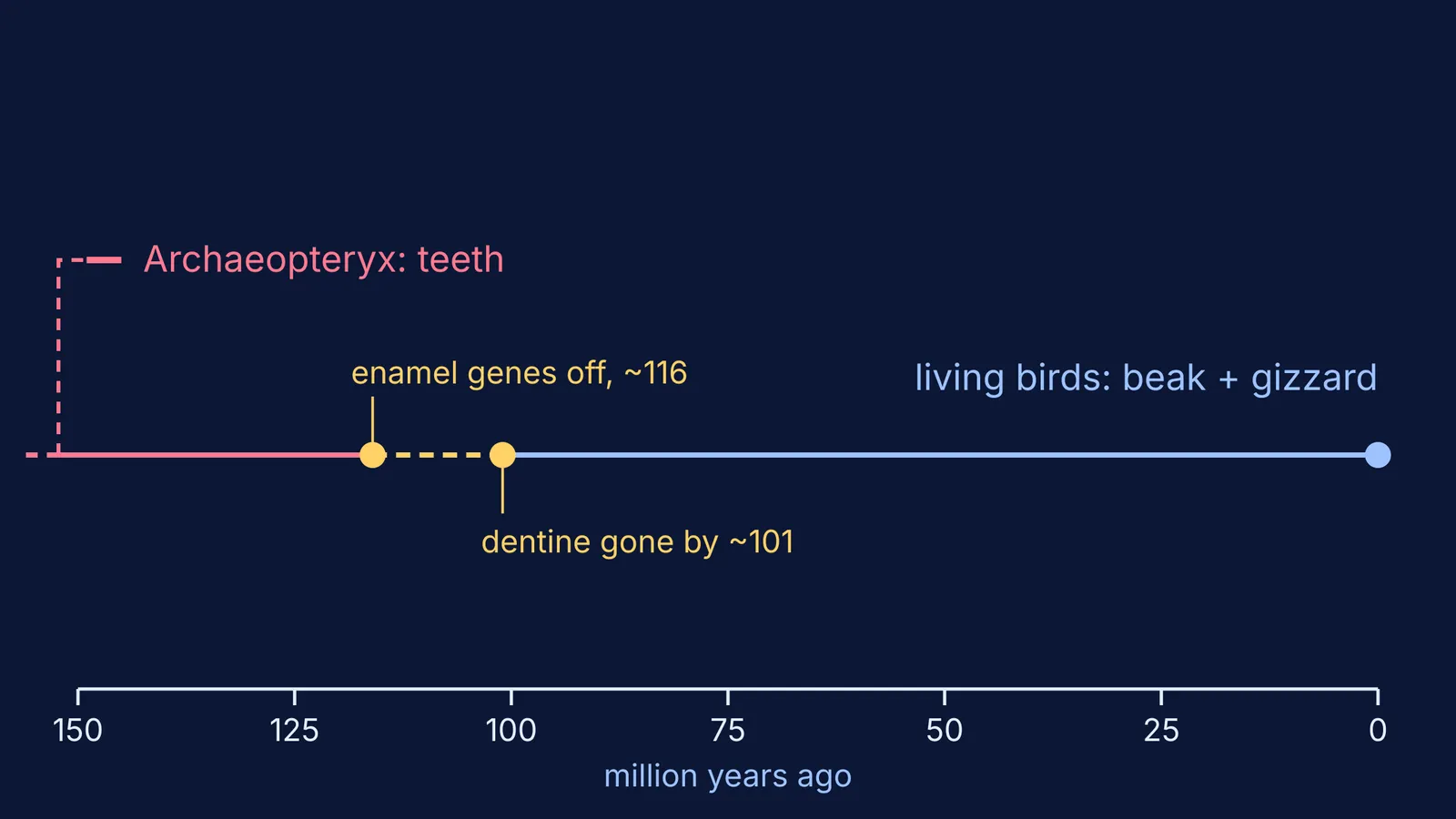
The team dated the loss of enamel to about 116 million years ago (Meredith et al., 2014). The same study puts the loss of dentine, and so of teeth altogether, at no later than about 101 million years ago (Audubon). Every descendant inherited the broken genes, which is why sparrows, kites and ostriches are all toothless.
How do birds chew food without teeth?
Birds split the work that our teeth do between two organs. Modern birds use a horny beak, called the rhamphotheca, and a muscular gizzard to acquire and process food (Meredith et al., 2014).
Grab: the beak. It picks up and holds food but does not grind it. A chicken takes in feed with its beak and uses its tongue to push it back to be swallowed (Poultry Extension).
Soften: the proventriculus. This is the glandular stomach, where hydrochloric acid and pepsin start breaking down the food chemically (Poultry Extension).
Grind: the gizzard. Also called the ventriculus, the gizzard is the mechanical stomach. Its two sets of strong muscles act as the bird's teeth (Poultry Extension).
Extra grinding surfaces: grit. The gizzard's thick muscular walls are often helped by particles of stone or grit that the bird swallows (Birds Outside My Window).
In your mouth, different kinds of teeth do this work (see how mammal teeth are described as thecodont, diphyodont and heterodont). Earthworms grind food in a gizzard too, as our walk through the earthworm gut, from mouth to anus shows.
Did birds lose their teeth to be lighter for flight?
This is the classic explanation. The idea, in the words of a University of Bonn release, is that a skull without teeth is lighter and so better suited to flying (University of Bonn, 2018). A keratin beak is light, and the grinding moves from the head to the gizzard.
Weight alone can't explain it, though. Bats fly without giving up their teeth, and Archaeopteryx flew and had teeth (Audubon). Toothless beaks also evolved several times in meat-eating dinosaurs that never flew (University of Bonn, 2018).
In 2018 Tzu-Ruei Yang and P. Martin Sander proposed a second reason (Yang and Sander, Biology Letters, 2018). Earlier research on dinosaur embryos had found that tooth formation takes up about 60 percent of incubation time (University of Bonn, 2018). If embryos skip teeth, they could hatch sooner and spend less time as eggs that predators can eat. The authors say plainly that their idea is a hypothesis without experimental support so far.
Doesn't toothed Archaeopteryx break the rule?
No. The rule is about living birds. Archaeopteryx lived in the Late Jurassic, 149 to 145 million years ago, in what is now Germany, and had many small, cone-shaped teeth (Natural History Museum, London).
That is roughly 30 million years before enamel loss at about 116 million years ago. Ever since Archaeopteryx was found in 1861, it has been clear that living birds descend from toothed ancestors (ScienceDaily). Its teeth are a reptile-like feature that later birds lost. This is the same kind of evidence behind why birds are called glorified reptiles.
How should you answer this in an exam?
For a three-mark question such as "Why are modern birds toothless?", write three points in this order:
Living birds descend from one toothless common ancestor; all of them share inactivating mutations in enamel and dentine genes, and enamel was lost about 116 million years ago.
The beak takes in food, and the muscular gizzard, often helped by swallowed grit, grinds it instead of teeth.
Proposed advantages are a lighter head for flight and shorter incubation; early fossil birds such as Archaeopteryx still had teeth.
Before you submit, check for these four mistakes:
Writing "birds never had teeth". Archaeopteryx had them.
Giving flight as the only, proven reason. Bats are the counter-example.
Mixing up the proventriculus (chemical digestion) and the gizzard (mechanical grinding).
Calling the gizzard unique to birds.
If you keep mixing up the parts of the digestive system, the Fermi Concept Library gives every biology concept its own lesson and shows where it sits in the map.
Next time you see a pigeon swallow a grain whole, remember that the grinding is still to come, in its gizzard.


