

On this page
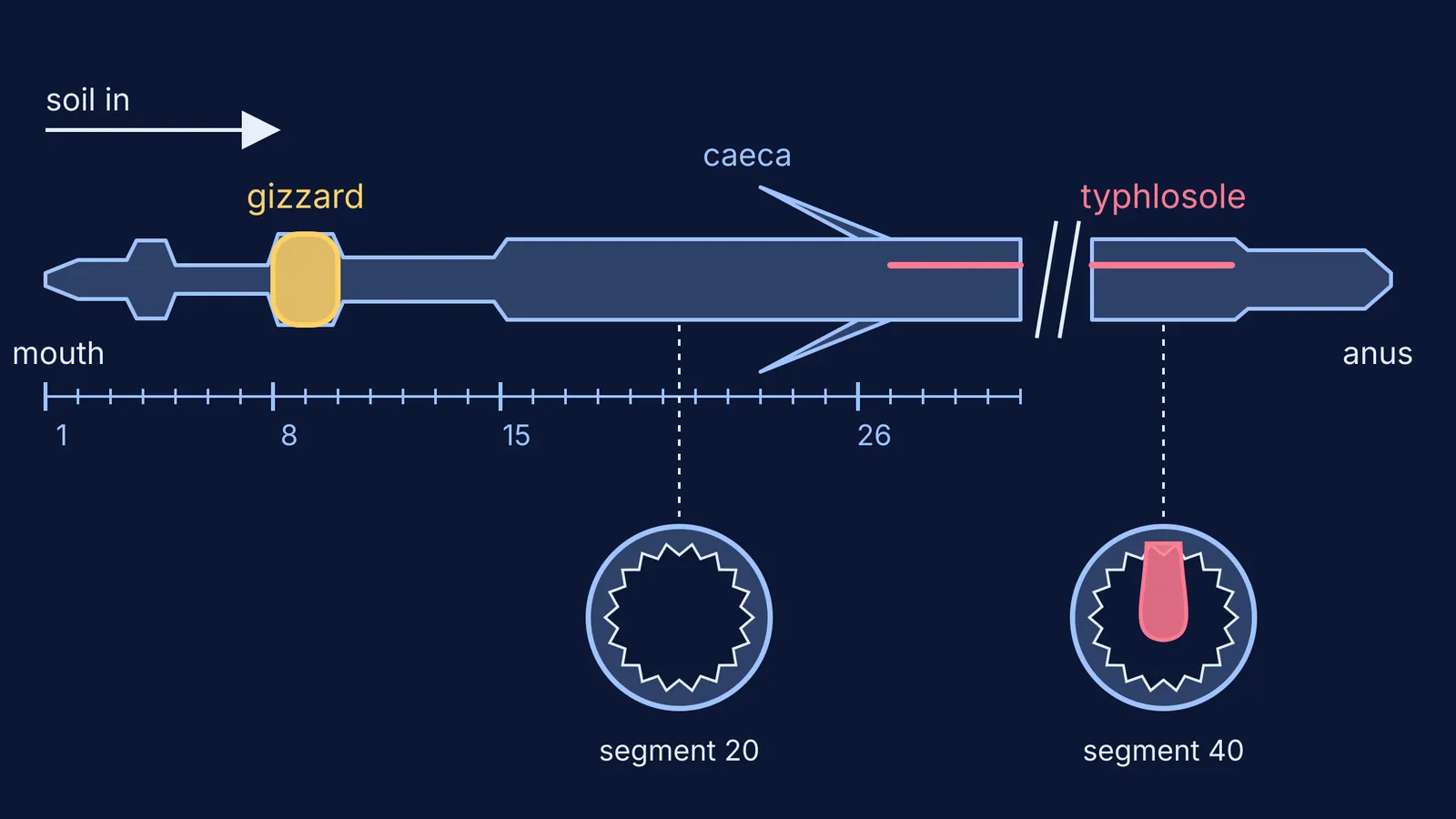
An earthworm's gut is one straight tube from mouth to anus. Soil goes in at the front and leaves as castings at the back. In between, the gizzard grinds and the typhlosole absorbs. This guide follows one mouthful of soil through *Pheretima posthuma*, segment by segment.
A syllabus note first: the current NCERT Class 11 chapter Structural Organisation in Animals (reprint 2026-27) describes only the frog, so check whether your board still lists the earthworm.
What does the gizzard do in an earthworm?
The gizzard is the earthworm's grinding mill. A college's zoology e-content notes on Pheretima posthuma describe it as an oval, thick-walled, highly muscular organ in the 8th or 8th–9th segment. A cuticle lining makes it the hardest part of the gut, and contractions of its circular muscles grind food into a fine state.
An earthworm's mouth has no teeth, so the gizzard does the job of your molars. Smaller particles give digestive enzymes more surface to act on. Next comes the stomach (segments 9 or 10 to 14), whose calciferous glands help neutralise the food and whose gland cells release protein-digesting enzymes.
A 2011 PLOS ONE study by Liu and colleagues cites earlier work suggesting the gizzard may physically break down mineral grains, increasing the surface open to attack. The same paper notes that food usually takes 12 to 20 hours to pass through an earthworm's gut.
Cockroaches have a gizzard too; our post on the gizzard and hepatic caeca in the cockroach makes a useful comparison.
What is the typhlosole and how does it increase absorption?
The typhlosole is a fold of the dorsal (upper) wall of the intestine that hangs down into the gut cavity. The Wikipedia entry on the typhlosole, citing Brusca's textbook *Invertebrates*, says that in earthworms it runs along most of the intestine and forms a tube within a tube, adding its own surface to the absorbing lining. It also notes that many earthworms have no typhlosole at all.
In *Pheretima*, the college notes place the typhlosole from the 27th segment to just before the last 23–25 segments, and call it a highly vascular (blood-rich), glandular fold. The typhlosole splits the intestine into three regions:
Pre-typhlosolar (segments 15–26): villi but no typhlosole. A pair of short, conical intestinal caeca arise in segment 26 and reach forward to segment 23; they make amylase, which digests starch.
Typhlosolar (segment 27 to the last 23–25 segments): villi plus the typhlosole, the main absorbing zone.
Post-typhlosolar, or rectum (last 23–25 segments): no villi and no typhlosole.
Worked example: how much does one fold add? These are round numbers to show the idea, not measurements. Picture a slice of intestine as a circle with an inner radius of 1 mm. Its lining measures 2π × 1, about 6.3 mm around. Push a fold 1 mm deep down from the roof. The fold has two faces, so the lining gains about 2 mm, to about 8.3 mm: roughly a third more absorbing surface per slice, without a wider worm. Villi in your small intestine use the same trick. If digestion and absorption still blur together, see digestion vs absorption vs assimilation.
How does soil travel through the earthworm gut, step by step?
Use this labelled-sequence checklist, with segment numbers from the Pheretima notes.
Mouth (segment 1): soil and decaying leaves go in.
Buccal cavity (segments 2–3): pushes out to grip food, then pulls it in.
Pharynx (to segment 4): glands add saliva with mucin and protease.
Oesophagus (segments 5–7): a narrow tube with no glands.
Gizzard (segment 8, or 8–9): muscular walls grind food fine.
Stomach (segments 9 or 10 to 14): neutralising and protein digestion.
Pre-typhlosolar intestine (15–26): villi; caeca at segment 26 add amylase.
Typhlosolar intestine (27 onward): extra surface; nutrients enter the blood.
Rectum (last 23–25 segments): no villi, no typhlosole.
Anus (last segment): undigested soil leaves as castings.
Segment numbers belong to the species. A Tamil Nadu Class 11 zoology summary on Lampito mauritii puts that worm's gizzard in segment 6, with the intestine starting at segment 7.
How do you check a labelled earthworm gut diagram?
Quick checks before you submit, using the segment numbers from the Pheretima notes:
Order: oesophagus, then gizzard, then stomach. Do not swap gizzard and stomach.
Caeca: at segment 26, pointing forward toward the head.
Typhlosole: on the dorsal side, starting after the caeca and stopping before the rectum.
Function words: gizzard grinds (mechanical digestion); typhlosole increases absorptive surface; caeca secrete amylase.
A two-mark answer can be this short: "The gizzard (segment 8, or 8–9) is a thick-walled muscular organ with a cuticle lining that grinds soil and organic matter into fine particles. The typhlosole is a vascular fold of the dorsal intestinal wall, from segment 27, that increases the surface area for absorption."
If surface area keeps turning up across chapters, Fermi's Concept Library gives every concept in biology its own lesson and its place in the map, so you can see how gizzards, villi and alveoli connect. For another earthworm question, read whether both halves of a cut earthworm live.


