

On this page
Your Class 11 paper may ask why Ascaris is not digested in the human intestine. A strong answer uses two terms early, cuticle and anti-enzymes, then adds a few more adaptations. Here is the biology, what researchers have found, and a model answer you can adapt.
The topic matters beyond the exam. The WHO fact sheet on soil-transmitted helminths estimates that 1.5 billion people, or 24% of the world's population, carry these worms, and it names the roundworm *Ascaris lumbricoides* as one of the main species.
Why is Ascaris not digested in the human intestine?
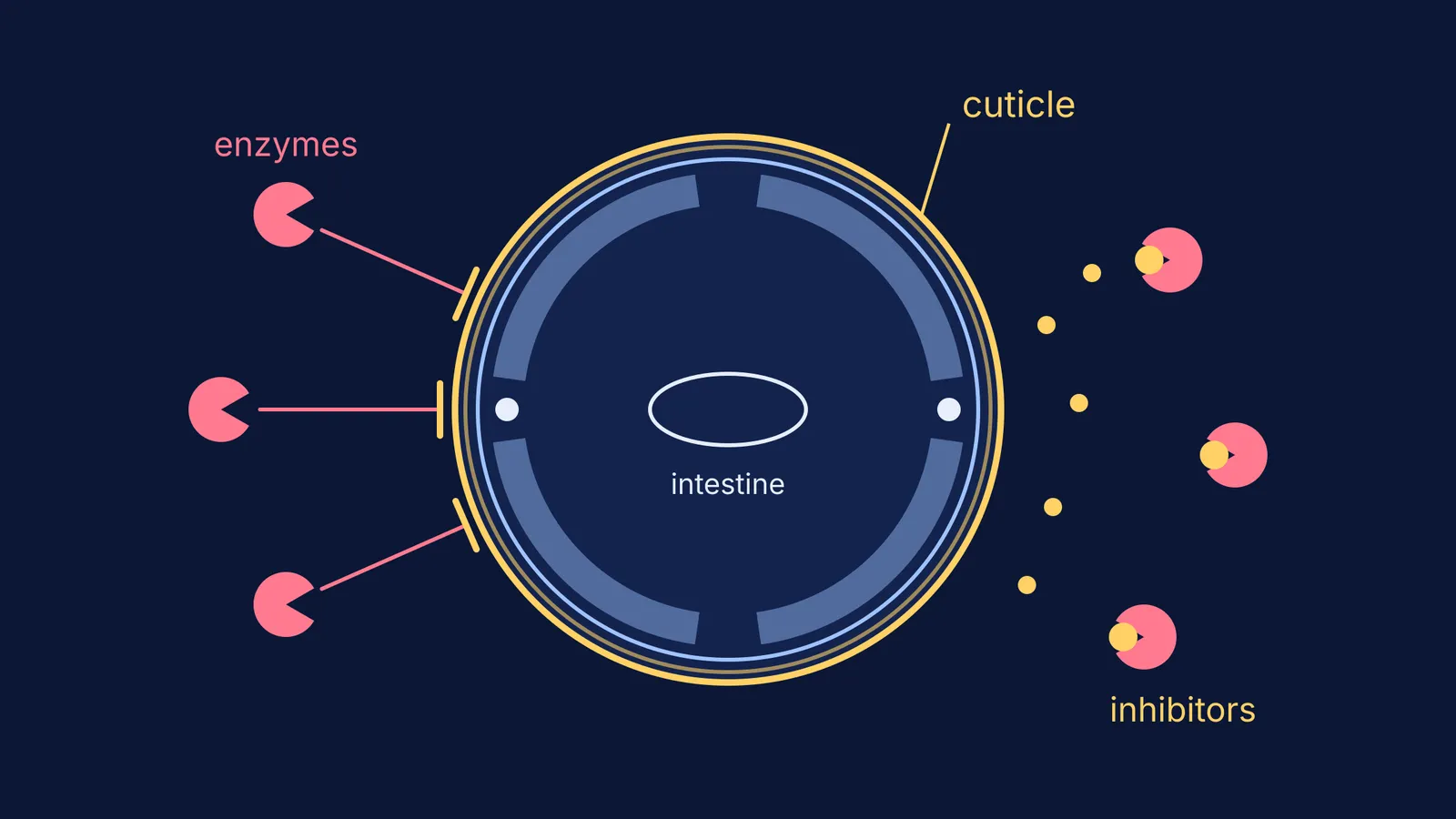
According to the CDC's DPDx page on ascariasis, adult *Ascaris* worms live in the lumen of the small intestine and can live 1 to 2 years. That is also where pancreatic enzymes such as trypsin and chymotrypsin break down protein from food. Two defences stop the worm from being digested like food.
A tough cuticle: a non-living outer layer that digestive juices cannot easily break down.
Anti-enzymes: proteins the worm makes that switch off the host's digestive enzymes.
A 2009 study in PNAS sums it up: "A battery of selective inhibitors protects them from host enzymes and the immune system" (Sanglas et al., 2009).
What is the Ascaris cuticle made of?
The nematode cuticle is made of cross-linked collagens, insoluble proteins called cuticlins, glycoproteins and lipids, according to the WormBook review The cuticle by Page and Johnstone. The same review calls it "an extremely flexible and resilient exoskeleton" that gives the worm environmental protection and attaches to its muscles for movement. The cuticle is made five times: once in the embryo, then again after each of the four larval stages, with a moult each time.
For your answer, the key word is cross-linked. Collagen chains tied to one another form a tough mesh, so it is much harder for enzymes to cut through than loose protein.
What are anti-enzymes in Ascaris?
Textbooks say "anti-enzymes". Researchers call them protease inhibitors. *Ascaris* roundworms secrete inhibitors that target pepsin, trypsin, chymotrypsin/elastase, cathepsins and metallocarboxypeptidases, according to Sanglas et al. in PNAS.
One of these molecules has been studied in atomic detail. In 2000, Ng and colleagues solved the 3D structure of *Ascaris* pepsin inhibitor-3 bound to pig pepsin. Their work showed that the inhibitor's first few amino acids occupy the enzyme's active site and block the first three pockets where a food protein chain would normally bind (Ng et al., Nature Structural Biology).
What other adaptations should a board answer mention?
The cuticle and anti-enzymes answer the question asked. For a longer answer, add some of these:
Anaerobic respiration: adults of the closely related pig roundworm *Ascaris suum* live in the low-oxygen small intestine and rely mainly on fumarate respiration, an anaerobic pathway (Inaoka et al., 2015).
Huge egg output: a female may produce about 200,000 eggs per day, which leave the body in faeces (CDC DPDx). So many eggs raise the chance that some reach a new host.
Muscular pharynx: NCERT notes that roundworms have a complete alimentary canal with a well-developed muscular pharynx (NCERT Class 11 Biology, Animal Kingdom). This helps the worm draw in food from the host's gut.
Separate sexes and internal fertilisation: the same NCERT section says sexes are separate, females are often longer than males, and fertilisation is internal.
Spread through soil: the WHO fact sheet explains that eggs in human faeces contaminate soil where sanitation is poor, which is how new hosts get infected.
To compare the two worms, see our guide to tapeworm adaptations for parasitic life and this overview of ectoparasite and endoparasite adaptations.
How do you write this answer in the exam?
Here is a model three-mark answer:
"Ascaris lives in the human small intestine, where proteolytic enzymes are present. It is not digested because (1) its body is covered by a thick, resistant cuticle made of cross-linked collagen, and (2) it secretes anti-enzymes (protease inhibitors) that inactivate host enzymes such as pepsin, trypsin and chymotrypsin. (3) It also respires anaerobically, which suits the low-oxygen intestine."
Before you hand the paper in, check that your answer:
names where the worm lives (lumen of the small intestine)
uses both terms, cuticle and anti-enzymes, in the first two lines
names at least two enzymes that are blocked
adds one or two more adaptations for a five-mark question
leaves out hooks and suckers
The same reasoning explains a classic follow-up, why the stomach does not digest itself: in both cases, living tissue is protected from enzymes that digest protein.
If terms like pseudocoelom, cuticle or protease inhibitor still feel hazy, the Fermi Concept Library has a lesson for every concept in biology, each with its place in the map. To practise answering, try the Fermi Problem Library, where a step-by-step solver explains the reasoning rather than just printing an answer.


