

On this page
Parasites are organisms that survive by drawing nutrients from a living host, often causing harm in the process. According to the World Health Organization (WHO), soil-transmitted helminths—a group of internal parasites—infect more than 1.5 billion people worldwide. To thrive in such vast numbers, these organisms have evolved highly specific physical and reproductive traits.
Whether they live on the surface of the skin or deep inside the digestive tract, parasites face unique challenges. Ectoparasites (external) and endoparasites (internal) have developed entirely different toolkits to attach to their hosts, avoid being destroyed, and ensure their offspring find a new host.
How do ectoparasites and endoparasites differ?
The primary difference between the two groups lies in their habitat, which dictates their survival strategies. Ectoparasites, such as ticks, lice, and fleas, live on the external surface of a host. Their main challenges are avoiding being brushed off, surviving changes in temperature, and quickly piercing the skin to feed on blood. Because they live outside, they retain functional sense organs to locate their next meal.
Endoparasites, such as tapeworms and roundworms, live entirely inside the host's body, often in the gut, bloodstream, or organs. Their environment is dark, warm, and constantly bathed in nutrients, but it is also filled with destructive digestive enzymes and immune cells. The adaptations of an endoparasite focus heavily on resisting these internal defenses and managing the complex, often difficult process of transmitting offspring to a new host. Understanding these differing strategies is an essential part of human health and immunity for biology students.
Why do endoparasites lose their organs?
One of the most fascinating adaptations of endoparasites is the loss of unnecessary body systems. In evolutionary biology, maintaining complex organs requires energy. If a system is not needed, it is often simplified or lost entirely over long periods of evolutionary time.
Because they live in the stable, nutrient-rich environment of the host's intestines, many endoparasites lack sensory organs like eyes or complex nervous systems. The most extreme example of this is the tapeworm, which has completely lost its digestive tract. Adult tapeworms lack a mouth, esophagus, and intestine, absorbing all necessary nutrients directly through their outer body wall (NCBI Bookshelf). If you need help visualizing how biological systems are simplified across different phyla, the Fermi Concept Library gives each evolutionary concept its own lesson and its place in the map.
How do parasites attach to their hosts?
Whether inside or out, a parasite must hold on tight. The host's body is constantly moving, shedding skin, or pushing food through the digestive tract.
Endoparasites use specialized anchoring structures to avoid being flushed out of the intestines. The pork tapeworm (*Taenia solium*) has a tiny, 1-to-2-millimeter head called a scolex, which is equipped with four muscular suckers and a rostellum containing two rows of hooks to grip the intestinal lining (CDC). Ectoparasites, on the other hand, rely on grip and glue. Head lice use specialized claws to grasp hair shafts tightly. Furthermore, the adult female louse secretes a strong, cement-like substance to glue her eggs—known as nits—directly to the base of the hair shaft, usually within 6 millimeters of the scalp, ensuring they cannot be easily brushed away (CDC).
Why is parasite reproduction so high?
For an endoparasite, finding a new host is a game of chance with terrible odds. Their eggs are usually excreted in feces and must survive in the open environment until they are accidentally ingested by another animal or human. This complex journey mirrors the intricate steps seen in the Plasmodium life cycle that causes malaria, where the parasite relies on mosquitoes to bridge the gap.
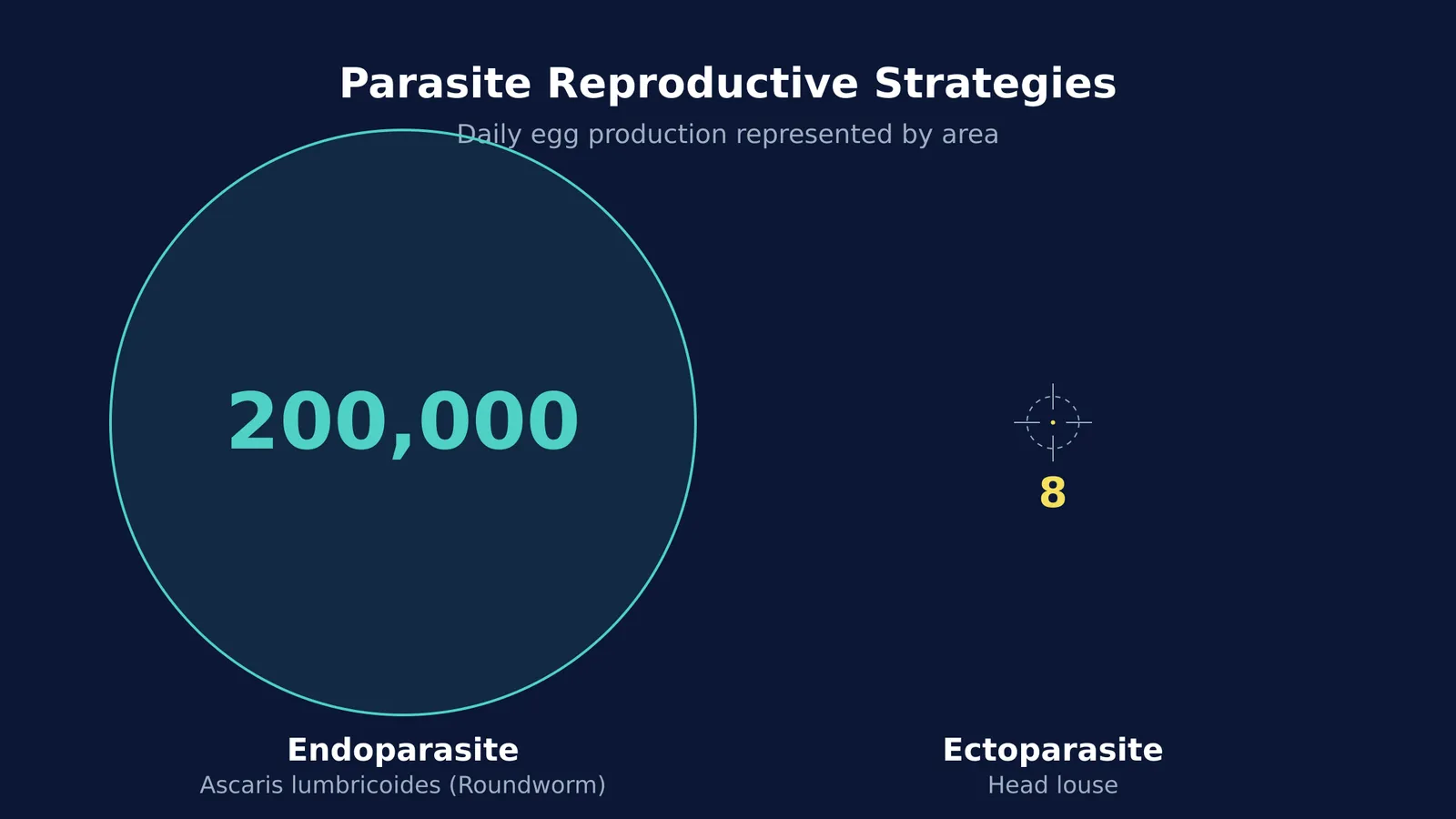
To compensate for this risky transmission, endoparasites have evolved massive reproductive capacities. The human roundworm (*Ascaris lumbricoides*) is a prime example. A single adult female can lay up to 200,000 eggs per day, and these thick-shelled eggs can remain viable in the soil for years. In stark contrast, a head louse—whose offspring hatch directly onto a ready-made host—only needs to lay up to 8 eggs per day to sustain its population.
The study of these adaptations highlights the relentless arms race between hosts and the organisms that feed on them, a biological puzzle that scientists like Carlos Chagas spent their lives unravelling. From shedding entire organ systems to producing millions of offspring, parasites have perfected the art of biological survival.


