

On this page
Tapeworms (class Cestoda) are often taught in biology as a classic example of an endoparasite. Living inside the human small intestine—a hostile, fast-moving environment filled with digestive enzymes—requires a specialised body plan.
To survive, these flatworms have evolved distinct physical and physiological traits. They have gained specialised holdfast organs to stay put and greatly expanded their reproductive systems. At the same time, they have completely discarded organs they no longer need, such as the mouth and stomach. If concept gaps are holding you back from mastering animal physiology, you can review these systems in the Fermi Concept Library.
How do tapeworms attach to the host?
The human small intestine is constantly moving, pushing food and waste along through muscular contractions called peristalsis. To avoid being swept away, a tapeworm must anchor itself firmly to the intestinal wall.
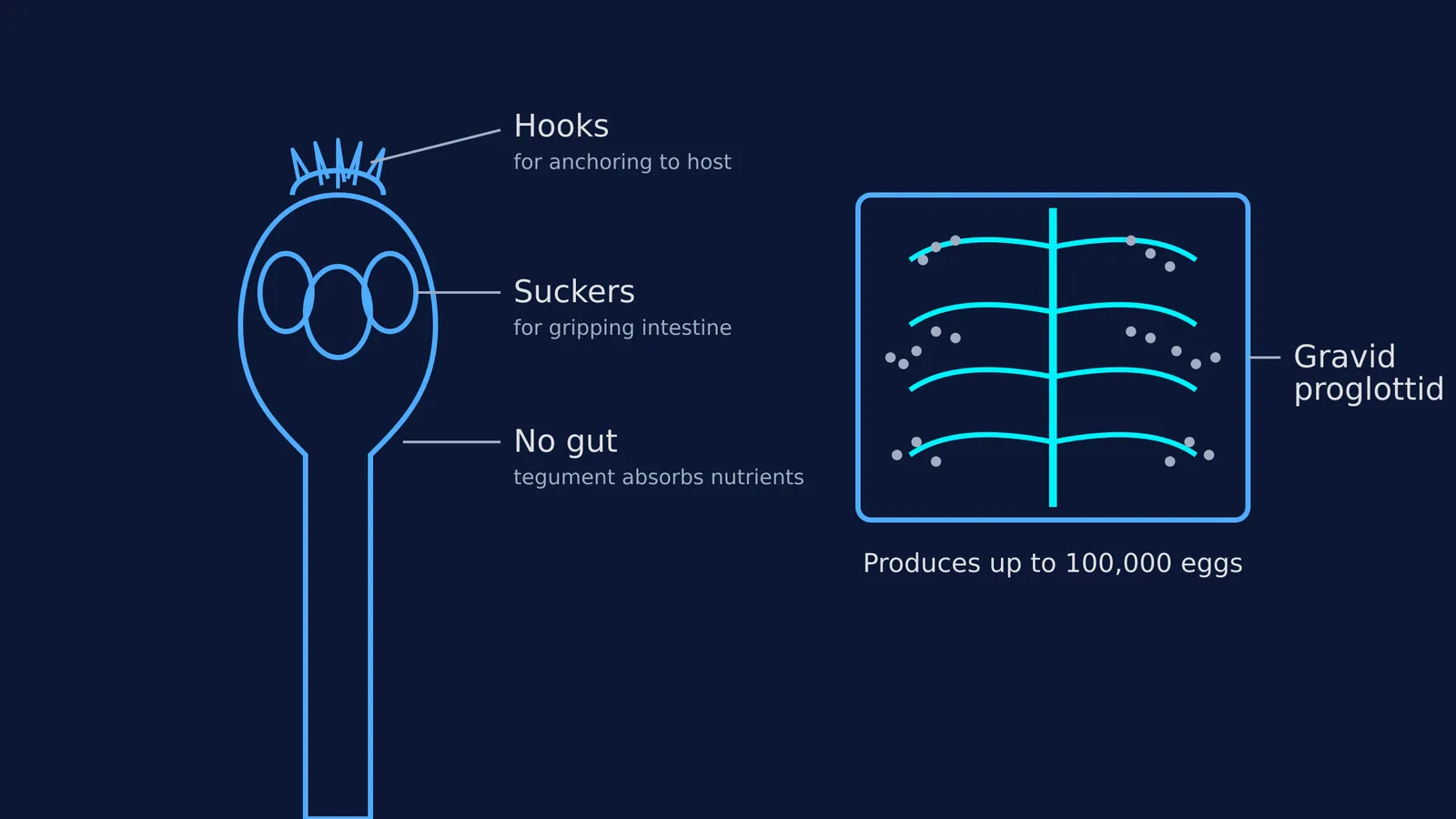
It does this using its anterior head region, called the scolex (NCBI Bookshelf). The exact attachment tools depend on the species:
The beef tapeworm (*Taenia saginata*) relies on four strong, muscular suckers to grip the tissue.
The pork tapeworm (*Taenia solium*) has four suckers plus an extra weapon: a ring of sharply spined hooks arranged in a double row, which dig into the host's tissue for a more secure hold.
According to the CDC, an adult tapeworm can live for years once anchored, growing to lengths of 2 to 7 metres for *T. solium* and up to 25 metres for *T. saginata*.
Why do tapeworms have no digestive system?
Most animals spend a massive amount of energy processing food, as covered in our guide to digestion and breathing in Class 7. Tapeworms, however, have no mouth, no stomach and no gut at all (NCBI Bookshelf).
They have lost their digestive system because they do not need it. By living in the small intestine, they are completely surrounded by food that the host has already broken down into simple molecules like glucose and amino acids.
Instead of eating, a tapeworm absorbs these dissolved nutrients directly through its outer body covering, known as the tegument. This thick outer layer acts as a highly efficient absorption surface while also protecting the worm from the host's own digestive enzymes and immune system. If you are stuck on how nutrients cross a cell boundary without a mouth, Fermi's AI tutor can draw the figure and check your understanding as it goes.
How many eggs does a tapeworm produce?
By abandoning their digestive tract, tapeworms free up large amounts of space and metabolic energy. They pour this energy into reproduction. A tapeworm's body consists of a long chain of segments called proglottids. As these segments mature and move away from the neck, they become "gravid"—meaning they act as little more than sacs filled with fertilised eggs.
The numbers are massive. According to the CDC, a single gravid proglottid of *T. solium* can contain up to 50,000 eggs, while *T. saginata* can pack in up to 100,000. Because an adult worm sheds roughly six of these segments into the host's stool every day, a single tapeworm can release between 300,000 and 600,000 eggs daily into the environment.
This massive output is a classic parasitic adaptation. The chances of any one egg surviving in the outside world and successfully finding a new host are incredibly slim. Producing millions of eggs is an evolutionary insurance policy. For a look at how other parasites manage complex life cycles, see our post on Carlos Chagas and the insect carrier of Chagas disease.
A framework for studying parasite adaptations
When preparing for exams where biological classification and animal kingdoms are heavily tested, do not just memorise lists of features. Use this three-step framework to understand any parasite:
The Problem: What specific challenge does the host environment pose? (e.g., being washed away by gut movement).
The Addition: What new structure evolved to solve it? (e.g., hooks and suckers on the scolex).
The Subtraction: What structure was lost to save energy? (e.g., the complete loss of the digestive system).
By linking the anatomy to the survival challenge, the facts become a logical story rather than a random list to remember.


