

On this page
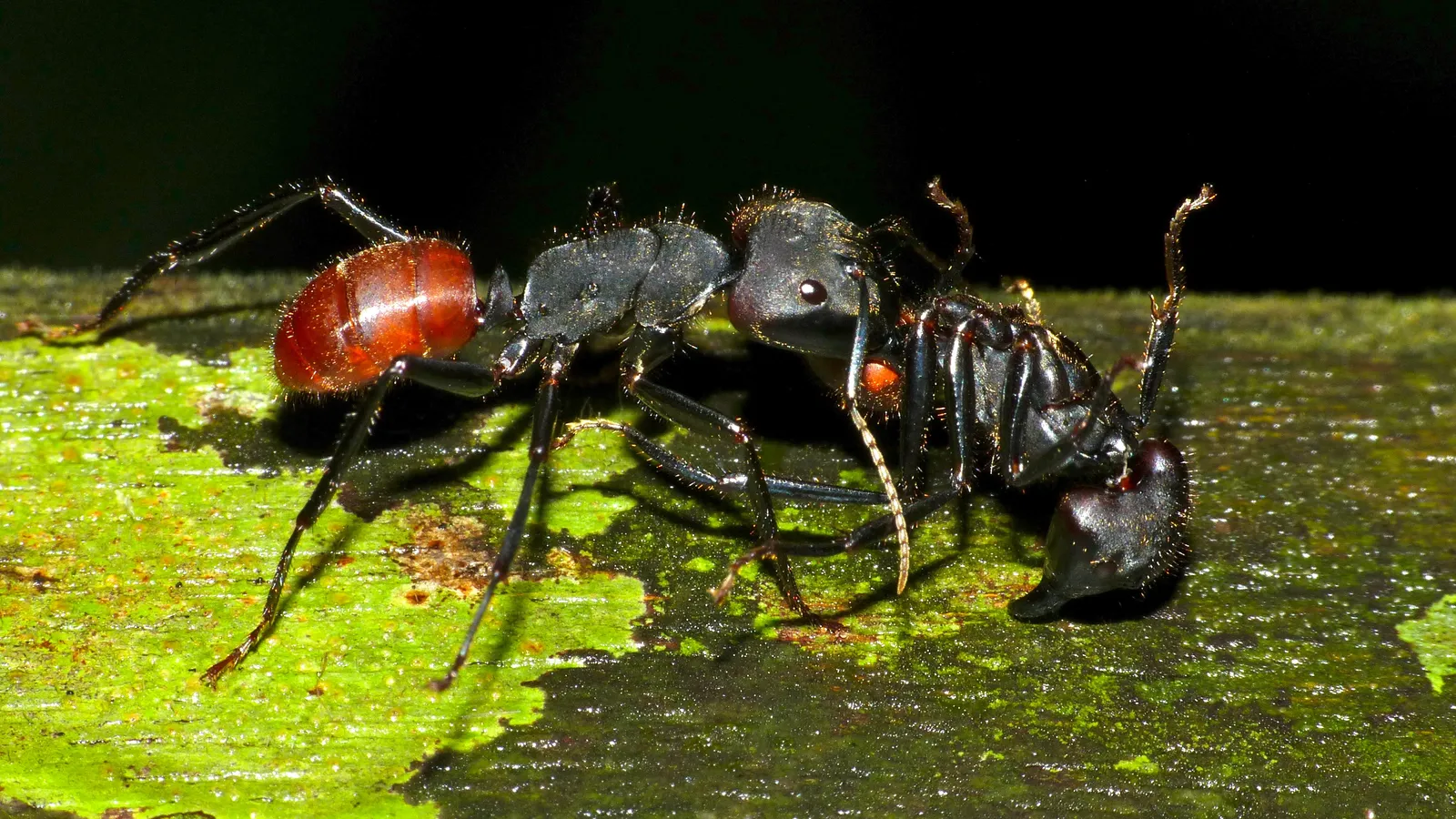
If you have ever watched an ant drag a motionless nestmate away from the nest, you have seen necrophoresis: social insects carrying their dead out of the colony. The behaviour is not grief. It is a fixed response to chemistry, and it helps keep the colony from getting sick.
How do ants know another ant is dead?
Two experiments, about fifty years apart, show what ants detect.
In 1958, E. O. Wilson, N. I. Durlach and L. M. Roth worked with harvester ants (*Pogonomyrmex badius*) and fire ants (Psyche, 1958, full text; DOI record). They daubed small paper squares with an extract of dead workers, and ants carried the squares to the refuse pile just as they carried real corpses. When the team daubed the extract on *living* workers, their sisters carried them out too. The living ants kept walking back home, and the cycle repeated over periods of one to two hours. The team then tested common decay chemicals on paper squares. Of those they tried, oleic acid, a fatty acid, was the only one that triggered corpse-carrying.
The harvester ant corpses in that study had decomposed in the open air for a day or more, but workers often carry out ants that have been dead for less than an hour. In 2009, Dong-Hwan Choe, Jocelyn Millar and Michael Rust studied Argentine ants (*Linepithema humile*) and found a second signal (PNAS, 2009). Living ants carry two compounds on their cuticle, dolichodial and iridomyrmecin. These compounds disappear within about one hour after death, and the authors propose that losing this signal of life is what prompts nestmates to remove the body.
Together, the studies suggest two signals:
A "death" signal that appears: fatty acids such as oleic acid build up as a body breaks down (Wilson's harvester ants).
A "life" signal that fades: compounds that coat a living ant vanish soon after death (Choe's Argentine ants).
This is chemical communication between animals; our explainer on the difference between hormones and pheromones sets out the terms.
Why does removing dead ants keep the colony healthy?
Living crowded together exposes a colony to disease. Biologists call the shared defences against this social immunity, and the health benefit of corpse removal was long assumed rather than measured. Lise Diez, Philippe Lejeune and Claire Detrain tested it with the common red ant, *Myrmica rubra* (Biology Letters, 2014). They set up 30 colonies, put 10 dead nestmates in each, and gave half of them an entrance cube with only tiny holes, so the corpses were hard to get out (full text on PMC). Over 50 days, workers survived significantly better from Day 8 onwards in colonies that could remove corpses normally. When removal was blocked, the ants carried as many corpses out as they could and moved the rest away from the brood, usually into the nest corners.
The researchers added no pathogen; they suggest corpses left in the nest may let naturally occurring microbes build up.
How can you watch ants deal with their dead safely?
You do not need to harm a single ant. Many outdoor colonies keep a refuse pile near the entrance, a small heap of husks, insect parts and dead workers. Here is a simple plan.
Find a colony. Look near a garden bed, a crack in a compound wall or the base of a tree. Watch from a distance and avoid red ants that bite (here is why red ant bites sting).
Look for the refuse pile. Note how far the pile is from the hole.
Watch for 15 minutes a day, same time each day. Count how many ants leave carrying something and how many of those loads are dead ants.
Log it. Use four columns: date and time, weather, loads carried out, dead ants seen at the pile.
Ground rules: never kill or poison ants, pour nothing into the nest, wash your hands afterwards, and supervise younger children. For a family version, see our guide to observing ants with children at home.
What does this teach you beyond ants?
Each study changed one thing: Wilson kept the smell without the body, Choe tracked compounds over time, Diez blocked the exit and measured survival. Change one thing at a time in your own observations too.
If a term like cuticle or fatty acid stops you, the Fermi Concept Library has a lesson for every concept in biology and chemistry, each with its place in the map. And if you want help turning your ant log into a proper investigation, Fermi's AI tutor can work out what you already know and build a plan for the session.
Next time you see an ant hauling a nestmate, check its route. It is probably heading for the refuse pile.


