

On this page
Your body runs on chemical messages. Some never leave you: insulin and adrenaline are made, carried and used inside one body. Others are made to leave: a female silk moth releases a scent that draws a male towards her. The first kind are hormones and the second are pheromones, and the difference comes down to one question: who receives the message?
What is a hormone?
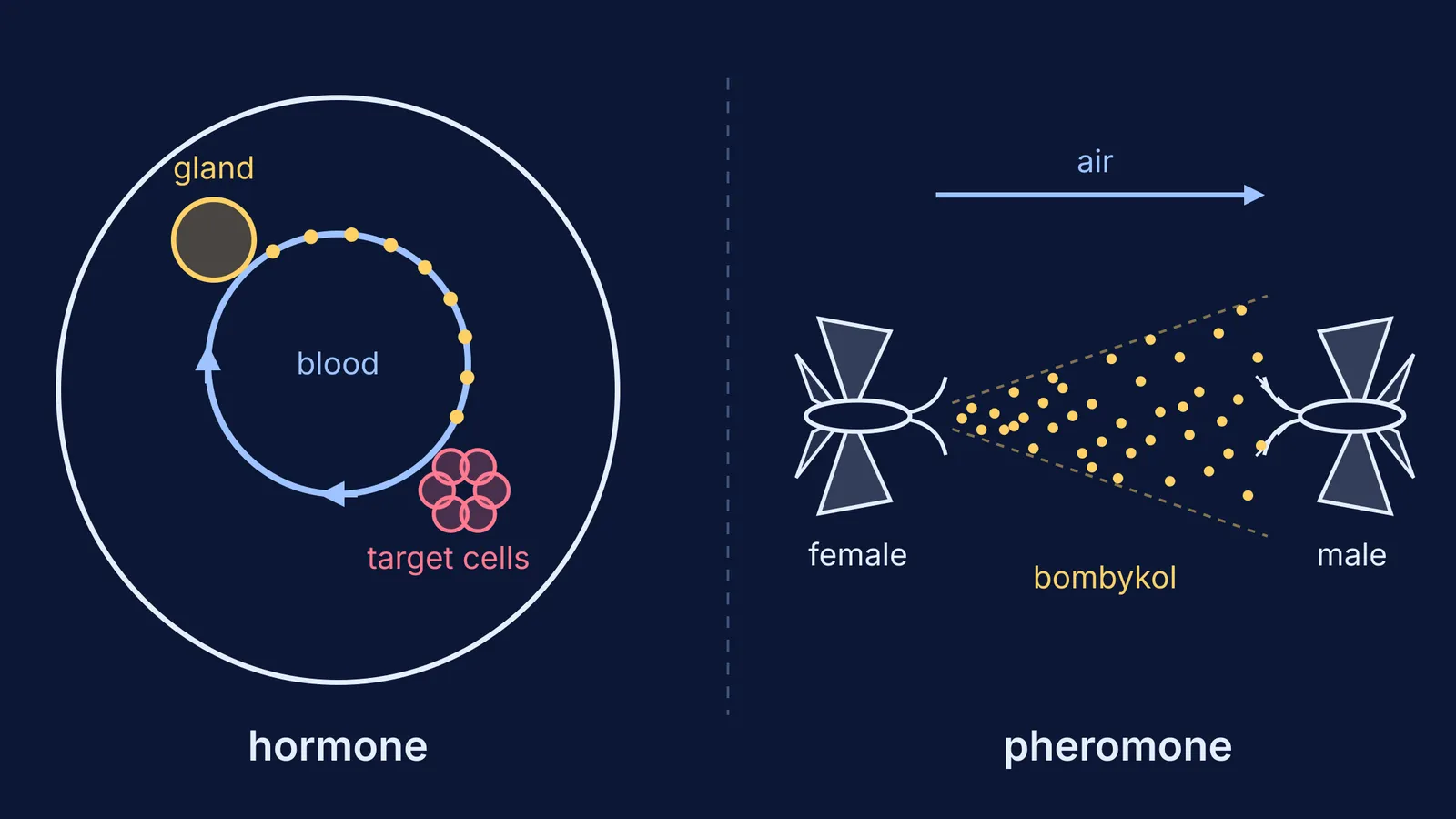
A hormone is a chemical messenger secreted by an endocrine cell into the extracellular fluid; in classic endocrine signalling it enters the blood and travels to target cells away from its source (Human Physiology, LibreTexts). Only cells that carry a matching receptor respond, so the blood takes the signal everywhere but the receptors decide who listens.
The same textbook notes that insulin makes skeletal muscle and fat tissue take up glucose, while in liver cells it changes enzyme activity and gene expression. If you mix up which glands pour into blood and which into ducts, our explainer on endocrine vs exocrine glands and why the pancreas is both sorts that out.
What is a pheromone?
The word was coined in 1959 by Peter Karlson and Martin Lüscher in a short paper in Nature (Karlson and Lüscher, 1959). In their definition, as summarised in a review by Stephen Liberles, a pheromone is a chemical released by one organism that changes the behaviour or physiology of a second organism of the same species (Liberles, Annual Review of Physiology).
The key words are released, second organism and same species. Liberles also separates two kinds: releaser pheromones trigger fast behaviour such as mating, aggression or fear; primer pheromones cause slower, longer-lasting changes in the receiver's hormones and body.
How does silk moth bombykol work?
Bombykol is the sex pheromone of the female silk moth, Bombyx mori, and in 1959 Adolf Butenandt's team made it the first insect pheromone to be identified (University of Bristol, Molecule of the Month). The effort was huge: the team extracted about half a million female moths to obtain 6.4 mg of pure bombykol, a compound with the formula C16H30O (Royal Society of Chemistry, Education in Chemistry).
The female releases bombykol into the air. In the male, the molecules diffuse through pores in the hairs on his antennae to a receptor protein, which sets off a nerve impulse to the brain, according to the Bristol page. For the insect's life from egg to cocoon, see our silkworm life cycle guide.
What does queen bee pheromone do?
A honeybee queen makes a blend in her mandibular glands called queen mandibular pheromone. In 1988 Keith Slessor and colleagues reported the chemical basis of the retinue response, the way workers gather round to tend the queen (Slessor et al., Nature, 1988). A 2010 study in Frontiers in Zoology describes the blend as five compounds that act together, including 9-ODA; it attracts young workers, stimulates queen tending and inhibits worker ovary activation (Maisonnasse et al., 2010).
That last effect is a primer action: a chemical from one bee changes the physiology of other bees. It is still a pheromone, because it passes between individuals. Our honeybee castes explainer shows where this fits with how queens, workers and drones get their roles.
Hormone vs pheromone: what is the difference at a glance?
Where it acts: a hormone acts inside the body that made it; a pheromone is released outside the body.
Who responds: a hormone acts on target cells of the same individual; a pheromone acts on another individual of the same species.
How it travels: a hormone travels in the blood; bombykol travels through the air.
How it is detected: a hormone binds receptors on target cells; a pheromone is picked up by the receiver's senses, such as the male moth's antennae.
Examples: insulin and adrenaline are hormones; bombykol and queen mandibular pheromone are pheromones.
How do you tell them apart in an exam question?
Run three checks on any chemical in the question:
Does it leave the body that made it? If not, think hormone.
Does it act on another individual of the same species? If so, it is a pheromone; a different species fails the 1959 definition.
Is the response fast behaviour or a slower body change? That tells you releaser or primer, not hormone or pheromone.
Worked example: 'Worker bees in a colony with a healthy queen do not activate their ovaries. Name the chemical signal responsible.' Check 1: the substance is made by the queen and reaches the workers, so it leaves her body. Check 2: workers are the same species. Answer: queen mandibular pheromone, acting as a primer. The trap is writing hormone because the effect is on ovaries.
If the chemical coordination chapter still feels like a list of names, the Fermi Concept Library gives every biology concept its own lesson and its place in the map, so hormones sit beside the glands they come from.
Next time a question names a chemical signal, start with the one-question test: who receives the message?


