

On this page
How does haplodiploidy determine sex in a honeybee colony?
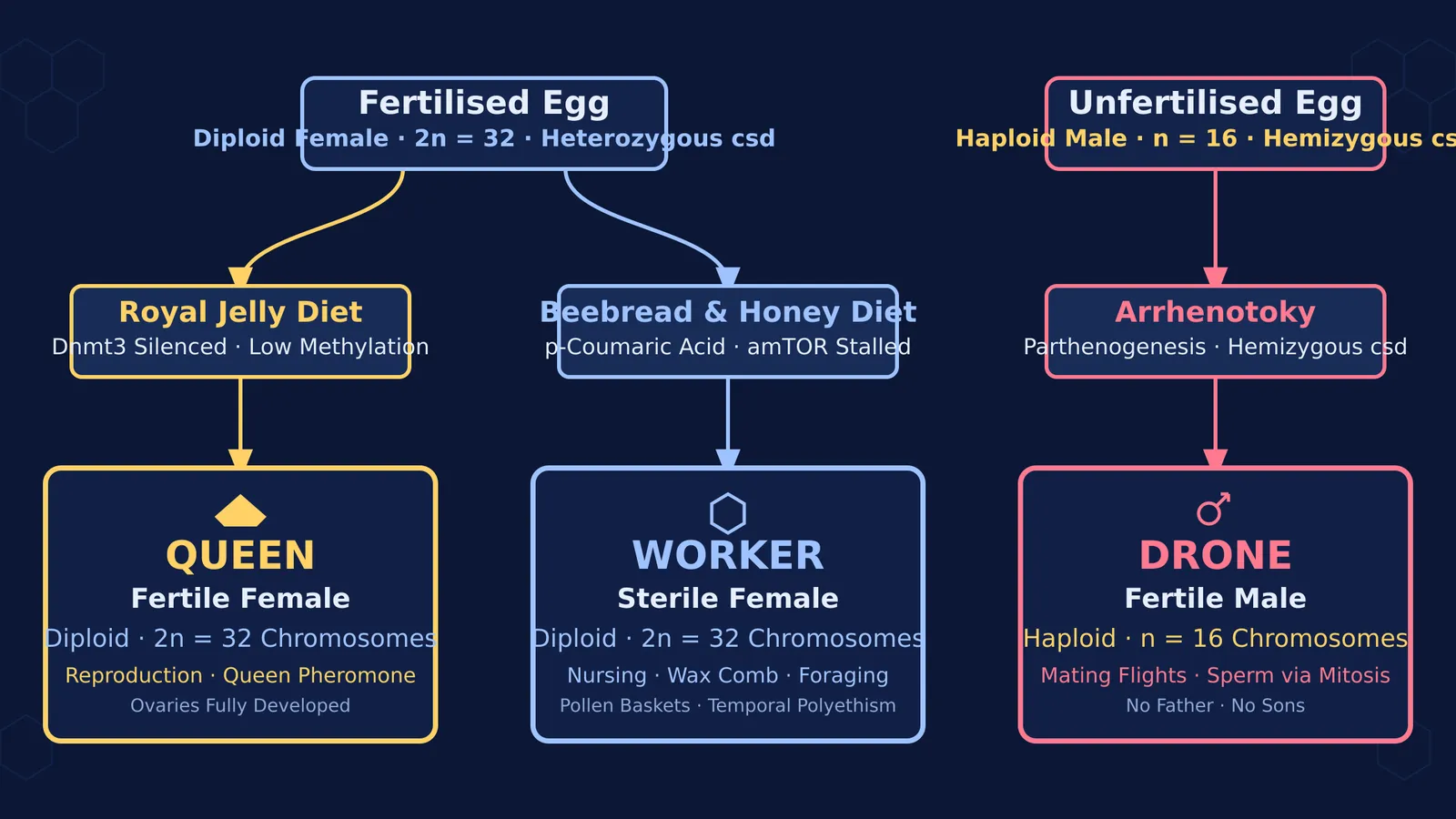
In honeybees (*Apis mellifera*), sex determination is governed by chromosome ploidy rather than sex chromosomes. As outlined in NCERT Class 12 Biology, females are diploid with 32 chromosomes (2n = 32), while male drones are haploid with 16 chromosomes (n = 16). Queens store sperm in a spermatheca and fertilise eggs selectively. Fertilised eggs develop into diploid females, while unfertilised eggs develop into haploid males through arrhenotoky, a form of parthenogenesis.
Because drones are haploid, their genetics follow unusual rules:
Drones produce sperm by mitosis rather than meiosis; each sperm carries identical 16 chromosomes.
A drone has no father and cannot have sons; his sperm produces only female offspring.
A drone has a maternal grandfather and can have grandsons through his queen daughters.
At the molecular level, sex is governed by the complementary sex determiner (*csd*) gene, identified by Martin Beye and colleagues in *Cell*00606-8). Heterozygous individuals at *csd* develop into females, whereas hemizygous haploid eggs become males. Rare homozygous diploid eggs develop into sterile diploid males that nurse workers cannibalise shortly after hatching. For students mapping inheritance lineages, our guide to sex determination and pedigree analysis provides parallel frameworks.
What decides whether a female larva becomes a queen or a worker?
Every female egg shares an identical diploid genome. As documented by Ryszard Kucharski and colleagues in *Science*, female larvae retain developmental plasticity for their first 3 days after hatching. The split into adult forms—a fertile queen with developed ovaries or a sterile worker with wax glands and pollen baskets—is driven by nutrition and epigenetics.
Queen larvae grow in large vertical queen cells, fed continuous royal jelly from the hypopharyngeal glands of nurse bees. Worker larvae receive royal jelly for only 3 days before nurses transition them to worker food containing honey, water, and beebread (stored pollen).
In that *Science* study, Kucharski and co-workers showed that silencing the DNA methyltransferase gene *Dnmt3* in young larvae caused 72% of treated individuals to emerge as queens with developed ovaries. This demonstrated that DNA methylation acts as an epigenetic brake that represses queen development in workers. An exclusive diet of royal jelly prevents this methylation, allowing queen developmental programmes to activate.
Worker differentiation also involves active dietary suppression. Wenfu Mao and colleagues reported in *Science Advances* that beebread contains p-coumaric acid, a phytochemical that represses larval ovary development and alters expression across one-third of the honeybee genome. In *PLOS Genetics*, Ke Zhu and co-workers showed that plant microRNAs like miR162a in pollen suppress the larval *amTOR* pathway. While early hypotheses proposed that a single protein named royalactin initiated queen fate, Anja Buttstedt and colleagues demonstrated in *Nature* that larvae still develop into queens when royalactin is absent, showing that queen differentiation relies on overall nutrition, high sugar levels, and freedom from plant inhibitors.
How is the division of labour organised among worker bees?
As documented in behavioural maturation research by Gene Robinson and colleagues in *PNAS*, worker bees exhibit temporal polyethism, an age-dependent division of labour:
Days 1 to 3: Workers clean brood cells and warm developing pupae.
Days 4 to 12: Hypopharyngeal glands mature; workers nurse the brood and queen.
Days 12 to 20: Wax glands activate, allowing comb building, honey ripening, and food storage.
Days 20 onwards: Workers guard the hive entrance and forage for nectar, pollen, and water, communicating locations through the dance deciphered by Karl von Frisch and the bee waggle dance.
This developmental sequence is dynamic rather than fixed. In that *PNAS* study, Isabelle Leoncini, Robinson, and co-workers identified ethyl oleate as a primer pheromone produced by older foragers and transferred to nurses during trophallaxis. Ethyl oleate suppresses juvenile hormone in young bees, keeping them in nursing roles. If field foragers die, ethyl oleate circulation falls, causing juvenile hormone to surge and accelerating nurse transition into foragers.
Understanding multi-tiered regulation in biology requires connecting individual mechanisms to the whole organism. The Fermi Concept Library maps every concept in physics, chemistry, biology, mathematics and computing, each with its own lesson and its place in the map.
How do you solve honeybee genetics and pedigree problems?
When solving honeybee haplodiploidy questions in competitive examinations like NEET-UG, apply the principles established in NCERT Class 12 Biology through this four-step diagnostic procedure:
Confirm ploidy before setting up crosses: Assign 2n = 32 to queens and workers, and n = 16 to drones. Drones produce gametes solely by mitosis.
Apply the single-parent lineage rule: Drones inherit 100% of their genes from the queen and 0% from a father. A drone has no father and no sons, but has a maternal grandfather.
Calculate worker relatedness: As formulated by W. D. Hamilton in the *Journal of Theoretical Biology*90039-6), full worker sisters share an average of 75% of their genes (r = 0.75). They receive all 16 chromosomes from their haploid father (0.50 of their genome) and half their mother's genes (0.25). Because workers are more closely related to sisters (0.75) than to potential daughters (0.50), natural selection favours cooperative colony defence over solitary reproduction, as explored in Mendelian genetics problem-solving.
Distinguish sex from caste: Sex is decided at fertilisation by ploidy and heterozygosity at the *csd* locus. Caste within females is determined after hatching by larval diet and epigenetic regulation.
For students testing their grasp of inheritance mechanisms, the Fermi Problem Library provides worked problems with a step-by-step solver that explains the reasoning rather than printing an answer.


